
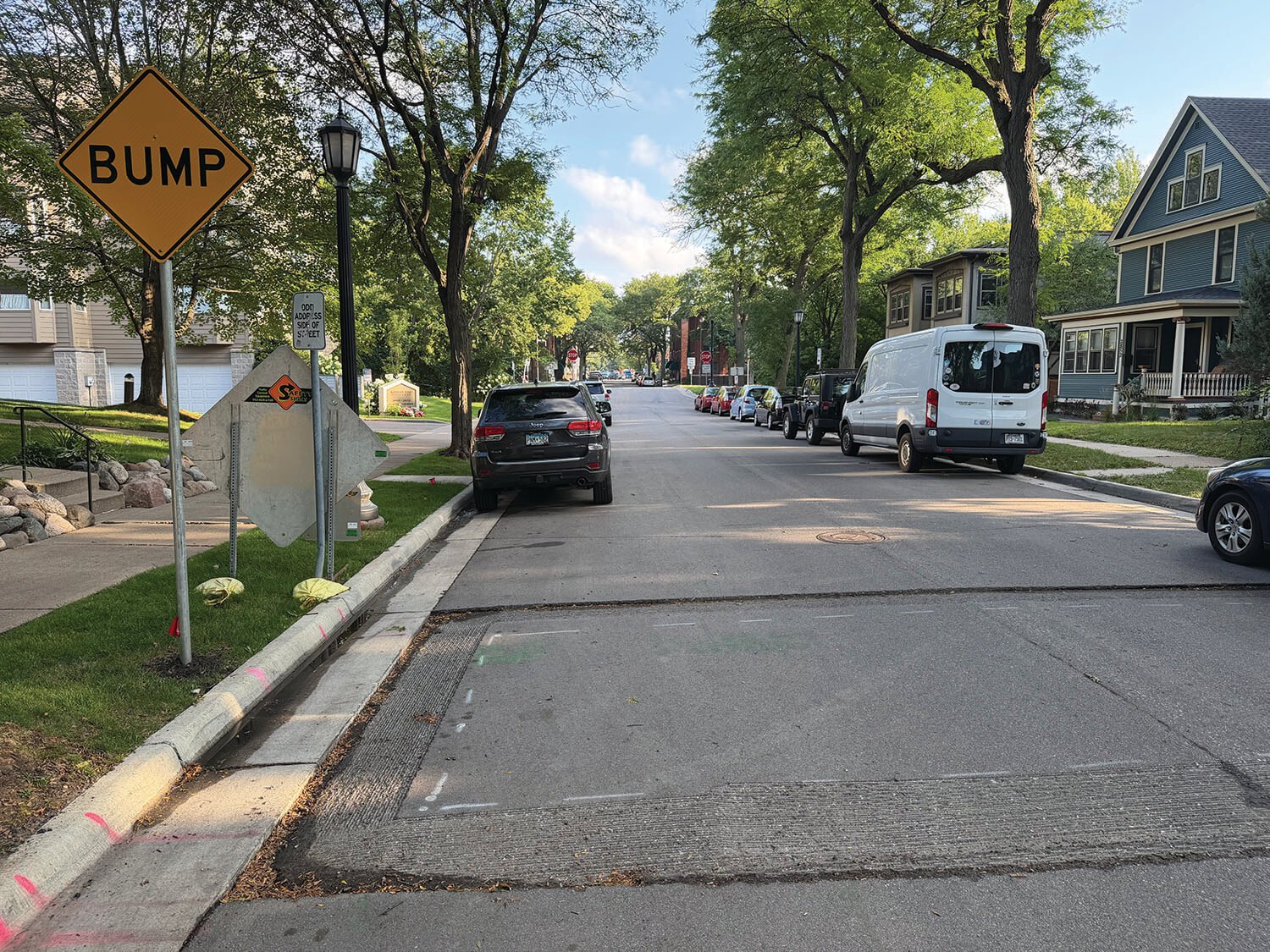
Top: New speed humps on Girard Ave S; Middle: Map of current calming projects and Bottom: Scoring criteria for traffic calming applications (Images: Quinton Courts)
Neighbors have recently been abuzz about mysterious road cutouts on some streets in Hill & Lake Press land.
We have seen quite a bit of construction in the past few years: Hennepin Avenue, road resurfacing in Lowry Hill, and work on natural gas mains and service lines by CenterPoint Energy.
“The first step of the eight-step traffic calming process is the submission of an application by a community member or a neighborhood organization.”
These new cutouts, however, were oddly shaped, and new signs were erected alongside them displaying the word “BUMP.” One neighbor was adamant in his theory. “I think these are speed bumps!” he said.
Naturally, the folks at the Hill & Lake Press looked into it. Indeed, a few streets in East Isles, East Bde Maka Ska and Lowry Hill East were awarded new additions to their roads as part of the city’s Neighborhood Traffic Calming Program.
As recently as March of this year, blocks whose applications were approved and selected are seeing either a speed hump at specific points on the street, a traffic circle in intersections, or both.
Eight Steps to a Speed Hump
The first step of the eight-step traffic calming process is the submission of an application by a community member or a neighborhood organization.
Seven more steps follow, including screening and scoring using a rubric, community meetings, and on-street data collection and technical evaluations by the Public Works department, before the recommended solution is installed.
One Block’s Long Road
Jonathan Beck of East Isles submitted an application on behalf of his block just off the Midtown Greenway.
After moving into the neighborhood in 2013, he became frustrated with cars driving the wrong direction on his one-way street, a problem he attributed to poor signage at the entrance of his block, beginning at the Midtown Greenway.
Beck half-jokingly suggested the use of one-way road spikes like those at rental car facilities. Instead, in 2017, the city installed plastic bollards, which did help to mitigate the problem but did not hold up against the strength of snowplows in the winter.
In 2024, he formally submitted an application for traffic calming but did not meet the scoring criteria needed to be selected.
The city automatically resubmits an application that was not selected for one additional year, and in March of this year he was notified that his block would be awarded a traffic calming treatment.
“Applications for the next round are reviewed on the city’s annual cycle, so a block that misses the cut one year is automatically considered the next.”
As of this writing, his block has cutouts ready and signs posted, awaiting installation of the new speed humps. Beck is pleased at the prospect that the humps, and possibly better signage further south at The Mall, will alleviate future traffic concerns for his block.
How to Apply
Residents and neighborhoods interested in applying for future traffic calming treatments should pay special attention to the scoring criteria, which are weighted and divided into two categories: transportation and community.
The city’s website includes a page on traffic calming, where residents can submit an application or request a temporary solution such as a speed display trailer for their block.
Applications for the next round are reviewed on the city’s annual cycle, so a block that misses the cut one year is automatically considered the next.
For now, the signs are up and the message is plain enough. Slow down.
Quinton Courts writes for the Hill & Lake Press. He lives in East Isles.