
My dogs don’t like walking through Uptown — and honestly, neither do I.
Within the past year, my partner and I foster-failed two rambunctious, 1-year-old litter mates through a Minnesota dog rescue.
Like many dog-owning neighbors, we take advantage of Minneapolis’ walkable neighborhoods with beautiful turn-of-thecentury architecture. Most days we head out for a 3-mile loop, choosing a different route to sniff out and explore.
From our home in East Isles, we can walk to the Minneapolis Institute of Art, Lakewood Cemetery, Loring Park or the entire path around Lake of the Isles.
I’m sure we look like a traveling circus when the four of us move through the neighborhood together, but I’m proud to say the dogs’ reactivity and lack of confidence has improved greatly since we adopted them, created routines and showered them with love.
I can’t say for certain which route is their favorite, but I know their least favorite: Uptown.
And I have to agree.
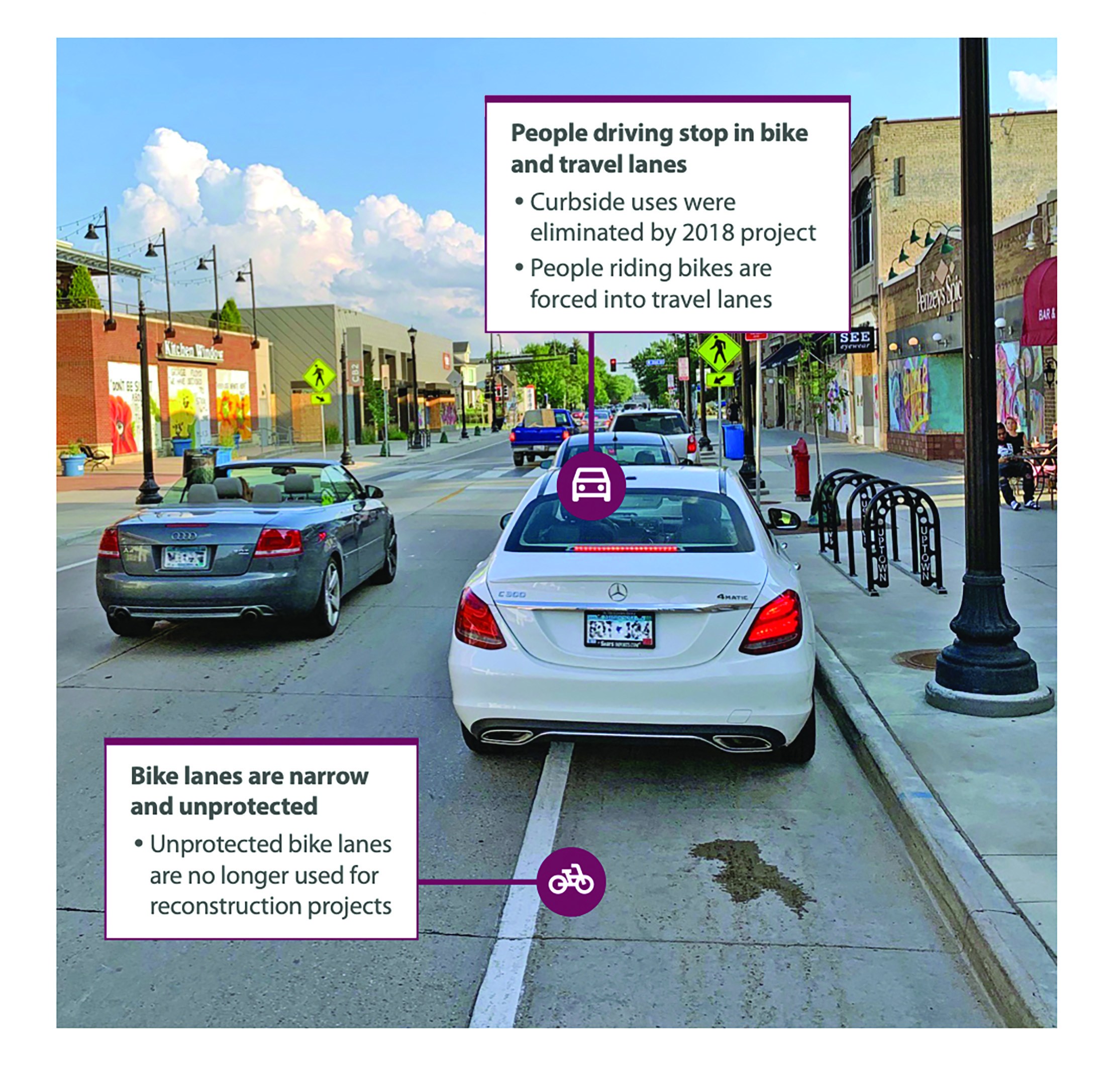
(Image: Paula Chesley)
There’s a lot going on — and not going on — in Uptown right now.
My partner and I moved to Minneapolis in 2021, and I never experienced Uptown in its heyday.
My partner, who grew up here, along with neighbors, often tell me about how lively it once was: safe, walkable and the place to be. I only caught the tail end of that era, visiting the small-format Target, Stella’s and joining the YWCA just before they closed.
Since then, I have repeatedly heard local elected officials describe Uptown as “vibrant.” I beg to differ.
With so many vacant storefronts, our “urban puppy walks,” as we call them, often feel like a trip into the Upside Down from “Stranger Things,” passing eerie shells of businesses that once thrived.
During winter walks, we frequently passed people using or selling drugs in alleyways, covered entryways of closed businesses and even at the Uptown Transit Center, in full view of the cameras.
I’ve watched my dogs’ demeanor change as we walked east along The Mall, hesitantly passing someone clearly under the influence of drugs but somehow still balancing on two feet and swaying in place.
More than once, I have called 911 to request a welfare check because I feared for someone’s safety.
Now that the snow has melted, Uptown walks still aren’t a favorite — sometimes for ordinary dog reasons.
The loud bursts of compressed air from city buses startle them. The automated crossing signals meant to help visually impaired pedestrians make them jump. I reassure them that it’s OK, while appreciating the infrastructure for humans.
Cities across the country spend millions trying to create exactly the kind of compact mixed-use residential-commercial district Uptown already has. Yet much of it now feels neglected, if not abandoned.
On many walks, we dodge broken glass from smashed car windows and piles of salt left carelessly in the middle of sidewalks. I pass doors with printed signs announcing a business’s final day years ago, some still with tables and chairs inside as if everyone suddenly disappeared. Some doors are now chained shut.
“When someone’s car window is smashed, their bicycle stolen, their storefront tagged with graffiti or their business entryway littered with drug paraphernalia and human waste, the burden falls on the same working people who keep these businesses alive.”
We also navigate human waste, vomit, used needles and food trash. Graffiti covers windows and brick facades. From Hennepin Avenue, it’s clear that Walker Library has effectively become a daytime warming center for people without stable housing.
I am hopeful about our newly elected Ward 7 Council Member Elizabeth Shaffer, who has shown a clear concern for Uptown’s future. That kind of attention and willingness to engage is a positive step and something our community needs.
At the same time, it is hard to ignore the broader failure of leadership. Uptown did not arrive at this moment overnight, and it will not recover without honesty about the depth of the challenges we face. Too often, elected officials have been slow to acknowledge the seriousness of the decline or to advance solu- tions that match the urgency on the ground.
Council Member Aisha Chughtai, in particular, has been largely absent from the day-to-day concerns of constituents in Uptown. Residents and business owners deserve consistent engagement and responsiveness, especially at a time when the neighborhood is struggling.
Chughtai appears more focused on ideological and international causes than on local concerns. She recently traveled to Cuba with a delegation aligned with socialist interests, missing a local Uptown United meeting. As a Cuban American, I find that deeply troubling, particularly given the history and realities of Cuba’s communist government.
“Many elected officials talk about representing working people. Yet ignoring the daily impacts of disorder and petty crime does not help the working class.”
Responsibility also extends to the mayor. These conditions have developed on his watch, and stronger, more visible leadership is needed. Where is the coordinated effort to stabilize and restore one of Minneapolis’ most important commercial and cultural districts?
In the absence of that leadership, residents, business owners and community organizations are stepping forward.
I appreciate the efforts of Uptown United and others who are refusing to accept a di- minished quality of life. If meaningful change is going to happen, it will require both accountability and a renewed partnership between the city and the people who care deeply about Uptown’s future.
Many elected officials talk about repre- senting working people. Yet ignoring the daily impacts of disorder and petty crime does not help the working class.
When someone’s car window is smashed, their bicycle stolen, their storefront tagged with graffiti or their business entryway littered with drug paraphernalia and human waste, the burden falls on the same working people who keep these businesses alive.
Spring and summer are coming, and at least the weather will make our walks through Uptown more pleasant.
It is my hope that our government and public agencies will step up in a way that matches the resilience of the businesses fighting to remain here and the grassroots efforts of everyday Uptown residents who continue to call this neighborhood home.
Quinton Courts is a community volunteer and lives in East Isles with his partner and two dogs.