
How a standard planning process may be failing a uniquely complicated place.
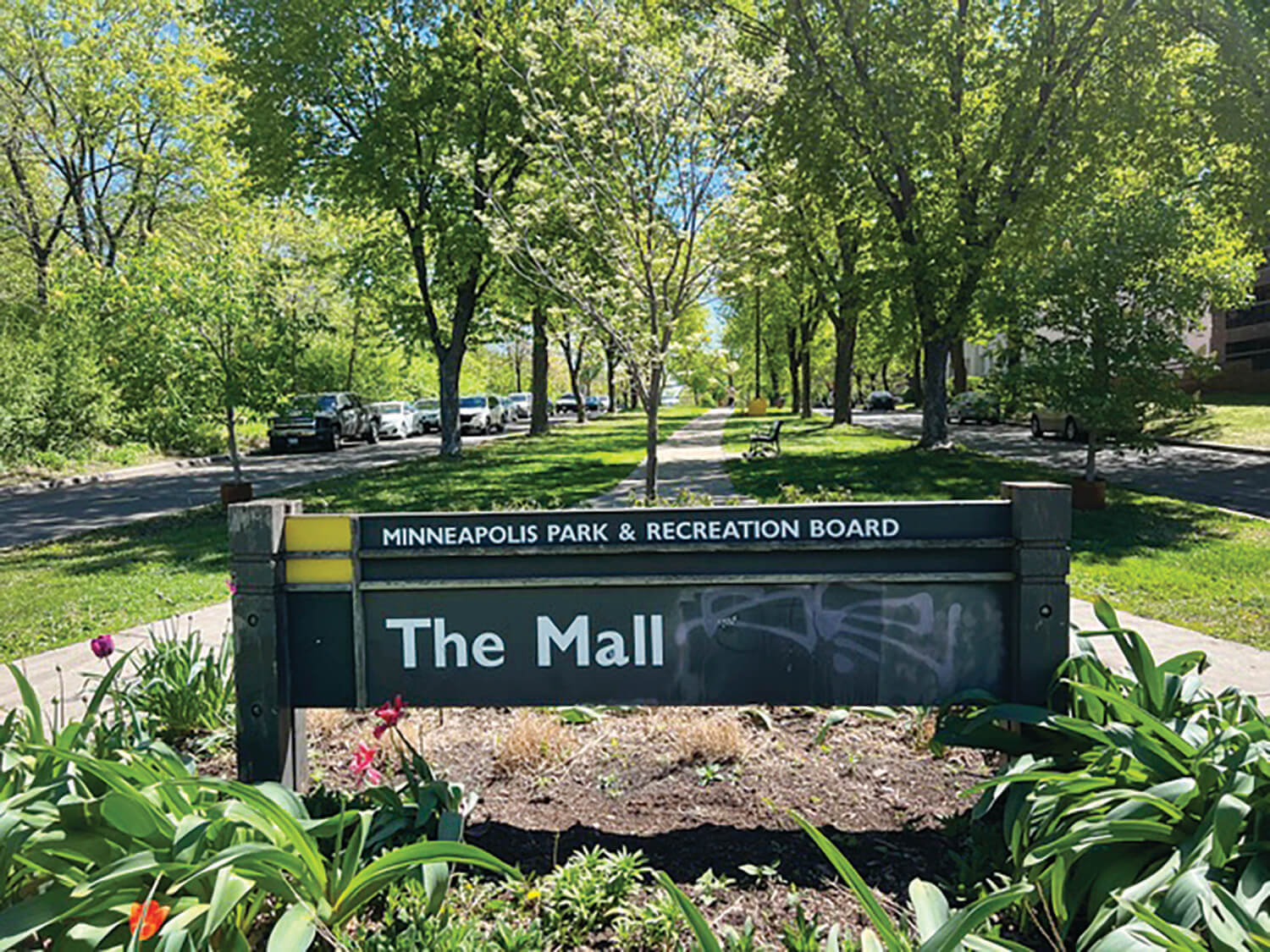
What began in 2018 as a conceptual planning discussion, part of the Minneapolis Park and Recreation Board’s 2020 Southwest Service Area Plan, has evolved into something much larger: a debate over public process, implementation and trust. The Southwest Service Area Plan was the end result of a long-range conceptual planning process covering 42 parks across Southwest Minneapolis. Ideas for The Mall Park from the Citizens Advisory Committee, comprising residents from all over Southwest Minneapolis, included roadway reductions, expanded green space, potential coordination with nearby Hennepin County property and a “woonerf-style pedestrian treatment at the eastern end of The Mall. (Some of these ideas were intended to complement the weekly Farmers Market that has since relocated away from The Mall Park.)
“When conceptual planning begins functioning as implied approval for implementation, do residents really have input?”
A relatively small number of people, about 60, gave feedback specifically about The Mall proposal during the Southwest Area plan development (partly because it occurred during the Covid pandemic when public meetings were limited). About 10 comments were categorized by the Park Board as opposing the proposal, while 12 supported it. The much larger share of responses expressed concerns or uncertainty or offered suggestions. And these comments came from participants living throughout the Southwest Service Area, not necessarily from the residents living closest to the project and most directly affected by its operational impacts.
That process served an important purpose. But many nearby residents increasingly believe a conceptual planning process is now being treated as though it already constituted approval for implementation.
Conceptual planning and implementation review serve fundamentally different purposes. One asks: What could this place someday become? The other asks: What exactly are we building, how will it function, what are the operational impacts, and does the public support implementation?
That second stage typically occurs through the Neighborhood Park Plan process tied to NPP20 funding and implementation, where project review becomes more detailed and site-specific.
For The Mall, that level of public review has yet to be completed.
That distinction matters be- cause the concept is no lon- ger theoretical. A Metropolitan Council sewer reconstruction project planned for 2026 or 2027 is viewed by supporters of the redesign as an opportunity to ac- celerate a partially vetted $2 mil- lion park project that includes roadway closures and circulation changes capable of altering how the area functions day to day.
Governments often coordinate infrastructure and redevelopment projects to avoid rebuilding the same space twice. But the resulting broad conceptual vision suddenly began accelerating toward physical implementation without a fuller project-specific review taking into account informed neighborhood concerns about real operational consequences.
Furthermore, unlike most neighborhood park planning, the proposal for The Mall reaches directly into questions of traffic circulation, emergency access, parking, loading and neighborhood connectivity.
The Mall functions simultaneously as public space, roadway, neighborhood connector and access corridor within a constrained lake-area street network shaped by lakes, congestion and limited east-west movement options.
A process designed for typical neighborhood park improvements may be inadequate when applied to a place that functions simultaneously as parkland and transportation corridor.
Even the Park Board itself has acknowledged the distinction be- tween conceptual planning and implementation review. In April 2025, former Commissioner Bil- ly Menz introduced a resolution calling for roadways disturbed during the sewer project to be restored to existing conditions while directing the Park Board to “re-engage the neighborhood” be- fore future redevelopment under the 20-Year Neighborhood Parks Program. That language implicitly recognized that the earlier Southwest Service Area planning process is not the same as implementation review.
Yet many residents no longer believe that distinction is recognized. Increasingly, project supporters speak as though the core question has already been settled because years of conceptual planning discussions previously occurred.
Once the proposed redesign began taking clearer shape, the neighborhood response became far more concentrated and organized. Following presentations of the proposal by Park Board planners, the East Isles Neighborhood Association circulated a petition opposing the project design and asking that neighborhood input be meaningfully incorporated into the implementation-level review process. The petition gathered nearly 900 signatures.
Supporters of the design that would add roughly 0.2 acres of parkland by closing sections of The Mall roadway justify the redesign as a forward-looking project that would expand parkland and create a more pedestrian-oriented public space. At-large Park Board Commissioners Tom Olsen, Meg Forney, Amber Frederick and District 4 Commissioner Jason Garcia support this redesign.
Many residents also ask: At what operational cost? Not simply the roughly $2 million associated with the redesign itself, but the broader day-to-day impacts imposed on how the neighborhood functions for the people who actually live around it and move through it.
A traffic and parking study has been conducted, and a fire department access review is reportedly underway. But a review of the traffic analysis suggests it remains limited in scope, focusing primarily on whether nearby street infrastructure can absorb redirected traffic volumes. The study area did not extend north beyond 28th Street or south toward Lagoon Avenue, leaving broader neighborhood circulation impacts largely unexamined.
While Park Board planners report that neighborhood review is still to come, residents also understand they will likely be presented with a design framework that already includes roadway closures. If future public feedback is limited primarily to benches, plantings, lighting or other design refinements, residents may reasonably ask whether they are being invited to shape the project or merely rearrange details within an outcome already decided.
Public trust depends on communities believing that implementation decisions receive meaningful project-level scrutiny before major changes move forward. When conceptual planning begins functioning as implied approval for implementation, do residents really have input?
Cities evolve. Infrastructure must be repaired. Parks should improve over time.
Steve Kotvis writes for the Hill & Lake Press. He lives in Bryn Mawr.