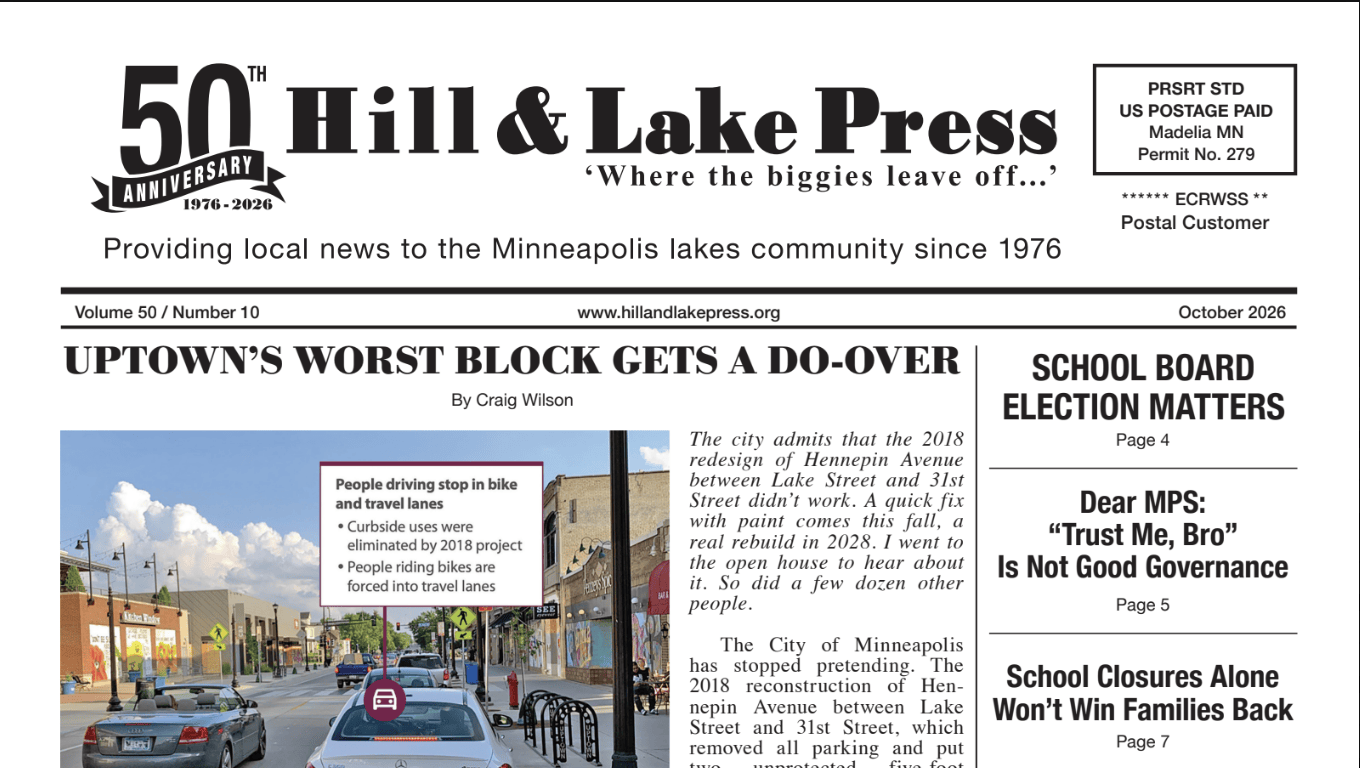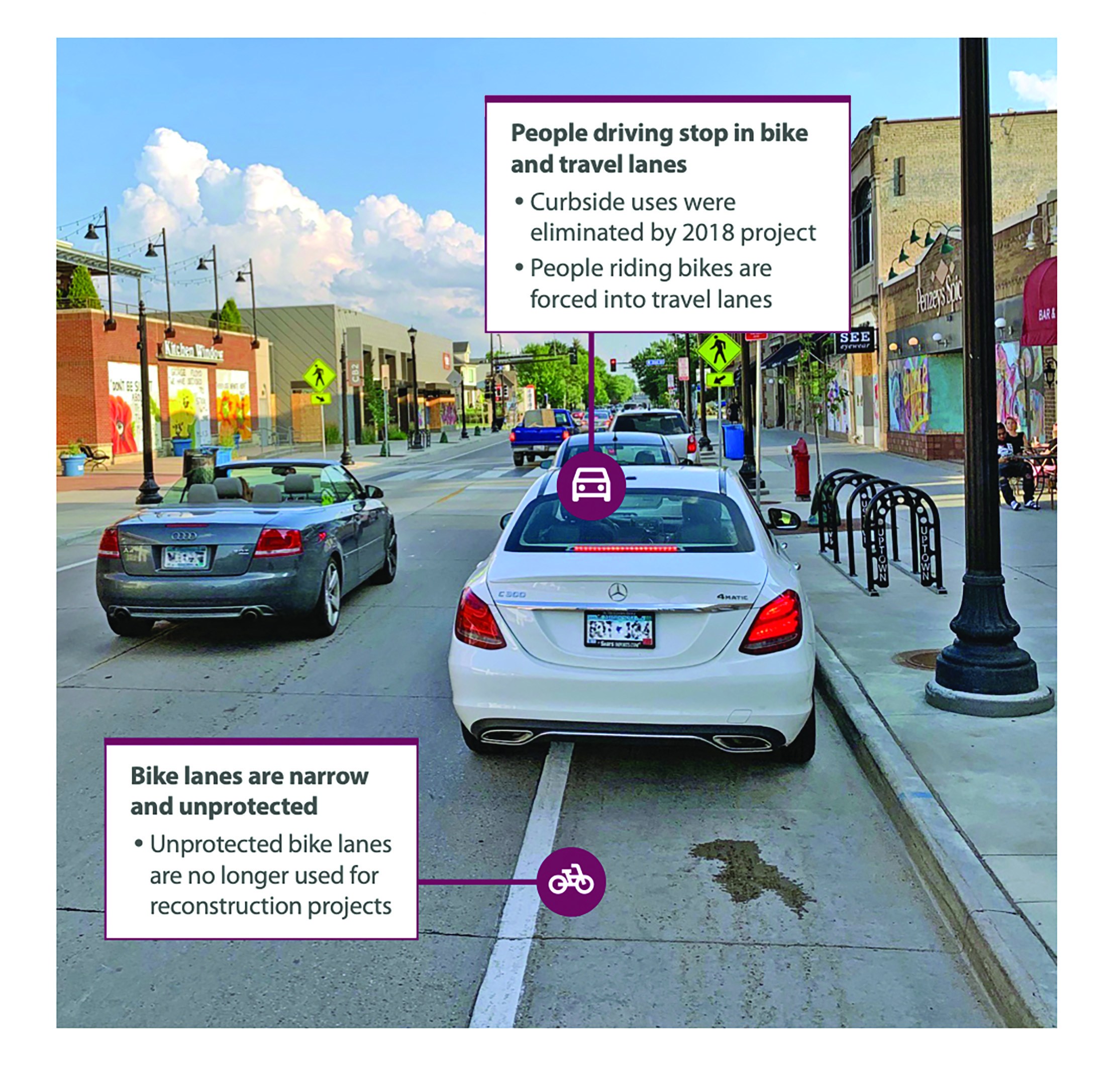

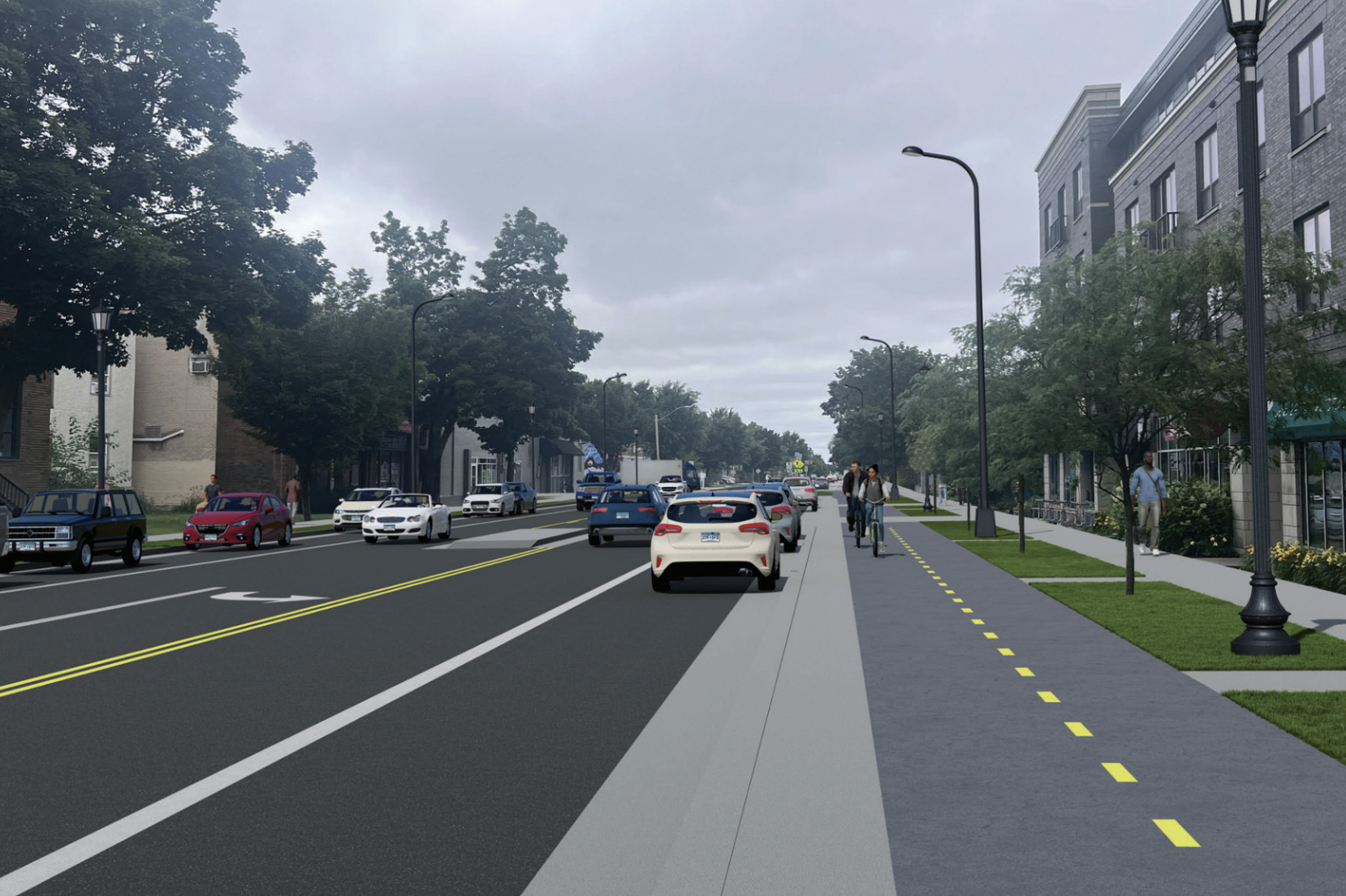
Proposed changes to 2400 block of Lyndale Avenue South, at left, and 2700 block of Lyndale Avenue South, at right. (Images: City of Minneapolis).
This year marks Knox Jewelers’ 42nd year in LynLake. The future of Lyndale Avenue is of the utmost importance to my family’s business, our employees and our clients.
Almost 2 1/2 years ago, dozens of concerned business owners and citizens met to talk with Hennepin County Commissioner Marion Greene about the future of Lyndale. And here we are again.
According to Hennepin County’s pre-project usage data, every day on Lyndale there are roughly 30,000 people traveling by car, 2,000 traveling by bus and between 500 and 2,000 people walking. At peak, the data show about 200 bicyclists use the corridor — but on most days that number is in the dozens, and in winter, fewer than 10.
That’s fewer than 10 bicycle users a day.
So after 2 1/2 years of public input, we are looking at a road design with dedicated bike lanes for a handful of cyclists on a road that serves 30,000 drivers a day. Does that make sense?
“We find this backdoor redesign to be poor governance.”
Of course not. But here we are.
For this entire project, a small but very loud voice has pushed for dedicated bike lanes on Lyndale. Given that the roadway has a finite amount of space, adding those lanes requires giving something up — narrower travel lanes, the removal of parking, or both.
Those are not painless tradeoffs. Our businesses depend on clients who travel from across the metro area, almost always by car. Customers are happier — and have better experiences — when they don’t have to deal with traffic, congestion and limited parking.
How did we get to dedicated bike lanes in the first place? A bit of history.
Late last year, a shared use path version of the Lyndale plan was handed to a handful of people at the city. That design was the culmination of years of public feedback, including tens of thousands of comments. Instead of a dedicated bike lane, it would have mixed pedestrians and cyclists on a single path. Was it perfect? No. But many of us considered it a reasonable compromise.
The shared use path design, however, never went to the Climate and Infrastructure Committee for review. A select few decision-makers shot it down and told county staff to put a dedicated bike lane into a new plan.
In a democratically governed city, decisions required to be made by the “council” should be made by a Council — not by a select few. The shared use path design should have gone to committee, as is proper protocol. It shouldn’t have been kicked back behind closed doors. We find this backdoor redesign to be poor governance.
“In a democratically governed city, decisions required to be made by the ‘council’ should be made by a council — not by a select few.”
And it may get worse. Supporters of what they call “Livable Lyndale” — which in practice means no parking and far fewer cars — are now pushing the county and the City Council to install a corridor-long dedicated bus lane in place of all the parking on northbound Lyndale.
A dedicated bus lane does not make sense, either.
Total Metro Transit ridership dropped 3% in 2025 from 2024, the Star Tribune reported, and the system has never come close to recovering from the pandemic — despite millions of dollars in upgrades to bus rapid transit lines and minimal route reductions. Route 4, the bus that serves Lyndale, is worse: according to Metropolitan Council data, Route 4 annual passenger trips remain about 40% below pre-pandemic levels.
Ridership is down 40% — and supporters are actively asking to remove small-business parking for a dedicated bus lane. Yet again, this is absurd.
Dedicated bus lanes haven’t resulted in better ridership numbers. They are merely making the bus trip faster and more convenient while shifting additional hours of congestion onto vehicle traffic — the same vehicle traffic Lyndale businesses depend on.
Lyndale doesn’t need dedicated bike lanes or dedicated bus lanes. It needs to function as a thoroughfare for all users. Catering to a small subset of the population at the expense of everyone else will push drivers away. They will decide the hassle of coming here isn’t worth it.
Once they stop coming, business will start to dry up. Owners will struggle to pay their bills. Storefronts will go vacant. And when storefronts go vacant, you get graffiti, drug use and crime.
Lyndale also doesn’t need any more shady backdoor dealings on this project. The county has gathered stakeholder input for more than 2½ years. It has a shared use path design that was a compromise for all — and it needs to stick to that design when it meets with the City Council.
If and when the council votes on a plan that wasn’t considerate of all public input, we will ask the mayor to veto it until we have one that is.
We hope you will stand with us when the time comes.
Ryan Knox is co-owner of Knox Jewelers at 2921 Lyndale Ave. S., where his family has done business in LynLake for 42 years. Figures cited above are drawn from Hennepin County’s pre-project usage analysis, Metropolitan Council ridership data and Minnesota Star Tribune reporting.