
When something goes wrong in Minneapolis — a stalled road project, an encampment that won’t go away, a program that falls short — residents tend to aim their frustration at the City Council. Often, though, the responsible party sits a level up and largely out of view, at Hennepin County. This November, much of the action many residents care about runs through an institution most of them would struggle to describe.
With county commissioner seats on the ballot this fall, readers have told the Hill & Lake Press they find the county baffling. What does a commissioner do all day? What is the county actually responsible for? Where does its money come from?
To make sense of it, the paper spoke at length with Hennepin County staff who agreed to talk on background and asked not to be named, citing the sensitivity of speaking during an election year.
What follows is their picture of a government that touches nearly every resident’s life while remaining, as one put it, shrouded in mystery.
A Creature of the State
Start with what the county is not. Unlike the city of Minneapolis or the state of Minnesota, Hennepin County has no constitution and no charter to define the scope of its powers.
It is a political subdivision of the state, essentially an arm of state government, and 86 of Minnesota’s 87 counties are organized the same way. (Ramsey County, which adopted a charter in the 1980s, is the lone exception.) For its authority Hennepin looks to state statute, and in particular to Chapter 383B, the chapter written specifically for Hennepin County’s powers and functions.
That distinction matters, county staff said, because it explains why commissioners so often cannot simply do what constituents ask. Much of what the county does is dictated, and constrained, by the state and federal governments above it.
Bigger Districts Than You Might Think
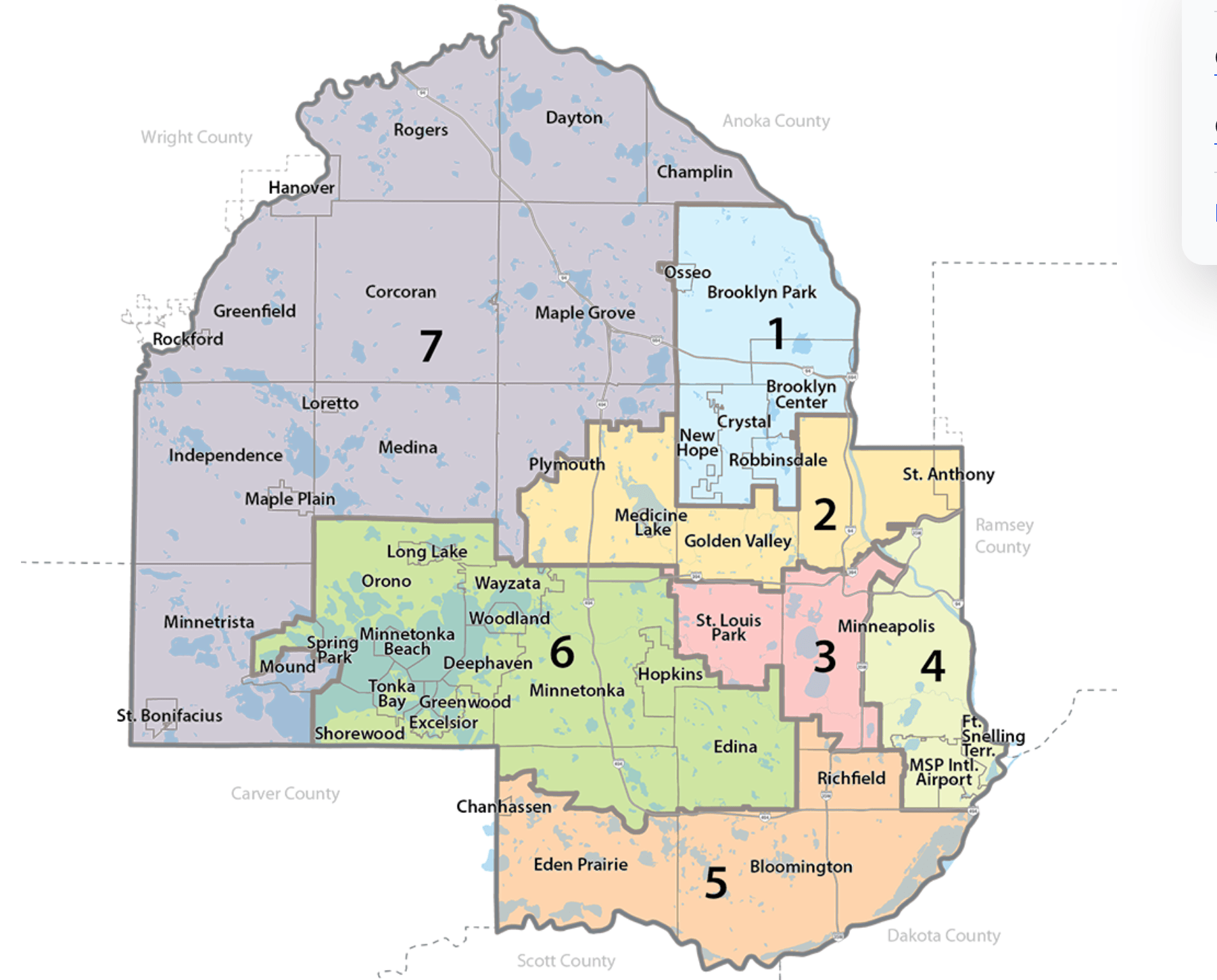
The county is governed by a board of seven commissioners, each elected from a district. Those districts are large. Each commissioner now represents roughly 180,000 to 185,000 people, more than two state senate districts and better than four Minneapolis City Council wards.
A city council member represents just under 40,000 residents; a state senator about 85,000. Each commissioner has two full-time staff, with an additional staffer in the clerk’s office added in recent years to support the board chair.
The Day-to-Day
A commissioner’s week is mostly meetings, staff said. Some are external, with neighborhood groups, labor unions, developers and the range of people who have business before the county. Some are internal, including one or two standing meetings a week with the county administrator, who brings most measures before the board.
And many flow from the dozens of outside boards commissioners are appointed to by virtue of the office, from the Metropolitan Council and the Metropolitan Mosquito Control District to the St. Anthony Falls Heritage Board. By one staffer’s count there are 30 to 40 such bodies, divided among the seven members.
“When something goes wrong in Minneapolis — a stalled road project, an encampment that won’t go away, a program that falls short — residents tend to aim their frustration at the City Council...
Often, though, the responsible party is largely out of view, at Hennepin County.”
The formal work runs on a two-week cycle. The board meets one week, its committees the next, and because the board operates as committees of the whole, the same seven people do both jobs.
Most measures (packaged as a board action resolution, or BAR) pass through three meetings: introduced at the board, referred to committee, debated and advanced, then approved back at the board.
As a result an item is typically in front of the public for 21 to 35 days. The Tuesday board meetings run anywhere from 90 minutes to three hours and require, staff stressed, considerable preparation and follow-up. The board also holds 15 to 18 deeper-dive briefings a year, usually on a Thursday.
Why Commissioners Barely Talk to Each Other
One surprise, staff said, is how little the seven commissioners speak to one another about official business.
Minnesota’s open meeting law bars a quorum from discussing county business outside a noticed meeting, and on a seven-member board a quorum is just four.
The law also counts serial and proxy conversations as violations: if two commissioners discuss an issue, then each takes it to a third and a fourth, they have serially broken the law, and their staffs can do the same by proxy.
Only two positions inside the county, the county administrator and the county attorney’s liaison to the board, are shielded from those disclosure rules.
The Legislature, staff noted with some irony, exempts itself from the open meeting law it imposes on nearly everyone else.
What the County Actually Does
The county board adopted a 2026 budget of about $3.15 billion. Roughly 60 percent of that comes from the state and federal governments, with about 40 percent raised through local property and sales taxes.
Add the public hospital, whose board the county made public again last year, and direct oversight climbs toward $5 billion, with another $1 billion to $2 billion of indirect influence through the various authorities commissioners sit on.
By far the largest function is human services: food assistance, medical assistance and Medicaid, housing assistance, child protective services and a range of programs for eligible residents.
As one staffer put it, if a human-services program is funded by the state or the feds, it is probably administered at the county level.
The county also handles public works, including some 2,200 lane miles of county roads; housing and economic development through the Housing and Redevelopment Authority; energy and environment work, from operating the Hennepin Energy Recovery Center to administering local cleanup dollars; the back-office operations that keep the county running; and the 41-branch library system, which ranges from the cavernous downtown Central Library to the one-room library in St. Bonifacius.
Paying the Bill Without Calling the Shots
Here is where public understanding most often goes wrong, staff said. In public safety especially, the county pays for a great deal that it does not control.
State statute requires the county to fund the courts, the public defender, the county attorney, the sheriff and community supervision, but the policies are set elsewhere.
The chief judge of the Fourth Judicial District runs the courts; the chief public defender runs public defense; the county attorney and the sheriff run their own offices; and probation and parole largely follow state handbooks.
The county supplies the courtroom, in other words, but does not decide what happens in it.
The sheriff’s budget is the sharpest example. The statute says the county board shall review and approve the sheriff’s budget each year, but it is not legally clear that the board may reject it.
The one time the question was tested, in a Ramsey County dispute that reached the Minnesota Supreme Court, the court declined to resolve it cleanly, and the gray area persists.
That leaves commissioners reluctant to force a standoff, and inclined instead to use ordinances, reporting requirements and conditions to steer spending.
The tension is live: Sheriff Dawanna Witt’s roughly $170 million office is running an estimated $15 million to $20 million over budget this year, both overstaffed relative to its approved positions and heavy on overtime, and the budget has nearly doubled since 2015.
The board, staff said, is still trying to understand how an office can be over on staffing and over on overtime at the same time.
Why the County Pays for Trains It Doesn’t Run
The same pattern of paying for what someone else mostly controls runs through the county’s role in light rail.
While the seven commissioners play a major role in advocating, planning and funding light rail transit in the region, the Metropolitan Council actually implements projects like the Green Line Extension, the Southwest light rail line.
Hennepin County is the main local funder of the Green Line Extension, using money that comes from a sales tax that Hennepin County commissioners imposed in 2017 which now generates more than $170 million a year.
Hennepin County holds seats on two key Met Council oversight committees, the Corridor Management Committee and the Executive Change Control Board.
Both committees have been apprised of the Met Council’s construction activities and have approved the many revisions to the original plan — changes driven, critics would argue, by inadequate preliminary engineering and political expediency.
The current Green Line Extension budget of $2.86 billion is more than twice the $1.25 billion first approved, and the line is in its eighth year of construction.
Commissioners Marion Greene, Debbie Goettel and Heather Edelson are the county’s representatives on these committees.
Why Lyndale is So Complicated
Few issues capture the county’s tangled authority better than the reconstruction of Lyndale Avenue.
Lyndale is a county road, so the county controls its design, construction and maintenance, but state statute dictates the priorities.
Because Lyndale is a county state aid highway and an arterial, the design must accommodate freight and a state-mandated minimum traffic volume.
Nothing in statute requires the county to weigh the interests of business owners in the corridor, or even to provide bike lanes or sidewalks; most of the county’s 2,200 lane miles have none.
Beyond those baseline requirements, staff said, the biggest factor is the wishes of the local commissioner, who historically drives how a county road is configured in his or her district.
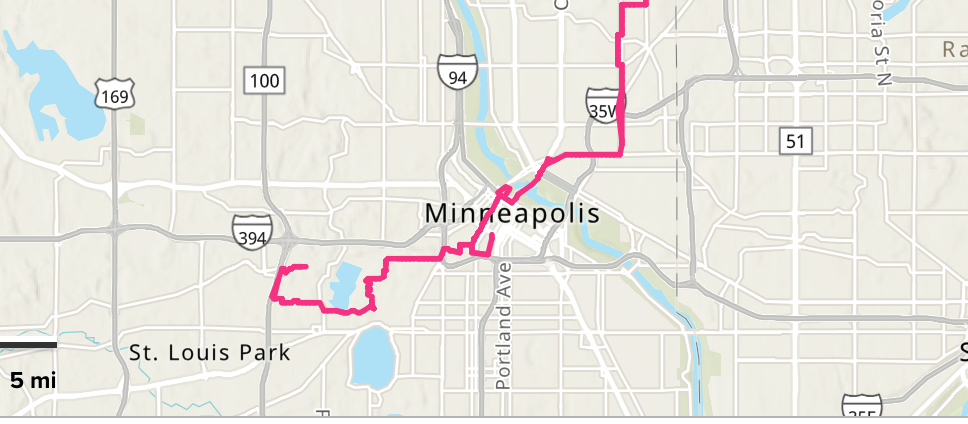
For Lyndale that is Commissioner Marion Greene of District 3, with board chair Irene Fernando and public works committee chair Kevin Anderson the next most likely to weigh in.
Then comes the city. Before construction begins the county and city must sign a general operating agreement governing work in a roadway that also carries city utilities; without it, the county cannot so much as patch a city water main it accidentally strikes.
Those agreements were once routine, staff said, but in recent years city negotiators have taken a harder line, withholding agreement until the city’s own priorities are met, a posture first seen on Hennepin Avenue in Northeast and now shadowing Lyndale.
There is one more wrinkle that cuts in the county’s favor. When the city rebuilds a road, it levies a special assessment on adjacent property owners, a bill that can run from a few hundred to a few thousand dollars for a small business already absorbing the disruption of construction.
The county does not levy such assessments for road reconstruction. Neither government, staff acknowledged, maintains a fund to help businesses weather the construction itself, a gap they conceded is probably worth addressing.
The Bottom Line
County commissioners, staff said, are the connective tissue among layers of government that rarely line up neatly.
They oversee billions of dollars and a sprawling set of services, yet much of what they manage is steered from St. Paul or Washington, and some of what residents blame them for is not theirs to fix.
As voters weigh their choices this fall, that may be the most useful thing to keep in mind: knowing what the office can and cannot do is the first step to judging the people who hold it.
Craig Wilson is the editor of the Hill & Lake Press. He lives in Lowry Hill.