
Marty Carlson is a regular contributor, attorney and senior policy aide to Council Member Elizabeth Shaffer. He lives in Kenwood.
February’s issue of the Hill & Lake Press was inspiring to me. The federal invasion of Minneapolis has no parallel in American history, and the degree to which our city has pulled together to resist this onslaught will be remembered long after we all are gone. We’re winning — at least for the moment — but the fight is painful. It has already cost lives, and it has cost others their liberty and the pursuit of happiness. Reading the many excellent articles, which I hope readers found valuable, made me want to answer a question no one’s ever asked — why do I write?
The short answer is Boston and the American Revolution. As many of you know, I’ve been writing for the paper for a number of years now, contributing articles on topics ranging from Park Board policy to city council actions to my last opinion piece, in which I argued (compellingly, I think) that I was sad my dog had died. But why write at all? Truthfully, the answer is Boston and the American Revolution.
What? That sounds nuts, and — dare I say — kind of pretentious. Perhaps, but it’s nonetheless true. In 2020, the year before I started writing, we ran smack into the pandemic, and that also happened to coincide with my son’s college search. On-campus visits were necessarily cut short, the world shrank to the field-of-view of a Zoom camera. Eventually there was a vaccine, and cautiously we were able to poke our heads out of our houses like moles blinking in the sunlight.
It was during that time we did a tour of colleges in Massachusetts, starting and ending with Boston. The college tours were fine — didn’t make me yearn for those thrilling days of yesteryear — but when they were over, I had a chance to explore streets and neighborhoods that were still largely devoid of people. But not of history.
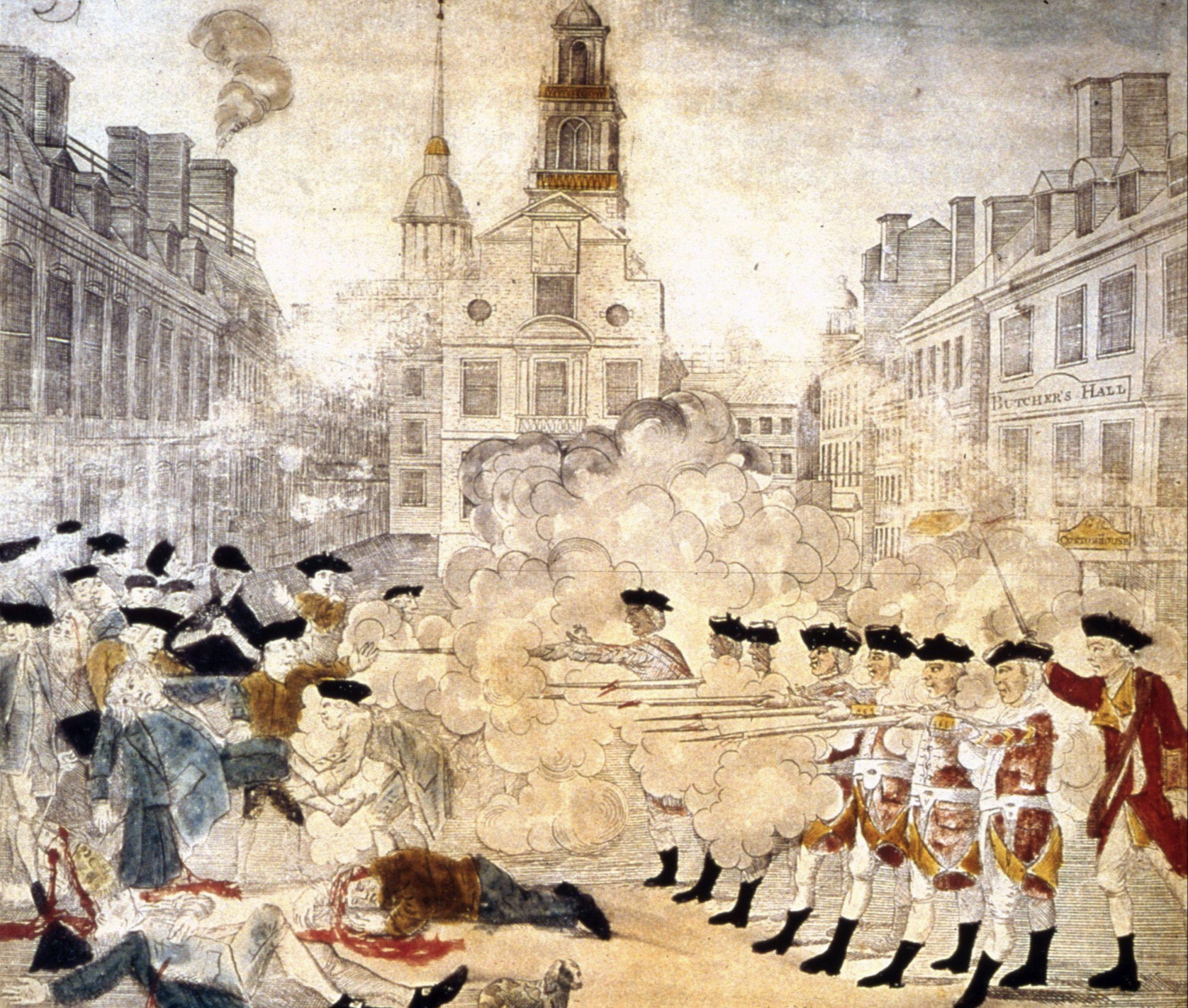
Boston is teeming with it, most of it revolutionary. You can walk the Freedom Trail, covering the site of the Boston Massacre, Paul Revere’s house, Copp’s Burying Ground, and ending at Bunker Hill. My wife often complains that no vacation is complete without a visit to a church, a cemetery, and an old boat. That is, sadly, true. But in Boston the church is Old North, in which patriots hung lanterns (“one if by land, two if by sea”), the cemeteries hold the bones of Paul Revere, Phyllis Wheatley, and signers of the Declaration, and the old boat is the U.S.S. Constitution, the oldest warship still afloat.
But it’s the words that matter. Boston was known in that time as “the Cradle of Liberty,” but it wasn’t just for its physical bravery (and brave that was), but for its revolutionary ideals, eloquently expressed. John and Abigail Adams, his fiery cousin Samuel, the remarkable Ms. Wheatley, Mercy Otis Warren and others all contributed to a free and rich exchange of ideas that helped galvanize an incipient nation into action.
Perhaps my favorite surviving artifact is the bookshop of the twenty-something Henry Knox, whose intellect drew the attention of General Washington, and whose ingenuity and stamina saw dozens of artillery pieces hauled hundreds of miles in wintertime over the Berkshire mountains from Fort Ticonderoga, through Springfield, to Dorchester Heights, overlooking Boston Harbor. There, on the high ground in 1776, they forced the British into ignominious retreat, marching down Boston’s Long Wharf, never to return. But it started with books — Henry Knox was a twenty-something bookseller, before the cannons, and before the U.S. gold depository was named after him.
Today, the building that housed the bookshop of Henry Knox is immaculately preserved as an historic site. It’s also a Chipotle. I’ve been wondering for years what to do with that jarring discrepancy, and as I finally reduce my thoughts to writing, I still don’t know. But what I do know is that Henry Knox rose to the occasion, and distinguished himself in a way that’s rightly remembered 250 years later.
But it’s ideas that drove the Revolution, bloody and awful though it was, and it’s those ideas — acted upon — that sustain us today. After I visited the Boston historic sites, I’d often spend time in the evenings reading about these remarkable people and the power of their expression. And it nudged me into a more public life.
Don’t get me wrong, it’s not that I hadn’t engaged in public interest work — I very much had, and I’m proud of my record — it’s just that it never crossed my mind to write personally to an elected official, or to express my opinion as an ordinary citizen. I simply didn’t think anyone would care. It’s an attitude that’s very Gen X — we were the latch-key kids of the 80’s — and which leaves me deeply impressed by the chutzpah of the Gen Z’ers who have organized (truly impressively), run for office and who have turned youth into an attribute.
But that wasn’t my experience. Still, when the Park Board proposed closing the parkway in front of my church, I thought — in all seriousness — of the revolutionaries in Boston, and I sharpened my pencil and wrote a letter. I didn’t really expect it to matter, but that letter found its way out into the larger neighborhood, somehow to this paper, and then onto the front page. People liked it, and they asked me to keep writing. So I’ve kept at it ever since. We’re nothing without an informed and engaged citizenry, and if I can play a small, extremely parochial part in that, it feels like a good use of my time.
Since the ICE invasion, I’ve been absolutely blown away by the coordination, generosity, and braveness of Minneapolis residents throughout the city. You can’t throw a stick around here without hitting someone who’s been shadowing ICE cars, blowing a whistle, delivering groceries, helping with schooling, or providing some other meaningful measure of support. The teachers are stunning, the twenty-somethings are fierce, and the lawyers in my life are swarming, albeit in a good way.
This is the spirit of America. Though it was the ghosts of patriots past who nudged me to engage, it’s the broad-swath courage of our fellow citizens that gives me hope for the future. The Trump Administration had a plan. They thought if they pushed us, we’d go nuts and burn down our own city again. They’d invoke the Insurrection Act, and they’d use us as a laboratory for the future. But instead, we fought back with cameras, whistles, frog costumes and (fabulously) dildos. Bullies can’t stand sustained resistance, and mockery makes them wilt. It’s far too soon to say this matches the British getting frog-marched down the Long Wharf in 1776, but it’s not to say that it doesn’t. Freedom requires critical thought, eloquent expression, physical courage, sacrifice and nearly unending stamina. I hope Minneapolis hasn’t cornered the market on those attributes, but we have them in abundance, and I’ve never been more proud to be part of this multitude we call home.