
The Met Council is enthusiastically announcing the opening of the Green Line Extension, also known as Southwest Light Rail, June 12, 2027. At the same time, and with much less enthusiasm, Minneapolis and other cities are announcing double-digit property tax increases.
The job of elected officials is to prioritize limited public resources. Are Hennepin County and the Met Council doing a good job?
Southwest Line Nears Opening
The Southwest Light Rail line has been under construction for eight years at a cost of $2.86 billion.
When the train finally begins operations next year, Metro Transit plans to discontinue the Route 25 bus through Lowry Hill, Kenwood and Cedar-Isles-Dean. No bus will connect with the light rail at the 21st Street station.
At one point, promoters called Southwest Light Rail “the equity train,” saying the 21st Street station was key for buses to connect urban residents with suburban jobs. But nationally, it is not uncommon for local bus networks to be phased out or reoriented along light rail corridors.
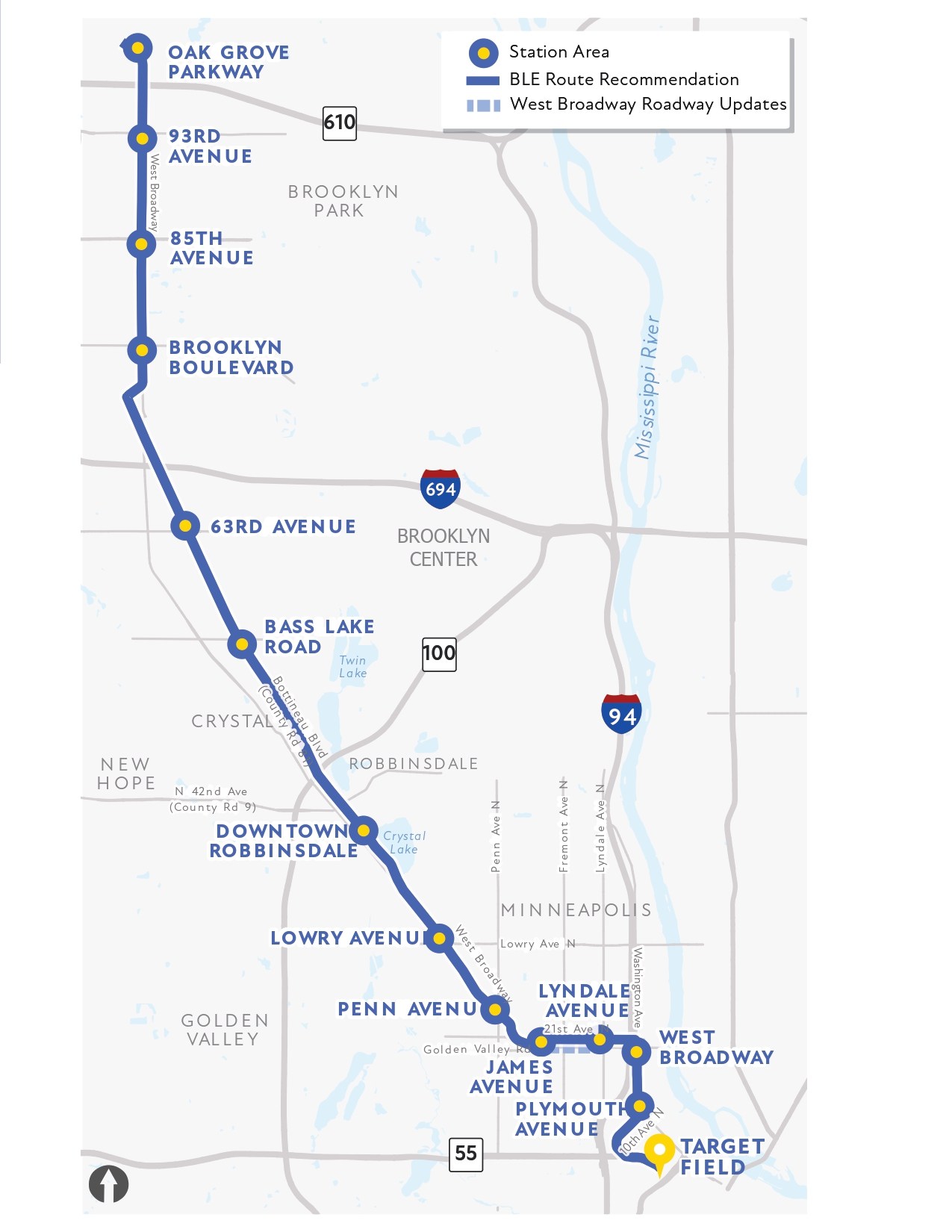
Meanwhile, transit planners are eager to move on to their next project: the Blue Line Extension through North Minneapolis to Brooklyn Park. The Hill & Lake Press was asked to attend a meeting at the Brooklyn Park library on Sept. 1 at which Hennepin County commissioners advocated for the extension.
The Case for the Train
Along with Brooklyn Park Mayor Hollies Winston and other supporters, county commissioners argued that they have waited long enough to bring high-quality transit to the increasingly diverse northern suburbs.
They articulated a belief that trains encourage development and would give transit-reliant residents better access to places they want to go. Light rail transit has many benefits, and understandably, they call it an equity issue.
Minneapolis City Council Member Pearll Warren had several disagreements with the plan. She noted that the “whole Northside needs a facelift,” but didn’t think the train would be the answer.
A Rising Price Tag
The meeting came about in response to a June 2026 Met Council study estimating that the Blue Line Extension will now cost $3.6 billion to build. That is up from a 2024 estimate of $3.2 billion and from $997 million in 2014, when the project was first approved.
The study puts operating costs at about $40 million annually and ridership at 10,000 to 13,000 daily. Hennepin County has increased its funding commitment from $680 million to $2.25 billion to build this project. County commissioners believe that the Met Council could and should cover an additional $224 million needed to apply for a federal grant of $752 million. The Met Council has followed all the mandated steps in the grant process, but the federal money is far from certain under the current climate in Washington.
The Bus Alternative
The Met Council study also shows that bus rapid transit, or BRT, along essentially the same route would cost a fraction of what light rail costs, perhaps as little as $120 million in capital costs. Expected bus ridership would be lower, though, at about 4,300 to 5,500 daily riders, and buses do worse in heavy traffic and snow.
The Blue Line Extension’s history has been long and complicated. But the region’s experience with the expensive and problem-plagued Southwest Light Rail line makes the question of cost-effectiveness more relevant than ever: Would limited public resources be better spent on the lower-cost option?
Advocates for BRT point out that the difference between the cost of BRT and the Blue Line Extension could fund a highly developed network of electric buses in the northern suburbs. North Minneapolis already has access to Metro Micro Mobility, an on-demand, shared-ride public transit service that costs riders just $1 to $3.25.
And if the extension is built, existing Northside bus routes are likely to be truncated or eliminated to support light rail ridership, as with Route 25 through Hill & Lake Press neighborhoods.
“ The job of elected officials is to prioritize limited public resources. ”
More Than Transportation
But people who champion light rail don’t approach it as simply transportation. They believe it can also be an economic development tool.
They say that a fixed transit route is a perk that property developers can offer potential tenants, making investment less risky since rail transit can’t be moved. The Met Council says that Southwest Light Rail has already done great things for development, though others argue that development was happening anyway along the economically prosperous route.
In 2017, the county implemented a half-cent sales tax to fund transit and transportation improvements. This tax generates about $170 million annually and has mostly been used for light rail. Then in 2023, the state Legislature passed another three-quarters-cent sales tax that increased Metro Transit’s annual budget by almost $400 million.
“ It’s all very complex, but it’s your community and your tax dollars. ”
Competing Priorities
Light rail advocates believe that, given climate change and the role that private vehicles play in it, expanding public transit options should be a high priority.
But with the ridership decreases since the COVID-19 pandemic, down 14% on light rail in 2025 from 2024, others ask about priorities. They point to the financial challenges at the Hennepin County regional hospital (HCMC), the affordable housing shortage and addiction crises, among other things.
Quality public transit helps people get to jobs, schools and other places. When routes were being studied, many people advocated for a Southwest Light Rail route that would have better served transit-reliant neighborhoods than the route that was ultimately chosen.
But the debate about the Blue Line Extension ultimately extends beyond transit modes and methods to broader questions about how the region should prioritize and manage limited public funds, including sales tax revenue, amid competing needs.
It’s all very complex, but it’s your community and your tax dollars. What would you do with $2.5 billion?
Jeanette Colby writes for the Hill & Lake Press. She lives in Kenwood.