
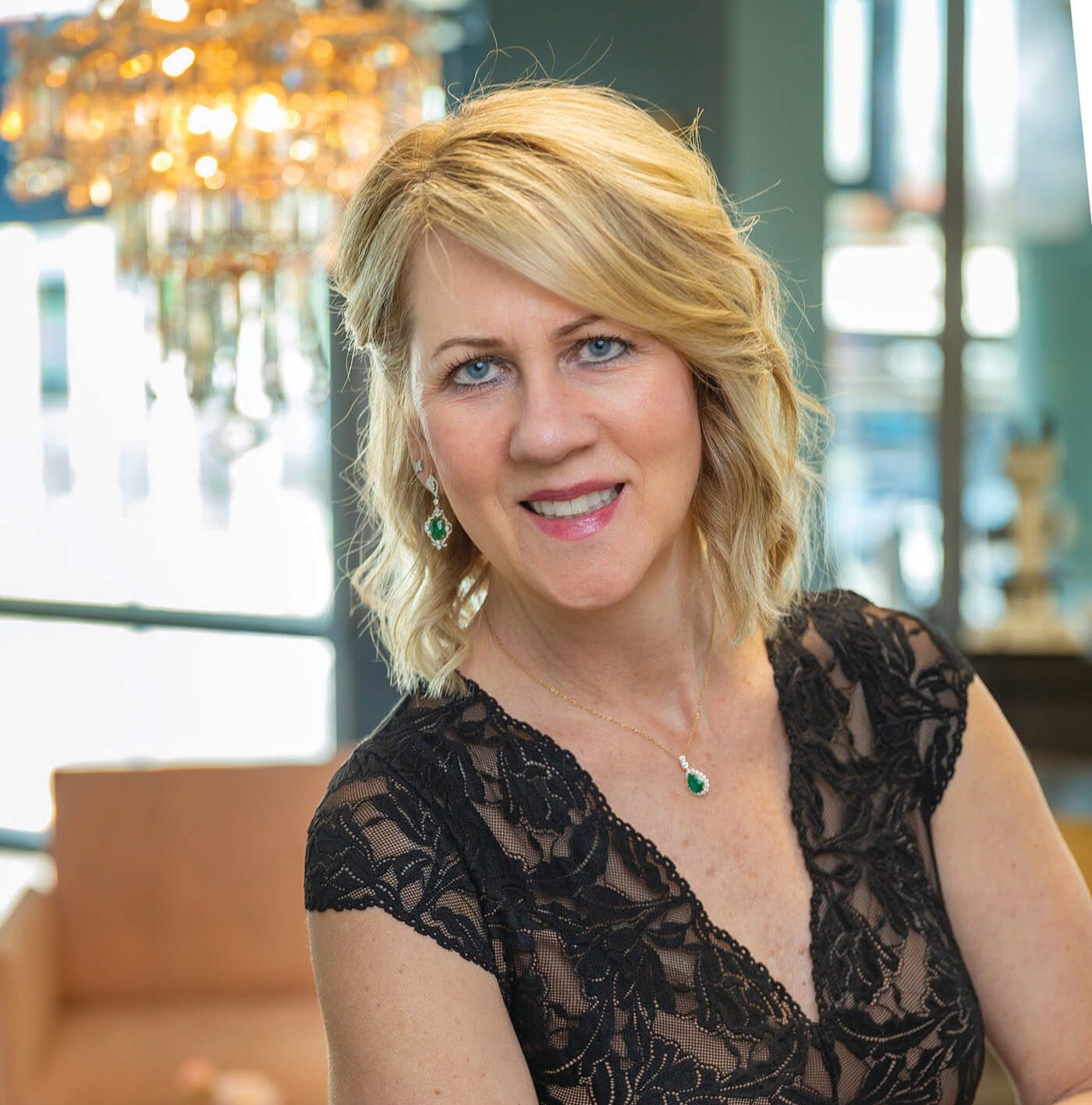
Meet Laurie Kottke, “gemologist, jewelry expert, lover of lace, sparkle, all things feminine,” and an ardent Uptown business enthusiast.
Laurie Kottke Fine Jewelers is in the Lakeside Center, formerly the Lake Calhoun Center, at the intersection of Excelsior Boulevard and Lake Street in West Bde Maka Ska.
I interviewed Laurie in her store on May 7, 2026. The interview has been edited for clarity.
How did your interest in jewelry evolve?
Well, it started when Dayton’s department store hired me in high school, and I got to choose which department I wanted to work in. My choices were between women’s lingerie and jewelry.
The only reason I chose jewelry was because women’s lingerie was in the basement. I thought, I’m going to go with jewelry because it’s on the second floor and there would be a lot of foot traffic.
The store had a great manager who pushed me along through high school and college and said, “Why don’t you go into jewelry?”
After college, I attended the GIA, the Gemological Institute of America, then located in Santa Monica, California. I graduated with a gemologist certificate, returned to Minneapolis and worked for 20 years with a jeweler in a job in what was then known as Calhoun Square.
What is the difference between a jeweler and a gemologist?
A gemologist learns how to identify gemstones. A green stone could be a tourmaline, a garnet or an emerald. And there are a lot of synthetics out there.
A jeweler can design, make and sell jewelry and sometimes all the above. People who make jewelry are called either silversmiths or goldsmiths.
Are there processes to determine what type of mineral it is?
There are processes that do that, starting with magnification and then using gemological instruments to determine if it is a natural gemstone or not.
Do you make jewelry yourself?
I do not. I help my clients design jewelry, and then my goldsmiths custom-make it.
What, if any, are the ethical considerations in buying jewelry?
I realize customers may question the authenticity and ethical practices in the sourcing of diamonds and colored gemstones. Increasingly, many of my customers want to know where the gem originated.
Most diamonds and colored gemstones come with a certificate of authenticity from reliable sources such as the Gemological Institute of America (GIA) and the American Gem Trade Association (AGTA). I understand GIA and AGTA can determine where a gem was mined.
Many diamonds and colored gemstones are found in remote areas of the world where mining is one of the few sources of income. I try to ensure that the diamonds and colored gemstones I sell have been mined through dealers who utilize fair trade practices and are transparent in their sourcing.
How has the jewelry business evolved over the years?
The business climate, like every small business, is evolving. The internet and online buying have changed things. Jewelry is different because it’s very hard to buy online. A lot of people want to see it.
How do you know the scale of a piece when you’re looking online?
I don’t even know sometimes when I’m buying from jewelers. One thing that has hit the jewelry business has been lab-created diamonds.
Lab-created diamonds are what young people want. They want a lot of bang for their buck. They want a nice diamond, and they are beautiful.
Are diamonds considered real if they are lab-created?
Lab-created diamonds have the exact same characteristics as a natural diamond, but they’re made in a laboratory versus being found in a mine. Now labs are manufacturing them so rapidly that prices have plummeted, and they are only cutting the best.
Most lab-created diamonds are high quality — with a natural diamond, you are picking out the characteristics that are important to you. But with a lab diamond, you’re just going to get the best cut, color and clarity.
However, I believe there is going to be a change in the business, because people want things that are different and special. Lab-created diamonds are not unique, but they still sparkle and shine.
Are you related to Leo Kottke?
I have a fun story that just happened about three or four weeks ago.
I was sitting at my desk, and a couple came to the door. “How can I help you?,” I asked. And they said, “We just have a question for you. It’s a silly question.”
I said, “Ask it.”
He wanted to know if I was related to Augusta Kottke. “That sounds familiar,” I said, and asked why. Hee said, “Well, yeah, I am related to her.”
Then it hit me. “Wait a minute. What’s your name?” He said, “My name is Leo Kottke.” And I said, “The Leo Kottke? Oh my gosh, this is the moment I’ve been waiting for! I have been asked if I am related to you my entire life.”
I invited them in to sit and chat for a few minutes. We had a nice conversation and I feel like I have a friend now.
I am pursuing my genealogy, and I am so curious to know if we are related. I hope so, because he is so talented, and such a treasure for Minnesota.
David Piper is a retired judge and regular contributor. He lives in Kenwood.