
Will Stancil is a lawyer and housing policy researcher. He lives in Lowry Hill.
The federal government has launched an invasion of Minneapolis, deploying thousands of heavily armed men from ICE and Border Patrol across the city.
Minneapolis has organized to peacefully resist. The resolution is still unclear.
The reasons behind “Operation Metro Surge,” likely the largest deployment in history by federal immigration agencies, remain opaque.
Officials claim it is a response to benefits fraud in Minnesota, yet the operation bears no resemblance to an accounting review. The federal government did not send auditors.
It sent 3,000 masked and heavily armed agents with assault rifles, tear gas and body armor.
Once here, these agents have carried out what I, as a firsthand observer, can only describe as a campaign of aggression and intimidation. Hundreds of neighbors have been stolen; two have been shot dead.
Unmarked vehicles filled with armed, masked ICE agents lurk across the city. I’ve seen confirmed ICE vehicles on Douglas and Summit in Lowry Hill, on Girard in East Isles, circling Lake of the Isles, and at Kowalski’s and Lunds.
They have been omnipresent along Hennepin, Lyndale, Lagoon and Lake.
Abductions in Broad Daylight
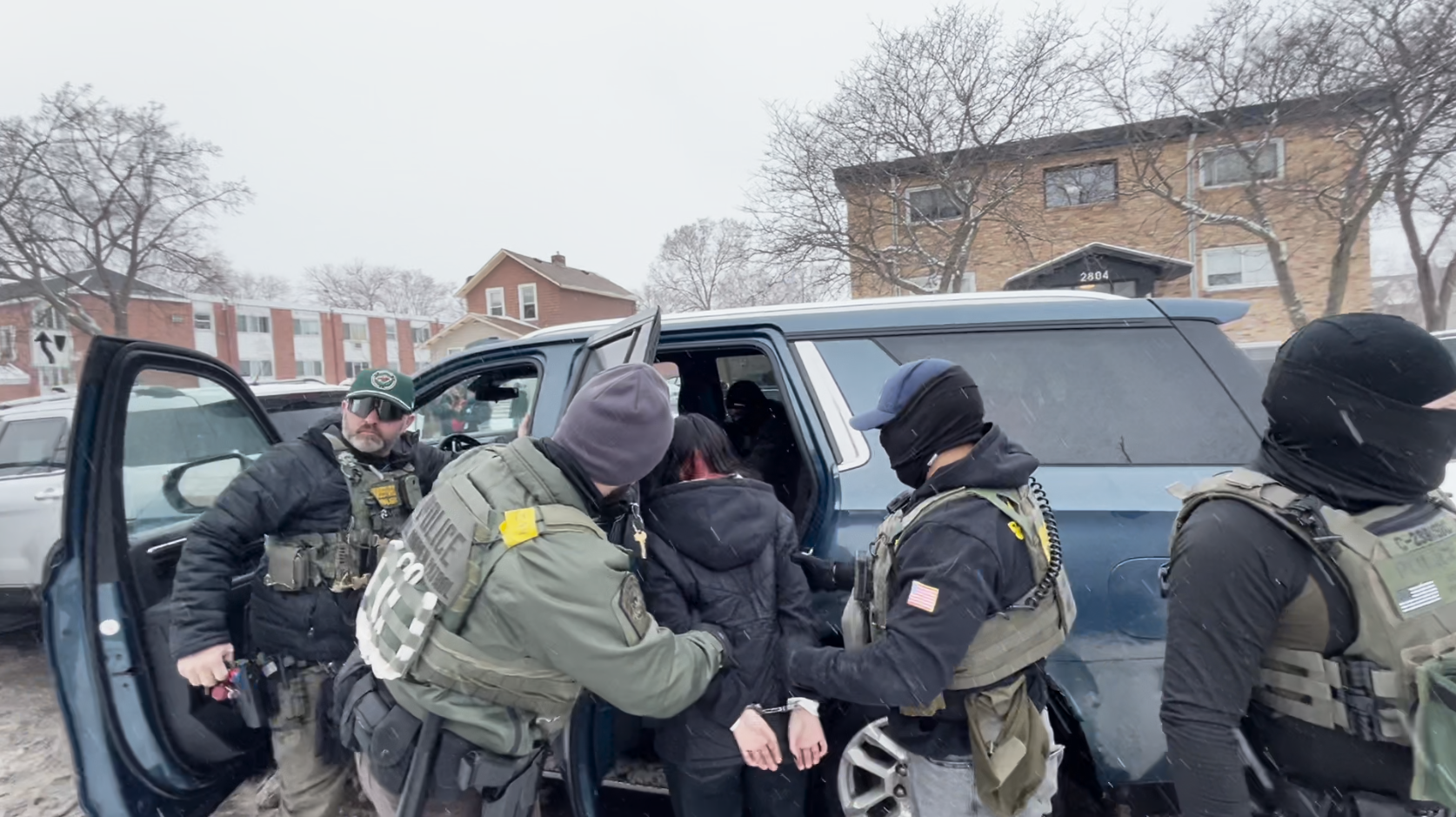
These agents lurk and sometimes detain residents. I have personally witnessed four “detentions,” which are better described as abductions.
“ICE abhors being watched. But thousands of us are watching anyway.”
In two cases, heavily armed men jumped from a moving convoy and seized a random nonwhite pedestrian walking alone — someone whose identity they could not possibly have known.
The person was shoved into the back of a black SUV that sped away within seconds. Observers were unable to obtain names, meaning those individuals simply disappeared.
In another instance, a platoon of ICE agents pulled over a car with two teenage Latinas. Sobbing, they were handcuffed.
As the crowd gathered, we were able to confirm their names and ages — both 16, both legally in the country. They were still taken. Agents then beat and pepper sprayed observers and fired tear gas into a residential block as they fled.
Border Patrol convoys have been even more menacing. Led at times by their local commandant, Greg Bovino, they park on public streets while agents brandish rifles, waiting for crowds to emerge.
No immigration enforcement of any kind seems to take place — though Bovino often strolls into the street to pose, like some kind of conquering legionnaire, for the small army of photographers he always has in tow.
They then proceed to brutalize any onlookers unfortunate enough to be stuck in their way, and often deploy tear gas into the crowd before moving on to do it again. This bizarre tactic resulted in the separate tear-gassings of Mueller Park and Wrecktangle Pizza in Uptown recently.
These scenes have repeated across the region. Few know the full scale, but the level of chaos is overwhelming.
Fear Across the City
Outside the military brutality of their operations, the psychological toll is profound. ICE now outnumbers MPD five to one and operates in secrecy.
That means any dark SUV with tinted windows could contain two to four masked, armed agents. Since the operation appears to indiscriminately target people of color, regardless of citizenship status, tens of thousands of our Black, Asian and Latino neighbors have been afraid to leave their homes, go to school, or go to work for weeks.
Given the lack of federal restraint, it is little surprise that ICE eventually killed two Minneapolitans in seemingly arbitrary shootings — Renee Good and Alex Pretti, both 37, a poet and nurse respectively. Pretti’s slaying, in which he was shot many times in the back while being brutally beaten by Border Patrol for no apparent reason, has especially shocked the nation.
But instead of fracturing the city, these deaths galvanized it. In its wake, thousands of neighbors in the Lakes area, and tens of thousands across the city, have banded together to slow ICE down.
A Citywide Network of Resistance
I was one of them. In days, an ICE neighborhood watch system grew from a small group of volunteers into a dense citywide network.
The concept is simple: neighborhood-based voice and text channels where participants report suspected ICE activity. Foot patrols walk blocks with whistles, sounding alerts.
“There are far more of us than them, and Minneapolitans have set aside their differences to protect one another.”
Another group, calling themselves commuters, patrol in vehicles throughout neighborhoods. I have mostly served as a commuter. The neighborhood watch groups maintain trained dispatchers on rolling shifts, who relay reports between local networks.
A crowd-sourced directory of known and suspected ICE plates is maintained by volunteers so that vehicles can be quickly verified.
The directory is imperfect, and federal agents often obscure plates, so observers rely on their eyes and judgment. For example, two masked men in sunglasses driving a dark Ford Expedition are almost always federal.
ICE abhors being watched. But thousands of us are watching anyway.
When ICE is spotted, observers rush to the location. Their role is to record, not interfere. They keep eyes on the agents — often by following in their vehicles — and record anything that happens. Physical or forcible inter
ference is illegal, but recording, observing and alerting has proven surprisingly effective at restraining this secretive operation.
Intimidation Tactics
Since ICE abhors being watched, it will work hardlose or intimidate observers. They speed away, leading observers on lengthy pursuits through the city. They will surround observer cars, threatening the occupants, in some cases smashing car windows and illegally detaining observers.
A common tactic — which I have experienced twice — is for agents to run an observer’s plates and then tail them all the way home, an unsubtle threat that effectively advertises that they know where the observer lives.
In one instance, as I followed an ICE vehicle, two additional SUVs pulled in behind me. The lead car, blacked-out and without plates, announced over a loudspeaker, “This is where you live. Go home.”
I shouted back that observing is legal and leaned on my horn, prompting a dozen neighbors to come outside with whistles. The agents sped off, finally escaping me by running a red light outside Kowalski’s.
This experience is representative of thousands of observers. Many have heroically endured long cold watches in subzero temperatures or physical abuse by government agents, to help ensure that their neighbors are not aducted secretly. Many more are spending endless hours helping feed and assist the people of our city stuck in their homes.
Meanwhile, social media algorithms have been amplifying false claims that observers and protesters are paid actors or from out of state. I have been on the ground witnessing this in real time. These narratives are lies. The protesters are local volunteers. The media presence is global, but it is Minneapolis residents who are fighting ICE.
A City Rising
Nobody knows how this ends. From my view on the street, the federal government’s mission appears to be fear — to provoke chaos, terrify and incite violence, possibly an excuse for greater domestic military repression.
Many seem to misunderstand Minneapolis as the city they remember from 2020: ready to erupt into unrest. They seem unsure what to do with a city that has responded to brutality not with riots but with organized, peaceful resistance.
There is no clear path through this crisis. Our neighbors are being taken in secret. Children are missing school. Businesses are struggling. But I am confident of this: ICE cannot win. There are far more of us than them, and Minneapolitans have set aside their differences to protect one another.
What I have seen on these streets is not despair. It is solidarity and courage: neighbors choosing to show up for one another again and again, no matter the hour, no matter the cold. The city is hurting, but it will survive.
“What I have seen on these streets is not despair. It is solidarity and courage.”