
Article and Images by Courtney Cushing Kiernat
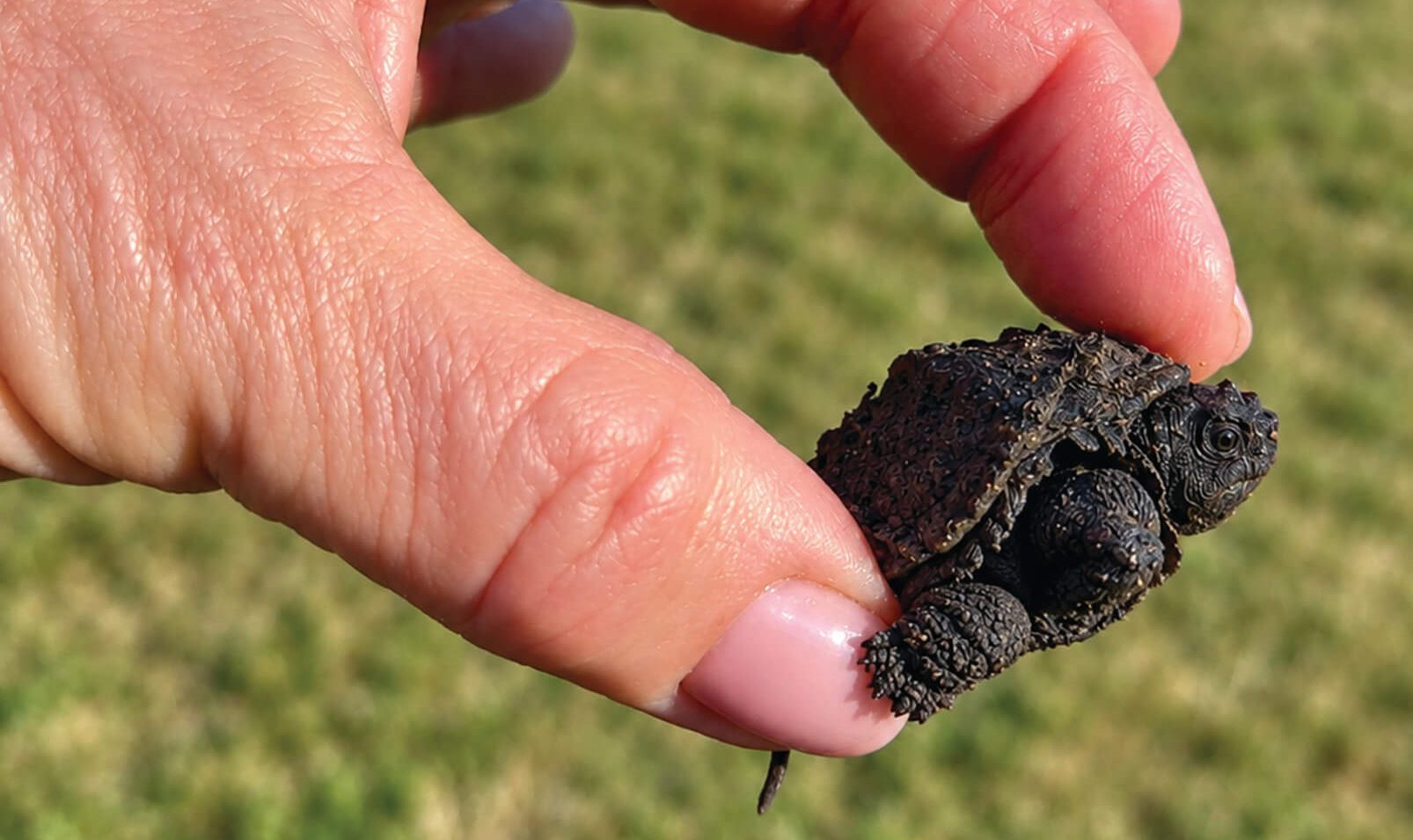
As my four dogs and I came around the bend one morning, I spotted a roughly inch-long, roundish black object on the sidewalk across the street from Lake of the Isles. The dogs paid it no attention (it wasn’t a squirrel or a rabbit), so we walked on by.
But then I did a double take. It was a baby turtle!
Not an unheard-of sight around Minneapolis lakes, but when I found another one in nearly the same spot that evening, I got curious.
According to the Minnesota Zoo and the Minneapolis Park and Recreation Board, my two tiny turtle friends were common snapping turtles (Chelydra serpentina), one of at least five native turtle species found in Minneapolis parks. Snapping turtles are Minnesota’s largest turtle species, with adults weighing up to about 45 pounds. They spend most of their lives in the water and survive our harsh winters buried in mud or decaying vegetation until spring.
Snapping turtles breed in spring and fall. Females leave the water to find nesting sites, often traveling surprisingly long distances. They lay 25 to 50 eggs, and the Minnesota Zoo estimates that 60% to 100% of those eggs may be eaten by other animals.
For the hatchlings that survive, another perilous journey awaits: getting from the nest to the water. Snapping turtles may travel up to a mile to nest where they hatched, crossing roads, bike paths and other hazards along the way.
In August, the next generation begins to appear. Baby turtles hatch from eggs laid earlier in the season and may continue emerging and heading toward water into October. Some late hatchers even spend the entire winter underground and emerge the following spring.
“I don’t think they use the crosswalk.”
There are turtle-crossing signs around the Minneapolis lakes, but as one neighbor observed, “I don’t think they use the crosswalk.”
Fortunately, snapping turtles are long-lived, so only a small number of hatchlings need to survive each year for a population to remain stable. Still, looking at a turtle barely bigger than a quarter and imagining it negotiating curbs, parkways, bikes, cars and dogs makes its journey seem rather heroic.
“Hard to imagine something so small making such a big journey.”
My dogs and I ended up accompanying two tiny travelers across the sidewalk and safely past the street before letting them continue toward the lake. The Park Board advises leaving healthy hatchlings alone whenever possible so they can find their own way, but if one needs help crossing a road, move it across in the same direction it was already traveling and minimize handling.
Hard to imagine something so small making such a big journey.
Courtney Cushing Kiernat writes for the Hill & Lake Press. She lives in Kenwood.