
My spouse and I were recently and unwillingly drawn into the growing debate over the Park Board’s master planning process for Lake of the Isles and Cedar Lake when the Board released a “concept” plan proposing to permanently close the northern portion of Lake of the Isles Parkway – a move which would have made our church, Lake of the Isles Lutheran, largely inaccessible to its majority-commuter membership, and which would have turned our adjoining parsonage into a landlocked island. To our great relief, the Board’s Citizen Advisory Council (or “CAC”) dropped that notion like a hot rock earlier this week, but as residents we cannot ignore the negative aspects of many of the Board’s remaining proposals. Put simply, the vast majority of these changes seem like solutions in search of problems, and many would actually limit the opportunities for park users to enjoy the park’s natural amenities.
Our primary concern is the diminishment of the park’s existing character. The accessible parkland is one of our favorite features of the neighborhood, and what we like most about the park itself is its abundant unstructured green space, its open feel that blends with the overall character of the neighborhood, and the easy lake access from virtually any point in the park. Many of the proposed changes would diminish rather than enhance the features we love the most. Some specific concerns:
There is no consistency to the landscaping plan and it undercuts the features that have made the park successful for over a century. The whole point of the park, as originally envisioned and maintained until this point, is to have an open, green, unbuilt, and pastoral setting equally open to all. Green is equitable; it’s green for everyone, and it’s also flexible. You can have large gatherings, small gatherings, or no gatherings at all, leaving just a peaceful, open view. The relative homogeneity of the park is soothing, and it’s also great for kids and pets. The new vision of the park has people jumping from lawn to prairie to marshland and back again with little rhythm or warning, and it has no relation to the rest of the neighborhood, which is one of the best-preserved late-19th/early 20th century neighborhoods in America. Yes, this is just one period in our history, but it’s living history in three dimensions and the Park Board should embrace this rather than run from it. Acknowledging the history right in front of us doesn’t mean we can’t talk about it in all its aspects – the good, the bad and the ugly – nor does it mean we can’t talk about other eras in the region’s history – we can and should. But the surrounding neighborhood as a whole still reflects to a large extent the vision of the city held by the people who originally built it, and learning and understanding that history in all its dimensions helps us better understand the times we are living in now. The park itself is an excellent and rare example of a large City Beautiful park, and while this is hardly the only model for a successful park, it’s a model that has proved durable and adaptable for over a hundred years and it has served this neighborhood and the City very well. Isles is pastoral, Cedar is wild, Bde Maka Ska is recreational and carries more important Native American history, while Harriet has a more formal civic structure. Each lake has its own character and we aren’t well-served by fighting their long standing natures when in aggregate they exhibit great diversity.
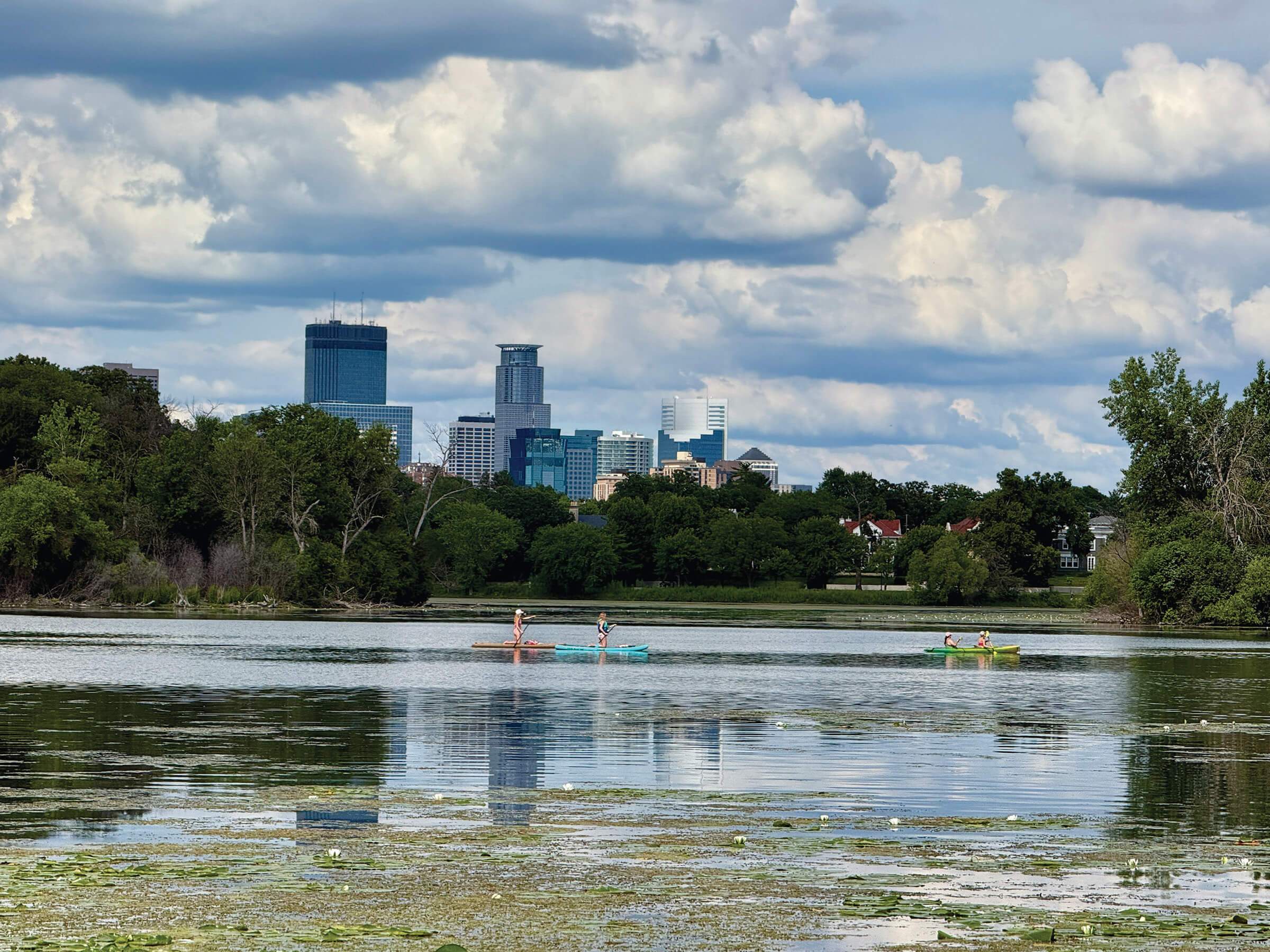
Permanent structures are largely unnecessary. The proposed “activity hubs” and picnic pavilions will make the areas where they are located useless for other purposes, and will needlessly conflict with the historic character of the area. No one needs a permanent, modern structure directly in front of historic Lake of the Isles Lutheran Church, particularly when the Rec Center is so nearby. Placing a picnic pavilion on the cedar point off the West Bay would destroy one of the most natural, tranquil, and beautiful spots on the lake. An “activity hub” by the West Bay, coupled with the canoe racks, the dock, trails, and a possible boardwalk (which would block the canoe access) would leave the area more infrastructure than parkland, wrecking the beautiful and historic vista residents and visitors first see when reaching the area from Kenwood Parkway. The original park planners favored uninterrupted green space for a reason, and this aesthetic has been embraced by residents for generations. After the Mall of America, the Chain of Lakes is already the most visited spot in the State of Minnesota, and people aren’t coming to look at infrastructure. Explore Minnesota, the state tourism office, estimated that in 2017 the Chain of Lakes drew more than seven million visitors, exceeding the total annual combined attendance at the Twins and Vikings stadiums by over 100%. On a warm summer day, a simple walk around the lake shows the neighborhood is open to and heavily used by Minnesotans from all over, as has been the case for decades. Minneapolis is a city comprised of beloved neighborhoods, but people are voting with their feet, literally by the millions, to say that Lake of the Isles is unique. Please keep it that way.
In-filling the North Arm and West Bay will make the lake less accessible. Yes, water quality is important, but Lake of the Isles is one of the least natural lakes in the State of Minnesota (by design, per above) and the most impactful issue for most users is actually the riotous overabundance of invasive species, particularly milfoil, which makes navigating the lake difficult in the summer. If the Park Board is going to commit major resources to Lake of the Isles, we’d prefer that it buy another lake mower or two and mow the lake on a more regular basis. No amount of vegetation or alum will correct the lake’s water problem until people stop using fertilizer on their lawns and the Park Board and City stop salting the roads, neither of which is likely to happen any time soon. While we are supportive of the CAC’s newly created water quality committee and hope it can find solutions that balance lake health with preserving recreational access, the sad truth is that we’ll likely have an impaired lake until we reach some sort of societal consensus that addresses the root causes. Filling in large portions of the lake will not only destroy the lake’s historical character, but it will make lake access difficult to impossible in those areas, and is unlikely to correct the problem to such an extent that you’d ever want to drink the water or eat the fish.
The proposed boardwalks will seriously limit accessibility. Since the proposed boardwalks are over open water, they would need to have railings on both sides so no one falls in. In the winter, when the lake freezes, this means they will have function as giant fences that people will need to climb over or around to access the lake surface. The boardwalk on the north arm would make the area look like a giant cattle corral in the winter, and the proposed skating loop in the center won’t work either. If the north arm is “rewilded” and turned to a swamp or bog, it will have plant cover well above the water line, which will remain above the water when the lake freezes, as is the case at several points on Cedar Lake. You can’t skate on plants. It would get worse in the summertime when the trails are more heavily used, particularly by the many slow-moving friend or family groups you see walking three or four abreast on the trails. Now, there is room for everyone to move at their own pace; you can just divert to the grass to jog around slower moving groups. You can’t do that with a railed boardwalk, meaning there will be serious and unending pedestrian congestion on those portions of the trail.
The proposed prairie plantings would make the park less accessible and less safe. While we love the prairie on the north end of Cedar Lake (and prairies generally), we do not think this is appropriate for Lake of the Isles. As a park user, you can’t do anything with prairie land other than walk past it and look at it. You can’t picnic on it, play catch or frisbee, or even walk through it with your dog. While the lawns on the west side of the lake near our house may not be as heavily used as other points on the park, they are still heavily used, particularly by our neighborhood kids, and they are greatly appreciated by park users who simply want to get some space from other people; this alone is a valuable use in a densely packed city. Prairie also burns. It needs to burn to stay healthy, and it also burns when you don’t expect it to, which we experienced with the Burnham Wood prairie that’s now been destroyed by the light rail. Fire is in the nature of that ecosystem, and it’s fine in a thinly populated area like north Cedar, but downright dangerous in a residential neighborhood filled with 100 year-plus wooden homes like ours. Last but not least, for the first time in decades we have serious violent crime in the area, and any landscape (i.e., tall grass) that gives potential cover to the criminal element in our society is going to make many users feel unsafe, particularly at night.
That’s a lot of what we don’t like. What do we like? We like green. Green open space with lawns and trees. We would love it if the Park added more trees, particularly spaded-in, larger ones that are part of a discernable plan. Maintain the trails, maintain the parkway. Bike trails are a thorny issue and worth a separate article, but any changes need to be thought through carefully, with attention paid to safety, preserving nearby tree cover, and acknowledging the reality and necessity of car travel on the parkway. On that same note, parking is essential and should be preserved. Yes, cars are bad on a number of levels, but they’re a fact of life and we need places to put them, particularly for visitors and emergency vehicles. We’d love to see the lake mowed more regularly. Beyond that, it ain’t broke, please don’t fix it.