
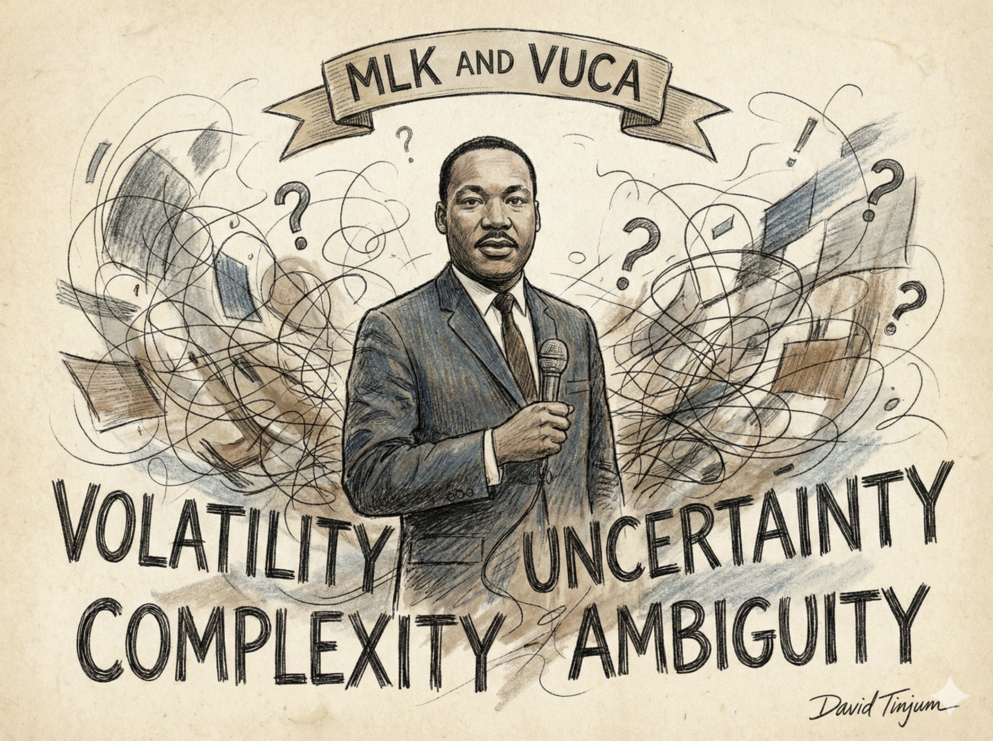
“The Rev. Dr. Martin Luther King Jr. also lived in a VUCA era. He faced different, yet eerily similar, forms of volatility, uncertainty, complexity and ambiguity. It is fair to ask: What would Martin do?”
Mary Ann Graham taught at the University of St. Thomas for 25 years before becoming the Master of Social Work program director at St. Catherine University. She lives in St. Paul. This story originally ran in the Minneapolis Times; it was edited for clarity and our style guide.
Can there be any doubt that we are living in VUCA times, meaning a time of “volatility, uncertainty, complexity and ambiguity?
Whether one looks domestically, at unprecedented ICE deployments, mass protests across the country, at least two deaths during encounters with an ICE agents, the resignations of six federal prosecutors and multiple lawsuits filed against the Justice and Homeland Security departments, or the killings of Minnesota legislators, or a mass shooting at a Minnesota Catholic school that killed two children and injured 26 children and four adults, volatility is everywhere.
Internationally, the United States has seized six sanctioned Venezuelan tankers and removed the Venezuelan president without congressional approval in order to “refine and control oil production.”
The Venezuelan opposition leader then presented the Nobel Peace Prize to the U.S. president. The United States has issued repeated threats to annex Greenland and taken a controversial role in Ukraine, including related threats toward NATO and European countries.
The U.S.-negotiated peace plan in Gaza followed mass casualties in both Israel and Gaza. Volatility and uncertainty with layers of complexity and ambiguity are now global conditions.
The Rev. Dr. Martin Luther King Jr. also lived in a VUCA era. He faced different, yet eerily similar, forms of volatility, uncertainty, complexity and ambiguity. It is fair to ask: What would Martin do?
Would he join mass protests, tweet, write a blog, deliver sermons, blow whistles or have a YouTube channel? Would he write another letter from jail or walk for peace with the Dhammacetiya Buddhists? Might he even come up with his own acronym?
Here is one MLK might approve: WHOA, which stands for wisdom, harmlessness, opportunity and action.
He might remind us that because we are hopelessly entangled and flawed human beings, just as he was, we need to resist the tendency to separate ourselves from others in order to feel superior.
“While alive, King urged people to be ‘wise as serpents and harmless as doves,’ meaning not just wise or harmless, but wise and harmless.”
King was committed to resistance, but not just any kind. He consistently urged people to be motivated not only by their own concerns, or even by the concerns of their group, but also by the concerns of their opponents. This radically inclusive motivation is practical, given how intertwined our lives are.
While alive, King urged people to be “wise as serpents and harmless as doves,” meaning not just wise or harmless, but wise and harmless.
He asked us not to give up our intention to change unjust laws, policies or procedures, and not to give in to reckless or harmful emotions that contaminate our actions and injure both ourselves and others.
He insisted that we hold both qualities inside ourselves. He called it having a tough mind and a tender heart.
Once we can hold that internal tension, we can then find, or create, opportunities to act from it. The actions available from that place vary widely.