“The big sense of community doesn’t leave, and we are impacted even while living away.”
— Max Endorf
Josie Owens is a regular contributor. She lives in Lowry Hill.
Left: Freshly upcycled art at Art Price Studio. (Image: Art Price Studio)
Right: Handmade red “Melt the ICE” hats are on display at Minneapolis yarn store Needle & Skein. (Image: Gilah Mashaal)
Art as Protest and Record
What do artists do when injustice happens? They create powerful art to protest, record and share. We are reminded of the tragedy of George Floyd by the colorful murals memorializing him. They do not let us forget what happened. Now the heart-wrenching images of Renee Nicole Good and Alex Pretti have joined him.
Some artwork was carved in ice and snow, while other pieces serve as permanent visual records. Many artists offered their designs for protesters to wear and carry.
Printing for the Movement
Art Price Studio in northeast Minneapolis was especially busy. The instructions were simple: bring an item of clothing to have it printed with a design by a Minneapolis artist. About 150 volunteers operating 30 active print heads processed roughly 1,000 items each day.
The Minneapolis American Indian Center also hosted print pop-ups. A corollary benefit was the sense of community built while waiting in line. People learned about organized protests, ways to volunteer or simply commiserated.
Bench Pressed in Seward had colorful art ready for purchase to raise mutual aid funds. Other screen-printing studios, including Afternoon Printing and Twin City Tees, joined in, while bars and coffee shops hosted printing pop-ups to raise money for neighbors in need.
Knitting Resistance
Textile artists have also been busy. Paul Neary, a designer at Needle and Skein in St. Louis Park, was inspired by the Norwegian resistance movement during Nazi occupation in World War II.
Gnome-like red hats with tassels were worn to communicate solidarity and boost morale. The movement was so effective that the Nazis banned the hats. Signs read: “Wearing of these caps is forbidden beginning on Thursday, 26 February, 1942. From that day forward, the caps will be confiscated from whoever is wearing one.”
Neary saw a parallel to what he describes as the ICE occupation of Minneapolis and designed a “Melt the Ice” hat pattern, which he posted on Ravelry, a fiber arts platform.
The pattern was offered for $5. As of Feb. 13, it had raised $692,463 for immigrant aid agencies. Red yarn has become difficult to find in the Twin Cities. Those eager to knit or crochet a protest hat can visit needleandskein.com.
Inked in Solidarity
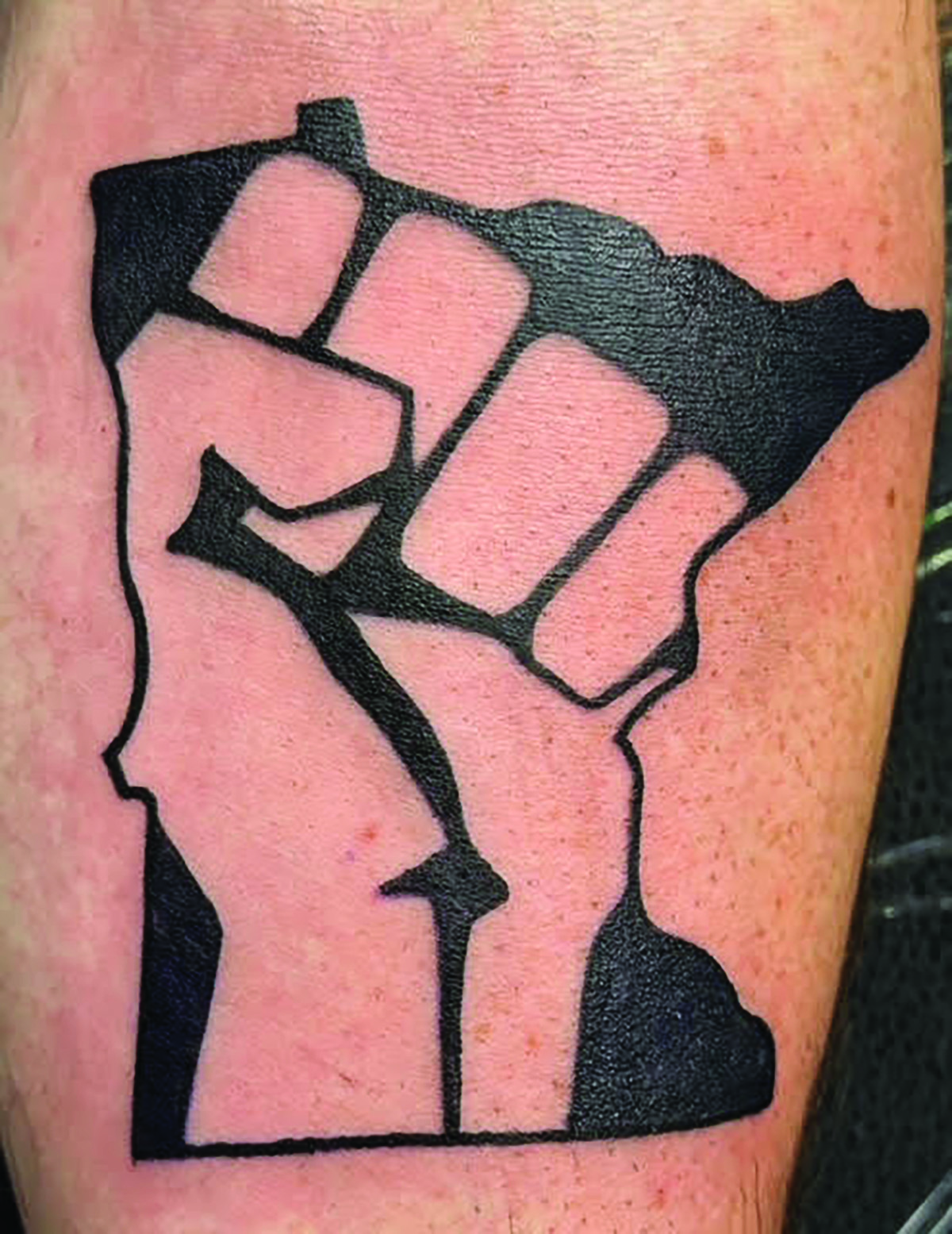
Some people chose to put protest art permanently on their bodies. Tattoo artist Max Endorf, a graduate of Perpich Center for Arts Education, Minnesota’s state arts high school, moved to Savannah, Georgia, to pursue his career.
Endorf said it has been difficult to be away from his home state during this period of unrest. He recently worked with a client who was also from Minnesota, and they shared what he described as a “weird, shared experience” of trying to reconcile news accounts with the city of neighborly love they knew.
The client initially wanted a tattoo with words expressing his emotions. Endorf, recognizing that iconography can communicate more quickly than text, designed an image of a fist symbolizing resistance and solidarity, barely contained within the outline of Minnesota. The client now bears a forearm tattoo that conveys a powerful message at a glance. Endorf is relatively new to protest art but said he appreciates creating political tattoos that evoke a strong message. He is receiving more requests, as are other tattoo artists, particularly for an image inspired by the “Star Wars” Rebel Alliance symbol in which the center spire is replaced with the Minnesota loon.