

Dear Emma Pachuta (Park Board) and Members of the Citizens Advisory Committee (CAC) for the Cedar-Isles Master Plan
By Kate Christianson
Thank you for creating a Circulation Subcommittee with a gracious, even-tempered leader and offering to host up to two additional public meetings via Zoom, so that a range of perspectives— emotionally charged at the last CAC meeting— could be carefully heard.
In many ways, it seems that the community came together last night during the first meeting, and we have much to be grateful for.
The Zoom format allowed public comments to be shared “in the moment,” while CAC memers followed a timed agenda and civilly discussed proposed recommendations, one by one. Professionals from the Park Board and the consultant team were on hand to address practical issues; fresh documents had been prepared; and, perhaps most importantly, the lens of the Circulation conversation expanded (from current wants at odds with each other) to include possibilities for the next generation of Minneapolitans to address. This kept us humble and connected.
Clearly, much structural work was done in advance, to pull facts together and incorporate our history of civic leadership in and around the Chain of Lakes.
I appreciate your efforts and will remember you, among many other things, for the attentive and transformative work you did last night.
Kate Christianson lives in Kenwood.
We adamantly oppose a two-way bike path around Lake of the Isles for these reasons
By Sandra Nelson & Larry Lamb
- Lake of the Isles (LOI), Bde Maka Ska, Harriet and Nakomis all have one-way paths. One of us, Larry,CC is an avid year-round cyclist; he and his fellow cyclists are accustomed to the uniformity and predictability of the current path structure around the lakes. The cycling distance around these lakes ranges from 2.76 miles (LOI) to 3.19 miles (Bde Maka Ska). It is hard to believe that any cyclist would be inconvenienced — in any way — by these short distances. As was noted in the meeting, city lake biking paths are designed and used for recreation, not commuting.
- The current LOI bike path is already dangerous in winter because it is shared with walkers due to the unplowed walking path. A two-way bike path would significantly increase accident risk. Larry witnessed numerous near-accidents this past winter.
- As CAC member Aaron Shaffer described, his proposal would require narrowing the parkway to accommodate the buildout for a two-way bike lane. That would require relocating 75 classic light fixtures, all of the lakeside curb signage and removing several trees next to the current cycling path. When one adds repaving the entire parkway and two way bike path, rerouting electrical and drainage infrastructure, we must be looking at a multi-million dollar expenditure, not to mention the disruption to the neighborhood during a massive and lengthy reconstruction project.
- We cannot imagine what could possibly justify a project of this scope and expense. The desire of some people who simply “want it,” or for whom “my bike is my religion” as one person defiantly declared at the July 28 CAC meeting, is not defensible or persuasive, in our judgment.
- In our view, people who advocate for bikes at any cost do not represent the diversity of residents in our neighborhood. The Hennepin Avenue Redevelopment Plan is/ was a prime example of biking fanaticism at the expense of neighborhood residents who are elderly, disabled, fear for their safety, lack confidence, have dyspraxia or other medical conditions that make cycling impractical or impossible. Inclement weather and Minnesota winters are a cycling deterrent for many people.
In lieu of a two-way LOI cycling path, we recommend the following:
- Install improved and prominent directional signage on the walking and biking paths. On the east side of LOI this week, I met a high-speed cyclist on the walking path. In my 30+ years in the neighborhood, I have encountered countless rollerbladers and skateboarders on the walking path; when I point out the bike path, they always respond, often swearing, that it is for bikes. At frequent intervals, we suggest painting “WALKERS ONLY” on the walking path. Ditto on the biking path: “BIKES, BLADES & BOARDS ONLY” or similar instruction.
- Allocate MPRB funds to plow city lake walking paths in winter in order to preserve a dedicated path for pedestrians and improve safety.
- Allocate MPRB funds to increase maintenance of existing bike paths. The recent bike path resurfacing on the east side of LOI was along overdue.
The CAC committee and MPRB have listened and responded to feedback and input from stakeholder neighborhoods. We are grateful for your diligence and your recommendations to date.
Many thanks for your leadership on behalf of our neighborhood,
Sandy Nelson and Larry Lamb live in East Isles.
As with most opinions, there is usually more than one side to the story and this is certainly true in relation to Martin A. Carlson’s latest submission to Hill & Lake Press: “Cedar-Isles Master Plan: Vast Improvement.”.
By Jake Warner
This new latest plan, labeled the “Preferred Concept” is a great plan for the well placed nearby residents who want to keep Cedar Lake a “hidden gem” and “secluded.” It’s as if they want this regional lake for themselves.
But it is a horrible plan for the general public and especially for the underrepresented segments of the population such as our elderly, mobility challenged, and ADA populace. Also this “soft touch” plan doesn’t work well for our diverse communities that are wary of hidden, secluded parks and are more comfortable having people around. The “Preferred Concept” discarded some very practical improvements to long-standing problems with the Cedar-Isles regional parks that were addressed in the trashed “Unique Lake Experiences Plan.” The baby was thrown out with the bathwater.
Regional park master plans involve a broader perspective than neighborhood parks. They draw park users from beyond the neighborhoods. The planning process is administered by the park board and funded by the Met Council—including implementing plan designs.
Inclusion and equity are bulwarks of regional park master plans, ideals endorsed by both the Minneapolis Park & Recreation Board and the Met Council. If equity and inclusion are existing problems with regional parks, steps must be taken to try and correct the conditions that foster these situations.
From the very onset of this master plan, access and circulation were defined as problems to be addressed, especially at Cedar Lake. The most egregious equity and inclusion problems entailed ADA, elderly, and mobility-challenged communities that are now, and with the “soft touch” Preferred Concept Plan, will continue to be, excluded from large portions of Cedar Lake, especially the “nature park” area, the Kenilworth Channel, and the SE lake shore, which is off-limits to all of the public save for the few homeowners along here who have had exclusive access to the park land for 80 years!
These areas would all be served by the hard paths that were incorporated into the “Unique Lake Experience Plan.” In the Preferred Concept Plan the conducive access paths were replaced with “soft surface” woodchip paths that restrict access to those needing hard surfaced paths.
There is an element of mean- spiritedness to this position of no hard paths. And for what reasons? Beyond improving access for a greater variety of visitors, including the underserved, would one hard path through the “wild & natural” zone detract from, or change in any way the aura of the area? My opinion is that it would bring a wider population through the area and this would make it a better park. It may surprise a lot of people, but secluded, isolated, heavily vegetated areas, with poor sight lines are threatening areas for many people and are therefore avoided! These features are not attributes of successful parks—in fact, these parks can become disseminates. There is a reason why the Kenwood Neighborhood Association still pays for extra police presence since 1995, at East Cedar Beach.
Adding a pedestrian footbridge (similar to the 19 footbridges that cross Minnehaha Creek corridor) at Kenilworth Channel and Cedar Lake would enable a loop trail around Cedar Lake. No longer would pedestrians have to negotiate Burnham Road’s two-way vehicle traffic with no public side walk to reconnect to Cedar Lake. It is an uncomfortable and dangerous route.
Finally, the dangerous confluence of bikers and pedestrians at the northwest corner of Cedar Lake needs a remedy. Increased bike traffic coming from the trailhead at Theodore Wirth has heightened the problem. The “Preferred Concept Plan” eliminated the proposed boardwalk for pedestrians along this corridor. In a 1997 “Chain of Lakes Renovation” plan, a boardwalk along this stretch was also proposed and turned down. The boardwalk solution gets introduced because it is the most viable and aesthetic solution to an area that must be addressed!
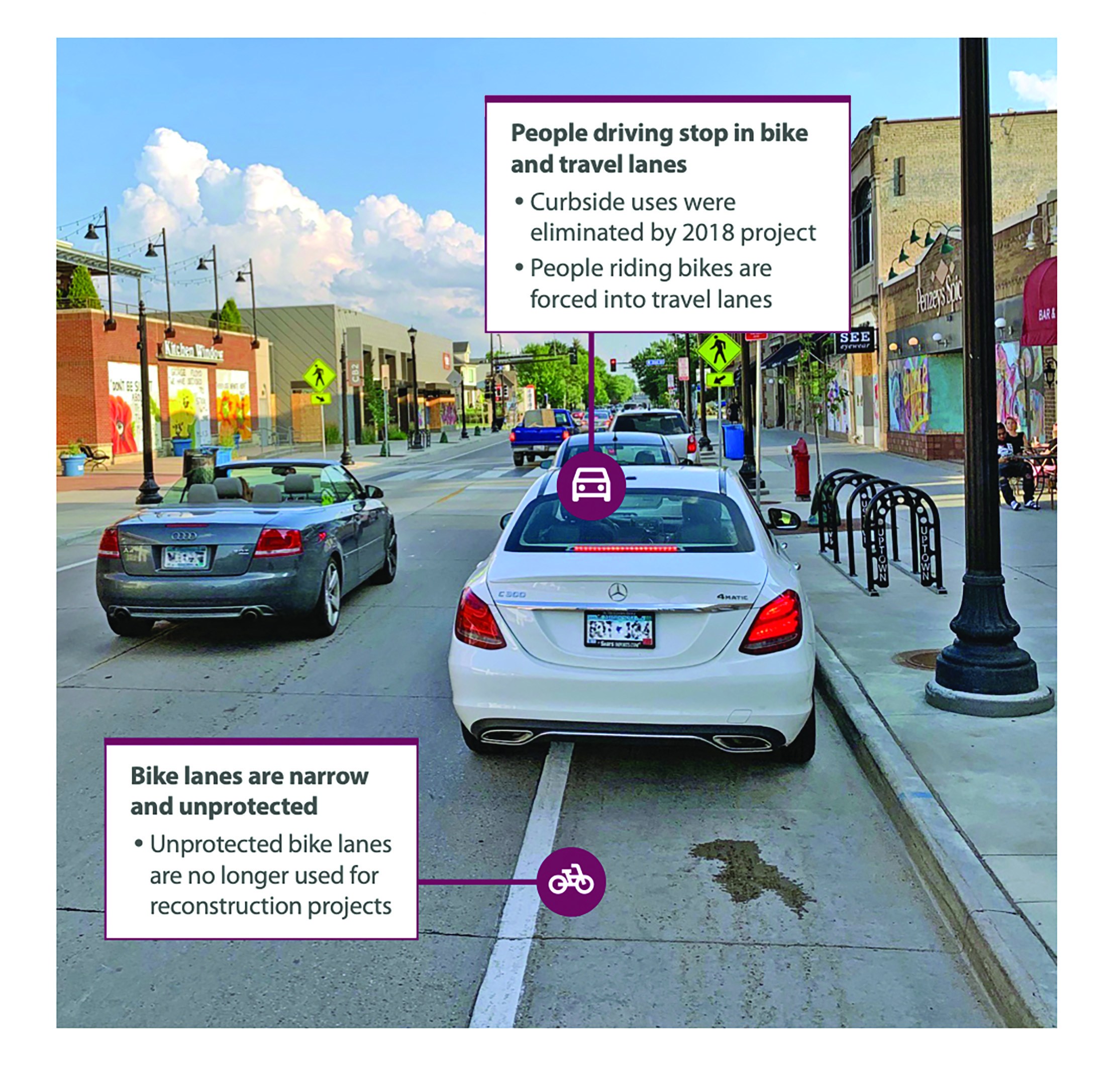
As for two-way biking around Lake of the Isles—we must support infrastructure that enables alternate transportation modes. The busiest bike trail in Minneapolis is the Midtown Greenway, which safely supports two-way biking, in addition to a pedestrian lane. Lake of the Isles also needs a public gathering spot—a commons area—to meet, to sit, to interact, to just people watch.
Jake Warner is a 31-year resident of the “west side” of Cedar Lake.
Celebrate Black Label Movement in September
By Ana Morel
I want to make you aware of a special event happening September 23-25 at the Cowles Center for Dance. Long-time Kenwood resident, Director of the UMN Dance Program, and Artistic Director of Black Label Movement–one of Minnesota’s leading dance companies–Carl Flink is celebrating the company’s return to live performance! The company is premiering Carl’s technicolor evening length work Canary, Crimson then Emerald that explores the energies surging right before (Canary) and during the COVID Winter (Crimson), then ends with the joyful celebration of touch (Emerald), which we all so desperately need right now!
Carl’s work is smart, daring, and athletically physical. The premiere includes original sound by Twin Cities composers Queen Drea and Greg Brosof ke. The diverse company is itself beautiful and a delight to experience. These are some of the area’s finest dance artists from many different movement backgrounds: Breaking, Athletics, Contemporary, etc., and includes Cheng Xiong, who just received a 2022 McKnight Dancer Fellowship.
Tickets for the event are pay-as-able, starting as low as $10, fee included, for all three performances. To celebrate the company’s return to the stage, audience members can also take part in a unique opening night event on Friday, September 23 called Bites with Black Label. This event features the culinary magic of James Beard Award recipient Chef Gavin Kaysen. Chef Gavin and his award-winning bar team from Spoon & Stable will present an array of bites and a designer cocktail (mocktail available) inspired by the premiere’s concept and rich colors.
For details visit: thecowlescenter.org and find the Black Label Movement ticket pages on the event calendar. Recommended ages are 12 and up, although younger children may also enjoy the exhilarating, highflying movement!
Come celebrate live performance and powerful art created by one of our neighbors!
Where: Cowles Center for Dance
When: Sept. 23 and 24 @
7:30 pm , Sept. 25 @ 2:00 pm (Length: 65 minutes)
Tickets & Info: thecowlescenter.org
Thank you!
By Ross Rezac
I am so impressed with your paper. All the stories were so spot-on in the July issue. Thank you for great reading.
Ross Rezac lives in Bryn Mawr.