
John Larsen is a community volunteer. He lives in Kenwood.
We said yes.
On Jan. 29, just days after Alex Pretti’s murder and 17 days after Renee Good’s voice was silenced, Hill & Lake Press editor Craig Wilson texted to ask whether we would host a re-created snow sculpture that had been censored elsewhere for being “too political,” referencing ICE OUT.
Our answer was immediate. Yes. We would be honored.
Like so many neighbors, we had been looking for a way to do more. Across Minneapolis, people were delivering food to families afraid to leave their homes. Fundraisers were lifting up immigrant-owned businesses hit hard by ICE’s presence.
Neighbors stood watch near schools and alerted teachers and families when armed men in masks appeared. Many gathered in protest and vigil. Our community was showing up, yet many of us still felt powerless. Hosting art on our own land felt like a way to reclaim some agency.
Poet and neighbor Heid Erdrich shared her vision.
Artists would re-create the sculpture on private property, safe from official demolition, and we would hold a candlelight vigil with local poets. My husband, Mike Stewart, and I were all in. A flyer announced a 6 p.m. vigil the following Saturday, timed to coincide with the Luminary Loppet in hopes of a symbiotic relationship.
The next day two teams of artists arrived: Beez in the Schneez, led by Heather Friedli, and Dusty Thune of House of Thune. We chose a highly visible site and, ultimately, created two sculptures. One was a mash-up of the destroyed competition pieces.
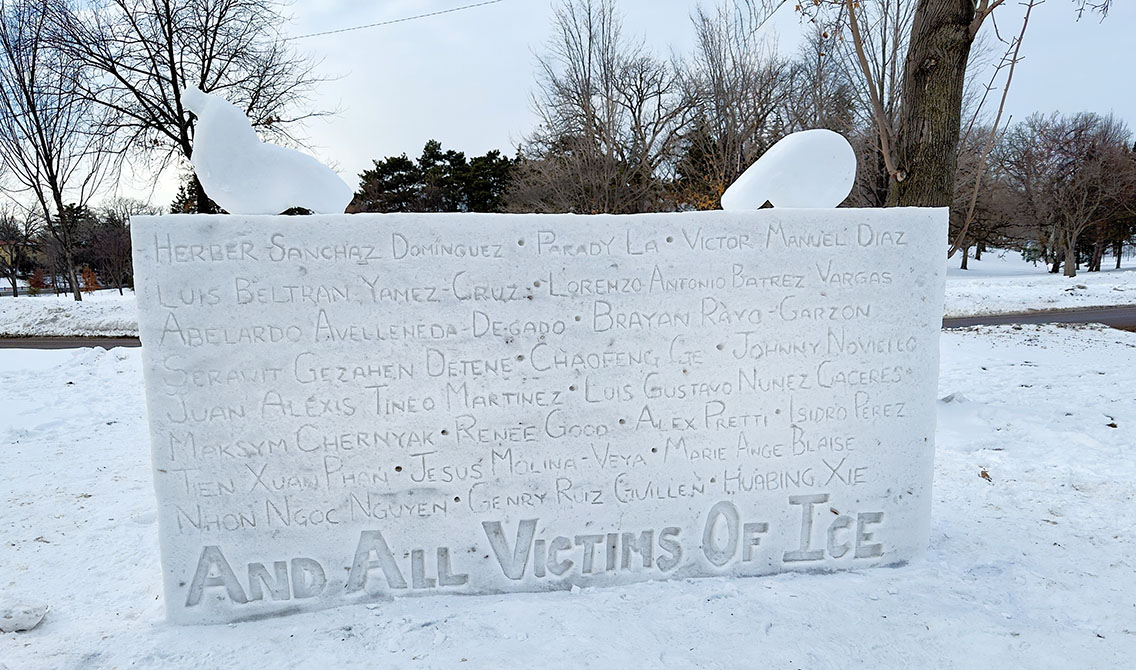
The second sculpture was a memorial wall to honor all victims of ICE. Friedli, who conceived the memorial, said “While the full list includes hundreds of names, I could only include a few from this past year and felt it important to emphasize BIPOC community victims.”
Snow was packed into large rectangular forms and the artists began to carve them into shape.
For a week, the artists worked in bitter cold.
We kept a fire going as neighbors stopped by, sharing stories of fear, resolve and solidarity. Thune later said, “It was really emotional having all the people stopping and talking, sharing their stories of what’s been going on in the community and how it has impacted them. It felt like a larger community all looking to put their best talents to use to speak out.”
Each morning we were relieved to see the sculptures untouched. As interest grew, we created a Linktree page and installed a custom sign, designed by artist Tristan Thiel, so visitors could learn about the vigil.
Warm weather arrived just before the event. The primary sculpture was wrapped in foil blankets to preserve it, while the memorial was left uncovered so visitors could read the names inscribed there.
In Many Languages, One Message
We planned a program that included silence, artists’ reflections, a reading of Renee Good’s poetry, and poems by local writers including Erdrich. We added songs and luminaria.
In Kenwood Park across the street, volunteers arranged 240 luminaria bags to spell ICE OUT 4 GOOD. Many brought their own candles, and despite the wind, the words glowed across the field.
We also spoke the name of the sculpture in as many languages as possible. The vigil opened in Dakota and Anishinaabe, with call and response from the crowd. Community members spoke in Spanish, Hebrew, Arabic and several Eastern European languages.
A Somali friend, fearful of attending in person, taught us how to say the phrase in Somali. We were reminded that some languages remained unspoken that night out of respect for those who felt unsafe to gather.
About 500 neighbors attended. Coverage followed from MPR and The New York Times, among others.
A Community Bound by Light and Love
Thune reflected, “It was powerful in that Renee Good’s voice was silent yet her message kept speaking on, maybe louder than ever. Putting that sculpture there in Minneapolis was meaningful for me coming from St. Paul. There’s always been rivalry, but we’re all in it together now. Creating the sculpture felt like I was able to offer some peace, unity and love to our cities.”
We are deeply grateful to everyone who came and to those who made the vigil possible: Heid Erdrich, Heather Friedli, Dusty Thune, Tristan Thiel, Thomas Reprographics, Mary Flood and most of all my husband, Mike, who watched over the sculptures and kept artists and neighbors warm and fed.
We hope each act, however small, brings us closer to decency, kindness, rule of law and respect for constitutional rights. The vigil helped us. It reminded us what community looks like. And it made us proud of Kenwood, the Twin Cities and Minnesota.
(Images: Courtney Cushing Kiernat)