

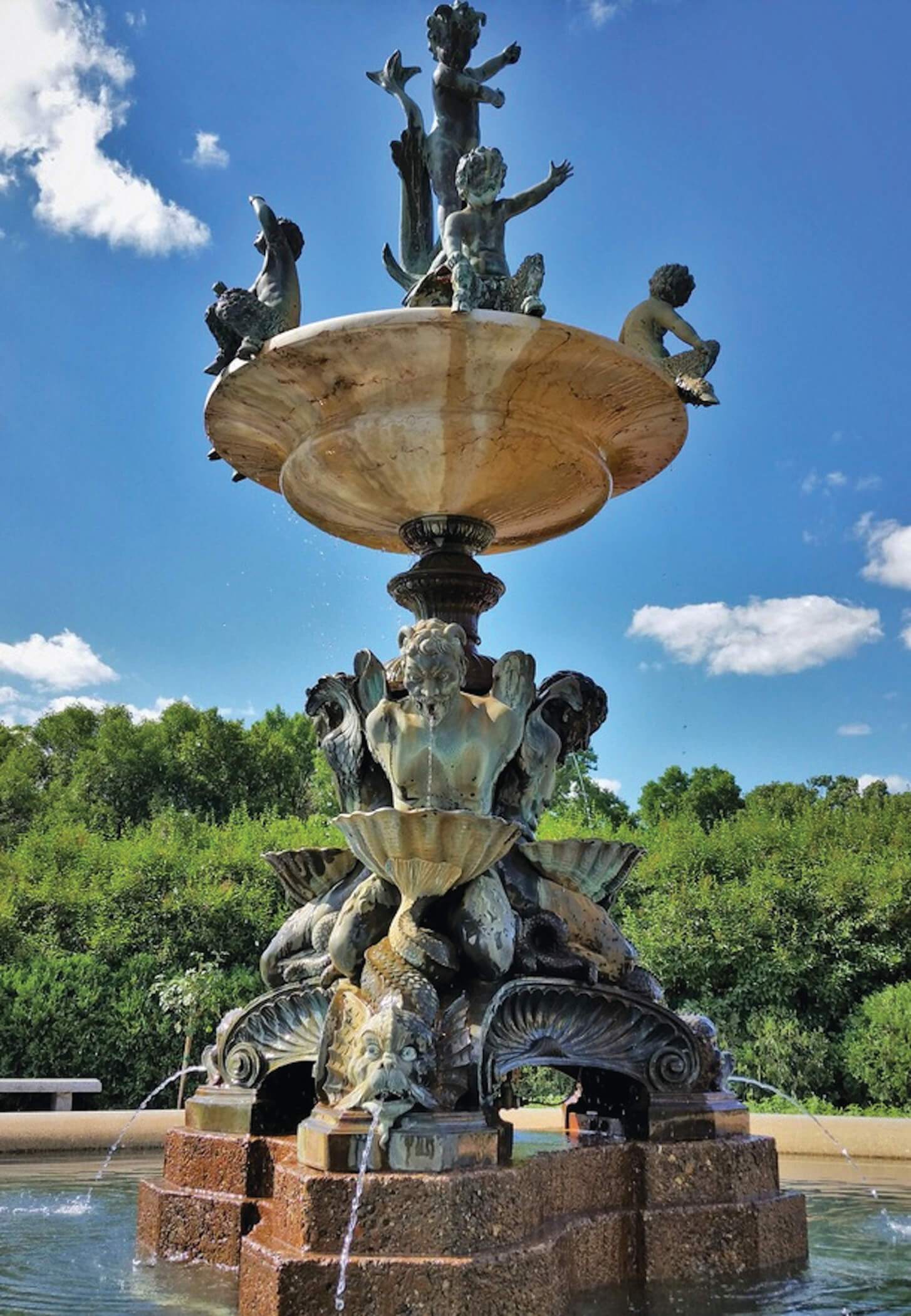
In the southeast corner of Minneapolis’ Lyndale Park on the northeast side of Lake Harriet, adjacent to the second oldest rose garden in the United States, stands the Frank Totton Heffelfinger Fountain, a work beloved by many Minneapolitans and often featured in wedding and graduation photographs.
“Repeatedly identified as the oldest fountain in the Twin Cities and as a work of the Italian Renaissance, it is, in fact, neither.”
The 11 1/2-foot-tall fountain was acquired by Heffelfinger in the 1920s from a villa near Florence, Italy, donated to the Minneapolis Park and Recreation Board in 1944, and finally erected and dedicated in 1947.
Repeatedly identified as the oldest fountain in the Twin Cities and as a work of the Italian Renaissance, it is, in fact, neither.
Its true origins, in the early 20th century, tell a fascinating story about the vogue for fountains and for collecting Renaissance objects among America’s monied class.
A collector goes shopping in Florence
Born in Minneapolis, Frank Totton Heffelfinger (1869-1959) made his fortune working at his father-in-law’s firm, F. H. Peavey & Co., a grain elevator business.
A collector, philanthropist and world traveler, Mr. Heffelfinger went in search of a fountain on a trip to Italy in 1924, and discovered one on the grounds of a Renaissance villa about three miles northeast of Florence.
Called Villa Montalto by the Prussian nobleman Friedrich Maximilian von Pless Graf von Hochberg, who owned the estate from 1895 to 1904, the property featured a simple marble Renaissance fountain with a water-spouting dolphin.
But sometime between 1918 and 1924, Lady Mexborough, born Anne Belcher, who inherited the villa from her husband, John Horace Saville, replaced it with a much grander fountain, the bronze and marble work that caught Mr. Heffelfinger’s fancy and which he purchased for his Wayzata home when the villa was being sold in 1924.
Why It Doesn’t Look Renaissance
While generically resembling Renaissance fountains, it lacks the unity and balance of works from the period. It is top-heavy, and its upper half, the section above the heads of the winged hybrid creatures, is not integral to the lower section.
The color and thickness of the bronze also differ between the upper and lower parts, and the shape and design of the central shaft that supports the marble basin and the standing faun above it are distinctly unlike those found on fountains of the Renaissance.
“What remains unanswered is whether Frank Heffelfinger thought he was buying a genuine Renaissance fountain or just a work that looked like one.”
Additionally, the style and conception of the central standing faun, the fauns on the basin’s edge and the tripartite pedestal smack of the early 20th century.
Lastly, the iconography of the fountain is a mishmash, an odd combination of marine and rustic elements.
The Twin That Surfaced in Paris
What definitively proves that the fountain is not a unique work of the Renaissance, and is instead a product of the early 20th century, is the existence of another fountain dating to about 1915-20, which was sold in 2023 by a Parisian gallery specializing in architectural and garden pieces.
A comparison of the two reveals that their lower halves are exactly the same in their sculptural elements and size, while their upper halves differ in their design.
That we have two fountains with identical lower halves and distinct upper halves points to the fact that in the early 20th century one could custom order such a work, selecting the type and color of the marble basin and the design of the upper and lower parts.
Both fountains, in other words, are pastiches, and although I have yet to discover who was responsible for designing the Heffelfinger Fountain or its French counterpart, both were likely produced by one of the artistic foundries in Florence, or perhaps Naples or Rome, which specialized in period-style works of art.
Not the Oldest, but the Most Unusual
The oft-repeated claims that the Heffelfinger Fountain is the Twin Cities’ oldest fountain and a work of the Italian Renaissance can now be put to rest.
It is, in fact, younger than at least 13 other fountains that were erected in Minneapolis and St. Paul in the 1870s, ’80s and ’90s, among them the Peavey Fountain at the intersection of Kenwood Parkway and Lake of the Isles Parkway, erected in 1892, and the Schiffman Fountain in Como Park, erected in 1897.
All the same, it is arguably the most unusual and imposing piece of garden sculpture in the Twin Cities, and ever since it was first erected in Lyndale Park it has convinced most viewers that it was a product of the Italian Renaissance.
What remains unanswered, however, is whether Frank Heffelfinger thought he was buying a genuine Renaissance fountain or just a work that looked like one.
Steven F. Ostrow is professor emeritus of art history at the University of Minnesota. He lives in Loring Park.