
The prior article I wrote for Hill and Lake Press was a light adaptation of a letter written to the Park Board during the public comment period following the release of its two “initial park concepts” earlier in the year. I wrote it to express my personal views and concerns, and—having been written in some haste—it was submitted before I had an opportunity to speak in any depth with other members of the community. Regardless, the letter seems to have tapped a vein of concern for many in the neighborhood. Since then, I have had the chance to email and speak with a wide range of community members, as well as host an informal neighborhood gathering at the home of some generous church friends, which was attended by about fifty neighbors, as well as the Emma Pachuta, the Park Board’s project manager.
With that in mind, I can report with confidence there is a high degree of community consensus regarding many of the issues raised by the master planning process. There is overwhelming support for protecting/improving water quality, preserving unstructured green/natural areas, and respecting the history of the park and surrounding neighborhoods. Opposition to permanent structures is equally overwhelming. All of these preferences are reflected in actual data. Earlier this month, the Park Board released the public comment “raw data” related to this project, which consists primarily of emails and citizen letters. I’ve taken the time to review them all and—along with the fact that you’re all very thoughtful and articulate(!)—the community preferences are quite clear, especially after I made an effort to tally the numbers. I don’t claim absolute perfection here, but I did my level best to count fairly, and the overall trends are unmistakable:
Water Quality and Natural Habitat: Overwhelmingly popular. 30 people specifically wrote in favor of improving water quality. No one was opposed (a shock, I know…). Wild/green space was also hugely popular. 20 people wrote in favor of preserving the lakes’ wild/natural character, while 15 wrote in favor of preserving existing green space. 7 wrote in favor of increased tree cover. Another 7 mentioned preserving the overall ecosystem.
Structures: Permanent structures are overwhelmingly unpopular. 41 people wrote in opposition to permanent structures, with 16 expressing concern about the unfunded maintenance they would require and the Park Board’s shaky track record on this point. Support was much more limited. Three people supported boardwalks in some form, while 11 wrote in opposition. Three people wrote in support of a permanent warming house on Lake of the Isles. Two wrote in support of permanent restrooms, with another 2 people specifically opposed. One person supported “lake decks,” with another 3 opposed.
I didn’t bother with tallying opposition to permanent road closures along Isles Parkway since this seems to be off the menu, but this was also overwhelmingly unpopular.
Finally, the phrases “solutions in search of problems” and “it ain’t broke, don’t fix it” were invoked by a number of other writers besides me.
So where do opinions diverge? I’ll flag two: one or two-way bike trails around Lake of the Isles and a proposed trail along the north side of the Kenilworth Channel.
The Lake of the Isles Bike Trail: My first reaction to the one-way/two-way debate was to immediately throw support to the two-way option. Seemed obvious. My wife and I live just off the west bay of Lake of the Isles, and if we want to reach the Midtown Greenway without riding on the parkway, we need to ride roughly two miles around the lake to reach a destination that is less than a mile from our home. I have since changed my tune, and am (at present) cautiously supporting keeping the trail one-way. Why? Making the trail two-way and off the parkway would require it to be widened. Sadly, this would require removal of many of the mature trees remaining in the park because they stand immediately next to the existing trail. There is at least one community-driven proposal to take space from the parkway drive lane to add a protected bike path going counter-clockwise around the lake. I do think this is worth exploring in more detail, but I worry that narrowing the parkway would diminish its historic character and eliminate much of the lakeside parking that is so important for our many non-resident park users. Again, we all understand that cars are bad on many levels, but despite the obvious passion of transit/bike/walking supporters, I have yet to see an option that’s realistically going to make most of us give up driving. The current configuration isn’t perfect, but it’s good enough.
Kenilworth Trail: For those of you who haven’t taken a walk down Burnham Road recently, I encourage you to do so. Looking from the channel bridge towards Cedar Lake, the landscape has been radically altered, apparently due to light rail construction and/or removal of the wooden retaining walls along the channel. Trees and undergrowth have been substantially removed, the earth is torn up (especially at the mouth of Cedar Lake), and there is now a clear path apparently created by the dewatering pipe along the north side of the channel. Previously there was nothing but woods and lawns and possibly a lightly-used game trail or path, so this begs the question should the new, larger path be permanent? Reasonable minds can and will differ on this point and it is public land, but I am leaning toward the “no trail” position. Part of what makes most wild areas special is their relative seclusion. The channel is a beautiful pocket of quiet in a busy city – a totally unique water trail – and I worry that by adding a pathway on the land it will become just another busy urban connection, destroying what made it special. Best keep it a water trail.
And the Duh! Award goes to… Bridges! Full credit to CAC chair Win Rockwell for this obvious but overlooked point. Few features of Lake of the Isles are more emblematic than the two historic channel bridges. They’ve served us with honor and distinction for over 110 years, but they need some TLC. The retaining walls are cracking and crumbling at some points, some of the rail spindles are eroding, and they’ve suffered other damage and defacement over the years. Time to love them back. If permanent structures are still on the menu, these are the most obvious candidates, being mindful we’re talking restoration, not replacement (except for the possible addition of an actual plank to the Kenilworth bridge for our summertime pirates constantly jumping off into the channel…).
So, what comes next? We are moving into the so-called “preferred park concept” stage, where the Park Board staff will release a unified proposed plan that takes all these preferences and concerns into account. After it is released in early June, there is a 45-day public comment window. Given the great weight of public opinion, I hope the new concept will focus heavily on water quality and protecting and preserving green space and natural areas, but in a way that respects the historical use of the parks and the history of the surrounding neighborhoods. If the new concept fairly responds to these public concerns, then I hope as a group we can put our weight behind it and urge its adoption. If not, or more mixed, then we can raise our voices again during the comment period. Personally, I’d much prefer to work with the Park Board than against it, and I hope that’s possible, but either way it’s important we stay informed and connected.
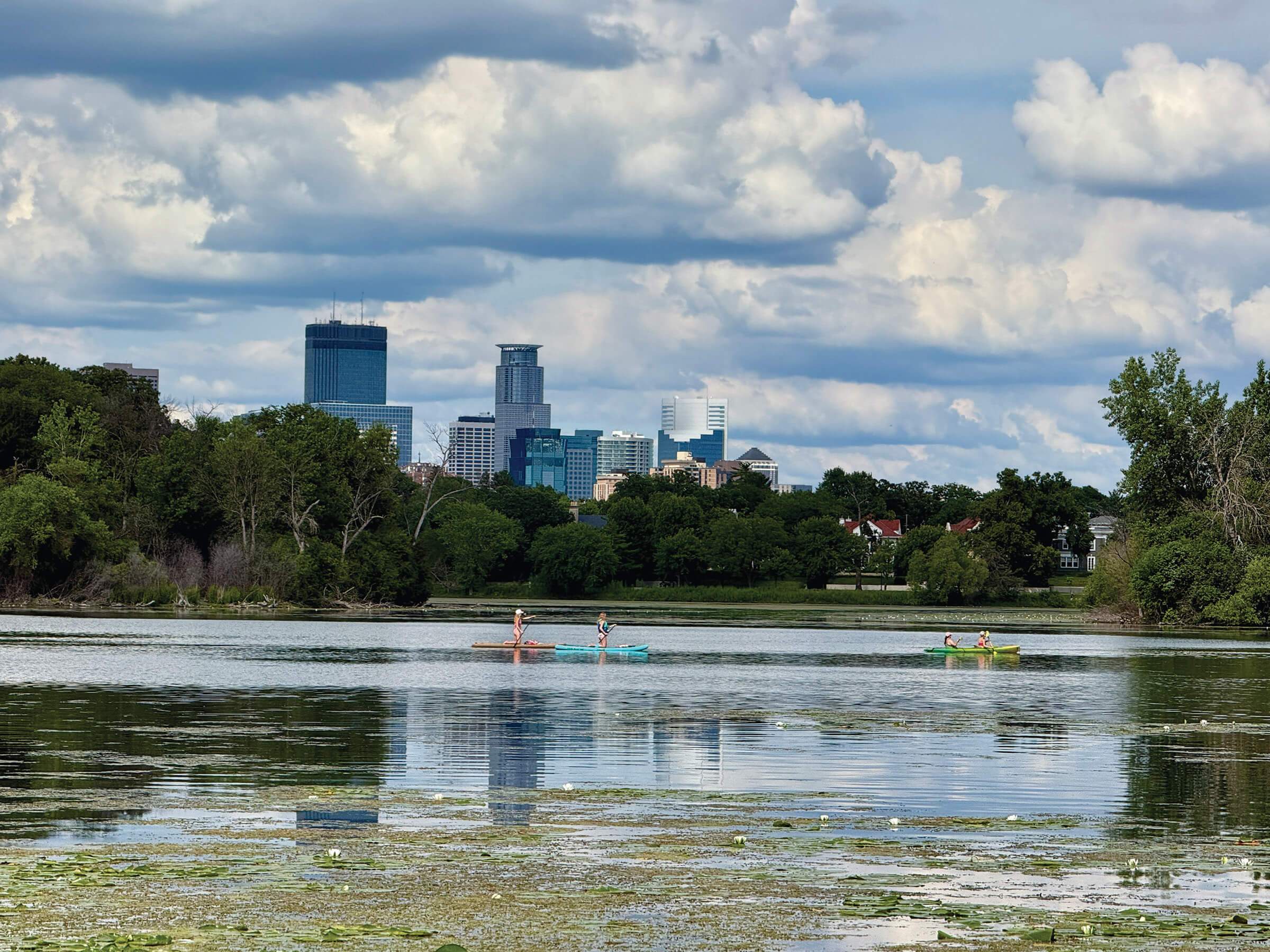
In the meantime, I hope creative restraint is the order of the day at the Board. It often feels like everyone in the landscape/urban design world wants to make a bold statement and build the next Highline in NYC. The difference here is the Highline was a liability— true urban blight—that the designers brilliantly turned into an asset. Lake of the Isles and Cedar Lake are already beloved assets, and I’m concerned that familiarity may be breeding contempt. The city has been exceptionally well-served by these two distinct parks for over 100 years, and their unique characters and open, unstructured, democratic natures have successfully accommodated new uses throughout that time. If you told Theodore Wirth that these parks would be popular for “hammocking” and “paddle boarding,” he’d look at you with bemused concern or outright alarm, yet popular they are. I have no idea what the next “-ing” craze is going to be (see “rollerblading”), but I do know two things: (1) whatever it is, our open unstructured parks will accommodate it, and (2) we will all laugh at it while quietly wishing we were young again. While we wait, I hope the Park Board will adopt as its overarching design principle an architectural phrase first made popular at the very end of Wirth’s life: Less is more.