
Several years ago, our friend Brad gave my wife and me a gift subscription to The Atlantic. I don’t always read it as closely as I should, but when I do, I typically find the articles thoughtful and provocative. One of the most recent issues featured a cover story on the life and legacy of the late Joan Didion.
While I didn’t like the actual article that much, it still piqued my interest to the point that I ordered copies of two of Didion’s essay collections, Slouching Towards Bethlehem and The White Album, which I now understand to be famous for their vivid portraiture and candid assessments of life in America in the 1960s and 70s.
For better or worse (worse, according to my wife), my reading taste frequently veers towards lowbrow escapism—car chases, explosions, and one-syllable action heroes. So Didion’s writing nearly gave me a case of sensory overload: colorful and evocative descriptions, cleareyed and incisive analyses that brought to life an era I remember mostly as disconnected images due to my young age at the time.
I was also struck by the numerous parallels between the issues of Didion’s time and our own: social and political upheaval related to women’s rights and abortion, rage against seemingly intractable racial injustice, a proxy war with Russia, and a serious presidential scandal – although I have to say January 6th is starting to make Watergate look like A Bargain for Frances (which, if you haven’t read it, features talking badgers and conflict over a toy China tea set). Everything old is new again. And Didion herself, with her conservative instincts but exotic milieu, found herself sandwiched between what she saw as the banality of Reagan-era conservatism and the strident dogmatism of young activists, a dissonant reality for many of us today.
One of Didion’s essays struck me as particularly relevant to our small corner of the world, and to the proposed Hennepin Avenue redesign in particular: a short 1976 piece entitled “Bureaucrats.” In it, she describes a visit to the California Department of Transportation (or “Caltrans”) to discuss the addition of a so-called “Diamond Lane”—what we now call an HOV lane—to the Santa Monica freeway. The effect was, of course, to further snarl already bad traffic and enrage local residents.
As Didion noted, “in practice this meant that 25 percent of the freeway was reserved for three per cent of the cars, and there were other wrinkles here and there suggesting that Caltrans had dedicated itself to making all movement around Los Angeles as arduous as possible.” As a Caltrans director perhaps unwisely admitted, “We are beginning a process of deliberately making it harder for drivers to use freeways.” Didion continues: “ of course this political decision was in the name of the greater good, was in the interests of ‘environmental improvement’ and ‘conservation of resources,’ but even there the figures had about them a certain Caltrans opacity,” which she later characterized as “reminiscent only of old communiques out of Vietnam.”
This essay jumped back to mind roughly a week later when I read Erik Storlie’s lead article for the June issue of Hill & Lake Press, in which he summarized the scope of the proposed Hennepin Avenue redesign: car traffic confined and congested in single lanes, dedicated two-way bike lanes, 24/7 exclusive bus lanes, and the elimination of 92% of on-street parking.
Although accompanied by “a certain Caltrans opacity” on the part of our city planners, the motive for reducing traffic lanes by 50% seems fairly straightforward: a bureaucratically centralized, top down push to make driving more difficult so residents will finally embrace public transportation and wintertime biking, despite age, physical fitness, disability, seasonal challenges, etc. The environment will benefit, resources will be conserved; everything old is new again.
The parking elimination is more sinister, because it carries with it a very real threat to our local small businesses. If customers can’t easily park, these businesses are not likely to survive. And as Storlie recounts, “City planners have insisted there is an abundance of off-street parking, while failing to acknowledge that the bulk of it is for private use only.” Talk about an argument reminiscent only of old communiques out of Vietnam.
I was thinking about the parking issue when, at the request of a friend, I drafted a short email to Seventh Ward Councilmember Lisa Goodman on the 24/7 bus lane debate (to which I received a prompt and satisfying reply). It seemed obvious that many—if not most—of these businesses will fail under this plan. Why would anyone want this? That led me to remember one of the primary rules for dealing with bureaucrats: Don’t pay attention to what they say, pay attention to what they do.
Applying that rule to the Hennepin redesign, the obvious answer seemed to be that the City actually wants these businesses gone. Why? The only answer I could come up with for why shuttered businesses would be desirable was so they could be torn down. And, given our current political climate, the obvious replacement would be new, large, high-density housing. So I was not surprised when Storlie reported at the end of his article that city insiders privately admit this is precisely their goal.
If true—which I suspect it is— that’s dirty pool, and we ought to be upset. Not because new, large, high-density housing is necessarily wrong— the rationale is not hard to articulate— but because we are being deprived of the chance to have a fair debate on the subject, instead having this major decision settled in secret and foisted on us in secret, largely by unelected bureaucrats.
The arguments for this proposed change seem predictable: equity, affordable housing tied to transit that residents will willingly embrace, environmental benefits. For my part, I’m not questioning the sincerity of these arguments, but I do question the likelihood those goals will actually be achieved. The “improved” stretch of Hennepin between 31st and 36th already resembles a concrete dead zone. As for the notion that intentionally creating congestion will divert people to public transit, we have a news flash from 1976: Diamond lanes didn’t work.
Last I checked, L.A. residents did not embrace public transit, and their traffic congestion has been horrible for 50 years. Our own metro diamond lanes are newer, but they haven’t fared any better. My guess is that Hennepin traffic simply diverts to side streets or other arteries, causing further congestion and disrupting residents’ quiet enjoyment of their homes. As for the notion this speculative new housing will be affordable, that simply doesn’t seem to be the trend anywhere in the city.
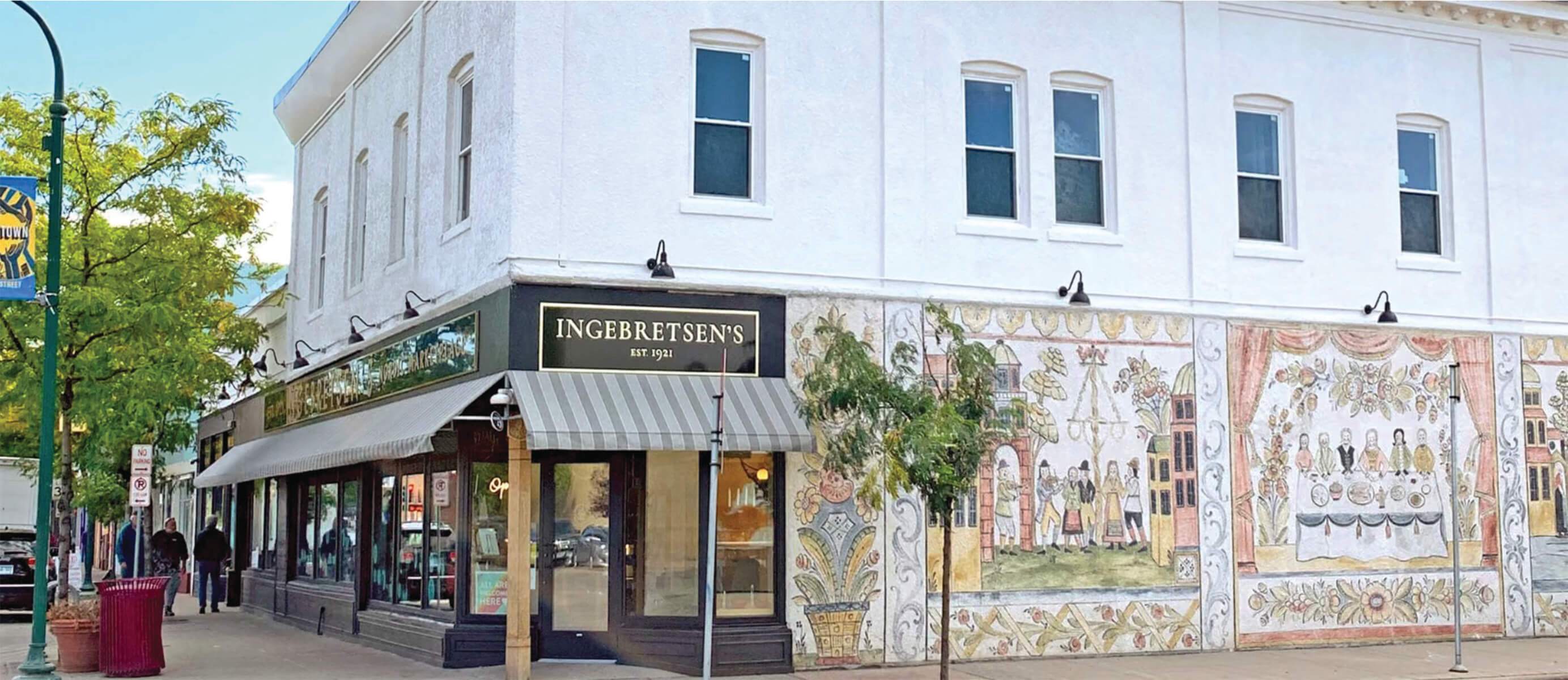
There’s also the question of the cost, not just in dollars, but to the fabric of our neighborhood. Many Hennepin small businesses are long-standing, beloved and necessary for residents. Some are minority-owned. This proposed plan would obliterate a large swath of an historic commercial corridor, all in the name of largescale “expert” social engineering.
Make no mistake: These are the same bright-eyed forces of urban renewal that tore down the Metropolitan Building, leveled the Gateway District, and destroyed vast swaths of downtown Minneapolis in the 1960s and 70s. The experts then thought they were accomplishing precisely what the experts now hope to achieve—a sweeping, centrally planned, equitable vision—but despite their best intentions, those efforts proved a crushing failure and are now regarded as civic vandalism on a grand scale. Minneapolis has a pattern of demolishing its way to the future, but losing its history and producing less-than-stellar results in the process.
To my mind, this feels like 1976 all over again. When it comes to transit, housing, the environment (not to mention other pressing social issues), we’re simply repeating the same old strategies that haven’t worked for decades and praying for a different result. So what to do?
For starters, we should have a fair and informed conversation. If the City wants to shut down our local businesses in a non-judicial taking, it should say so. I’m guessing the business owners might have an opinion about that. The rest of us might too. But, if some of these businesses fail without governmental assistance, more housing may well make sense.
As for the streets, there will likely be a diversity of opinion. Personally, I think single-lane traffic with no parking is an epic failure waiting to happen. Although it will probably get me burned as a heretic, eliminating the bike lanes and medians seems like the lowest-hanging fruit, along with making the bus lanes more flexible.
For the most part, the only spaces more dead than the new “improved” section of Hennepin in Uptown are the many new bike lanes the City has installed in our neighborhoods. And for an interesting take on why bike lanes aren’t actually that equitable, check out Patrick Rhone’s excellent piece in MinnPost, “Color and privilege on the proposed Summit Avenue Regional Trail” (June 24, 2022). This is a chance to step away from tired transit orthodoxy and start talking about solutions that actually are new, including ride-sharing and electric vehicles.
Regardless, we deserve to have an informed, meaningful conversation. Despite some obvious flaws, the Park Board’s recent Cedar-Isles master planning process sparked a thoughtful civic conversation. A clear neighborhood consensus quickly emerged, followed by a much-improved plan. I’m pretty sure we could do the same thing here, but that won’t happen if the City won’t be upfront about its plans and the likely consequences.
Now that we know (or reasonably suspect) what city insiders are actually planning, it’s time to hit the reset button on public comment. Otherwise, a quote from a Caltrans director back in 1976 seems apposite: “I would emphasize that this is a political decision, and one that can be reversed if the public gets sufficiently enraged to throw us rascals out.”