
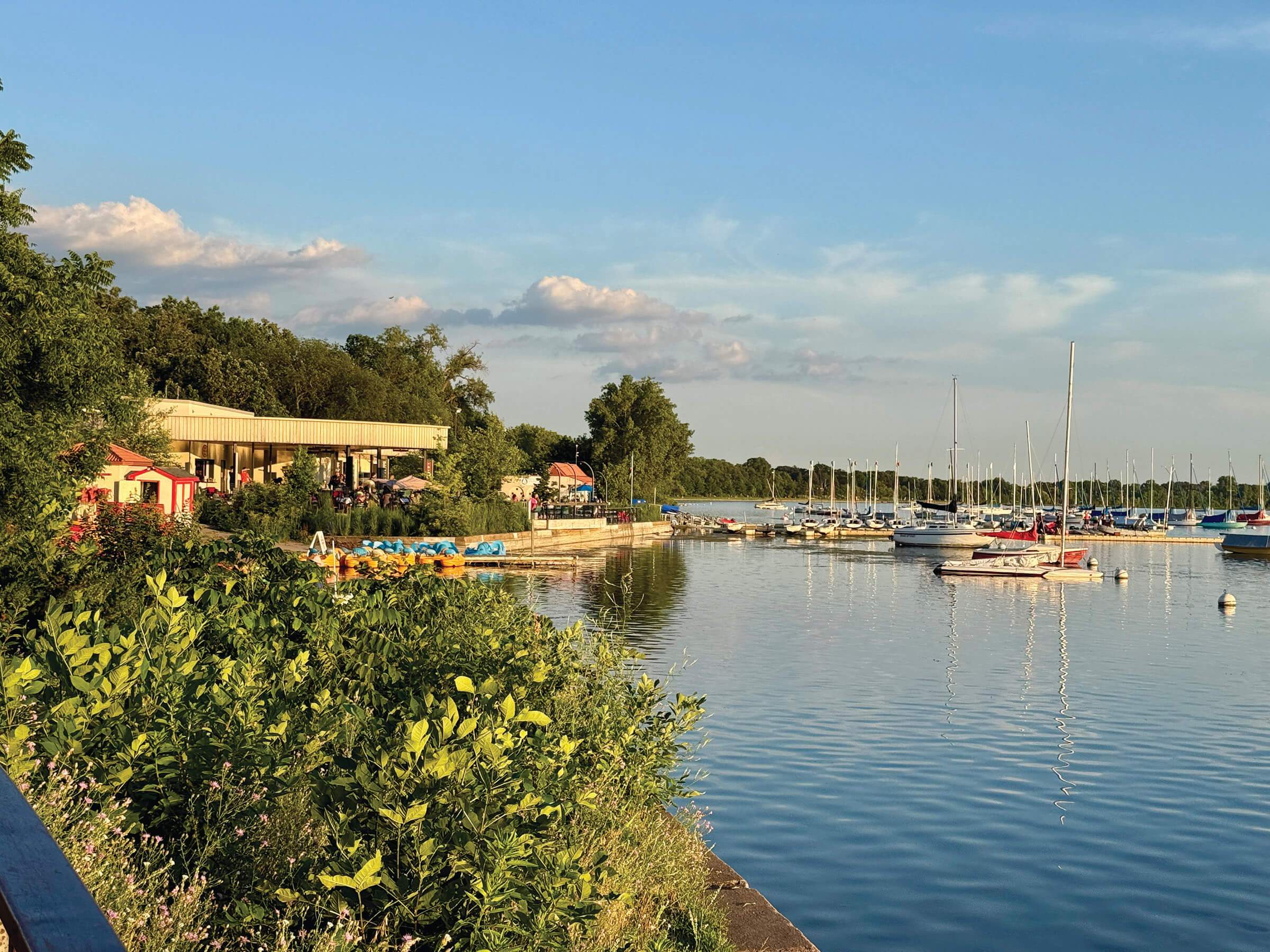
The restaurant operating inside Minneapolis’ $6.5 million Bde Maka Ska pavilion never competed for the job, which may help explain Pimento’s difficulties.
The Minneapolis Park and Recreation Board selected Lola’s on the Lake in 2017 for a building that burned down in 2019. When the replacement opened in October 2023, commissioners relied on that selection rather than reopening the concession to bidders. The new concept, Pimento on the Lake, had never been competitively evaluated.
Two years later, Park Board financial reports show losses totaling $291,777 at the site.
In 2025, Sea Salt Eatery at Minnehaha Falls produced $424,264 in operating income for the Park Board and Bread & Pickle at Lake Harriet produced $143,650. Bde Maka Ska lost $107,027.
“The restaurant operating inside Minneapolis’ $6.5 million Bde Maka Ska pavilion never competed for the job.”
Lease Renewed, Concept Changed
Tin Fish operated successfully at the pavilion for 14 years, from 2004 through 2017. When its lease expired, the Park Board offered the operator a 15-year renewal. It declined.
A 2017 request for proposals drew 12 responses. The Park Board narrowed them to a Tin Fish franchise formed by former employees and Lola’s Cafe on the Plaza LLC, doing business as Lola’s on the Lake. It selected Lola’s.
In its only complete season, Lola’s generated $72,865 in Park Board revenue, compared with $171,616 during Tin Fish’s final year. Lola’s reopened in May 2019, but the pavilion burned down on May 16 and was demolished.
In November 2022, commissioners approved a new five-year lease with Lola’s, relying on the 2017 selection rather than issuing another request for proposals. By the pavilion’s October 2023 opening, Lola’s had joined with Pimento Jamaican Kitchen to operate Pimento on the Lake.
The Park Board described the arrangement as a partnership but has not explained how contractual responsibilities are divided among Lola’s, Pimento and Pimento on the Lake LLC, the entity named on the alcohol license.
What the Books Show
The Park Board records its restaurants separately from tax-supported operations. Its financial reports show what the board collected and spent at each location.
In 2024, Pimento’s first full year, Bde Maka Ska recorded $27,627 in operating revenue against $212,377 in expenses, a loss of $184,750. In 2025, revenue rose to $123,219, but expenses reached $230,246, producing another $107,027 loss.
For roughly 15 years before the new pavilion, annual expenses at the site remained between about $21,000 and $40,000. They rose from $38,233 in 2023 to $212,377 in 2024.
The reports do not itemize that increase. Restrooms, grounds, utilities, snow removal and building depreciation may be included. Debt service is reported separately.
The figures also do not establish that Pimento itself lost money. They are the Park Board’s numbers, not the restaurant’s.
During Tin Fish’s final three years, the same refectory produced $478,103 in Park Board revenue against $70,118 in expenses, or $407,985 in operating income.
One figure remains unexplained. The audited report puts 2024 operating revenue at $27,627, while staff later told a commissioner the board received $80,113 from Pimento that year. The 2025 figures align; the 2024 figures do not.
Mixed Reviews, Falling Sales
Pimento averages about 3.4 stars across roughly 120 Google reviews. About 56% award four or five stars, while 37% award one or two.
Supporters praise the setting and dishes such as jerk chicken, curry goat and plantains. Critical reviewers describe long, disorganized waits and missing orders.
Restaurant sales declined from more than $1 million in 2024 to about $750,000 in 2025, roughly half the $1.4 million Tin Fish reported in its final year.
In its 2024 annual concession operations summary and evaluation, Park Board staff called the decline concerning and noted frequent complaints about cleanliness, trash and service. The 2024 report was published in April of that year; a 2025 annual report has not yet been published.
Pimento also lost the ability to serve alcohol after appearing on Minnesota’s tax-delinquency list, which prevents distributors from supplying it.
Proven on Nicollet, Untested at the Lake
Pimento built a successful restaurant and respected brand on Nicollet Avenue. Pimento on the Lake placed that brand in a different setting with a new concept, seasonal demand and sudden crowds.
Park restaurants such as Sea Salt, Bread & Pickle and the former Tin Fish rely on fast counter service designed for that volume. Pimento’s broader menu is harder to deliver at the same pace, and slow service dominates its critical reviews.
“Pimento also inherited an October opening, a site dark for four years, a changing Uptown economy and inevitable comparisons with Tin Fish.”
A competitive process could have tested whether the concept fit the pavilion’s demands. But the 2017 process evaluated Lola’s, not the Pimento restaurant that opened in 2023.
Pimento also inherited an October opening, a site dark for four years, a changing Uptown economy and inevitable comparisons with Tin Fish. The unanswered question is whether anyone assessed what Pimento would need to succeed at the lake.
What the Park Board Says
A Park Board spokesperson provided this statement: “All concession agreements include specific performance standards covering financial obligations, operational requirements, facility maintenance, customer service, and regulatory compliance. We monitor operator performance through regular inspections, financial reviews, and documented complaint tracking. When operators fall short of these standards, we have contractual remedies available, up to and including termination.”
The statement describes a process but does not say what it found at Bde Maka Ska or what followed. A records request seeking annual concession evaluations from 2017 forward is pending.
Questions remain. What have inspections and complaint tracking found? How does the Park Board explain the differing 2024 revenue figures? What support has it offered the operator?
Sea Salt, Bread & Pickle and Tin Fish show that a park restaurant can return money to the public and delight its customers. Nobody is served by a $6.5 million pavilion that does neither, not the Park Board, the operators, or the neighbors who pass it every day.
What the Park Board intends to do about a restaurant concept it never competitively evaluated remains the open question.
Steve Kotvis writes for the Hill & Lake Press. He lives in Bryn Mawr.