
I had occasion to contemplate this question while renting a small adobe house in Tucson’s Jefferson Park Historic District for 10 days.
One of several National Register Districts in Tucson, Jefferson Park developed in the 1920s to 1950s on a monotonous grid of streets platted in 1905. Lots ranging from 60 to 120 feet hold mostly small one-story houses of many styles—Spanish Colonial, Pueblo Revival, Territorial, Bungalow and Ranch. There’s also a great variety of landscaping in the small front yards: gravel, gravel edged in rock, gravel punctuated with a few cactus, lots of cacti, lots of cacti and bougainvillea and blooming trees. It struck me that the people living there were tolerant of neighbors with differing aesthetics!
What they weren’t tolerant of was “dorm houses”—two-story “California-style” stucco houses with three garage doors and room for many students to rent. A developer had clearly swept through the neighborhood and torn down little houses and dotted several blocks with what the neighbors saw as monstrosities. We learned from our next-door neighbor Alon that women who knew how to protest in the 1960s, including his late wife, had banded together to pressure the city to ban any places renting to more than five unrelated people—first in Jefferson Park, and then citywide.
Though generally well kempt, the streets felt forlorn. For one thing, trees were rare. For another, many of the nicer houses were encased in high, usually stucco walls. We couldn’t even see the houses. And shades were drawn on the windows of most of the houses we could see. We saw few people walking, and only a few getting into their cars. It felt deserted, though it clearly wasn’t.
A bit of context is necessary.
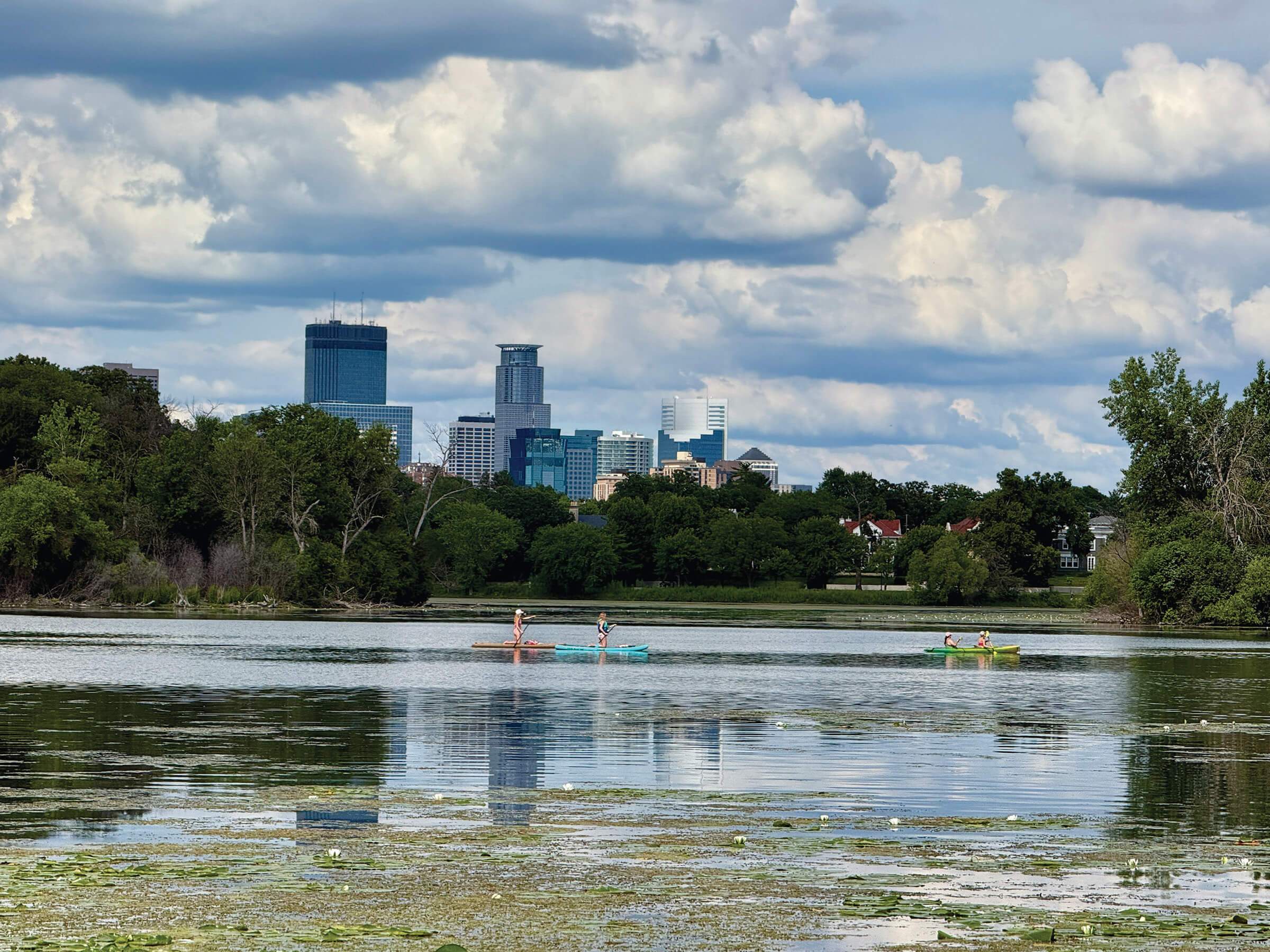
Where we live in Minneapolis is a lovely Midwestern neighborhood with tree-shaded streets and generally decentsized houses with landscaped—and yes, grassy—yards. Nearby is Lake of the Isles Park, a pastoral green space winding around a small, island-dotted lake that flows into a channel connecting another lake. We are fortunate to live in a city where the extensive park system is integrated with the residential areas. It was designed so every resident would be within 10 minutes of a park. ParkScore data now show that 98 percent of Minneapolis residents live within a 10-minute walk of a park, up from 96 percent last year. That is the totally brilliant goal: People don’t have to drive to a park!
Due to our proximity to the park—and, perhaps, to Midwestern recreational habits— in the course of a day we will see scores of people walking, running, biking, dog-walking, fishing or, in the winter, cross-country skiing. In the summer, people in canoes, kayaks or paddleboards create an almost carnival scene on the lake and channel: there might be 30 or more at once!
So our days are filled with the vicarious pleasure of human activity. We spend most of our time in a greenhouse attached to our house, so we have a great view of people walking their dogs, getting out of their cars to go run or passing by with their families. Sometimes we even wave to people we don’t know but who are obviously looking at us in our glass house.
I expect someone has researched this but I’m pretty darn sure this experience contributes to mental health. Add in the view of geese and ducks and a muskrat sitting on the edge of the thawing ice, as I see now, and it is clearly therapeutic.
So, though the Tucson sun was shining, the sky was blue and the temperature that ideal 70s, I felt bereft.
Fortunately, the few people we did encounter were exceptionally friendly. I first met Alon, who lived next door and was the father of Hadley, who booked our house. (We later learned the family had renovated the house, which had seen hard times.) Then we walked by the most appealing yard on our block—one overflowing with blooming bushes, small canopy trees, and intriguing sculptures—a crow with a fish in its mouth, two abstract deer and a giant sunflower—and complimented the owners, who were just arriving home.
It turned out that Jerry was the sculptor and Sue, his second wife, was the gardener. Both in their 80s, they claimed to be slightly deaf, as was their ancient dachshund Gus. But they took us back to see their backyard and Jerry’s workshop in a very unhurried visit. (We fell in love with one sculpture and ended up buying it!) Sometime later we continued our walk!
Another day we stopped to compliment another lady on her yard, which she was working in before a predicted rain. She said she wrote the neighborhood newsletter and told us how the homeowners raised $36,000 to fund the research needed to get Jefferson Park on the National Register. She also told us about the current challenge to the neighborhood: some kind of tall communication towers that would wreck the streetscape.
(Interesting to me as a preservationist, the National Register designation meant contributing homes receive a 40% tax break, but there is no local ordinance to prevent demolition. In fact, one of the famed bungalows built nearby by Annie Lester in the 1930s was threatened. We later found it and it looked like a goner.)
Another gentleman of a similar age watering his plants one morning was happy to answer my question about when his house was built. Across from the red brick school, the long, flat-roofed rectangular red brick house looked like a miniature version of the school. Oh, he said, this part, on the left with the front door, is the oldest house in the neighborhood, built a hundred years ago. The part on the right was added in the 1950s. Under the brick— obviously a local brick that covered a lot of houses in the neighborhood—was adobe. And, he said, the old adobe part stays really cool but not the new adobe part. That all made sense to me.
Another morning on my walk, I watched a young couple and a realtor stand in the yard and stare at one of the little white stucco houses for sale—there weren’t many for sale—only nine in the whole district of 788 properties! The couple nodded their heads and the bearded realtor said he’d talk to the selling agent.
For some reason, my heart swelled. And Jefferson Park felt more like home.