
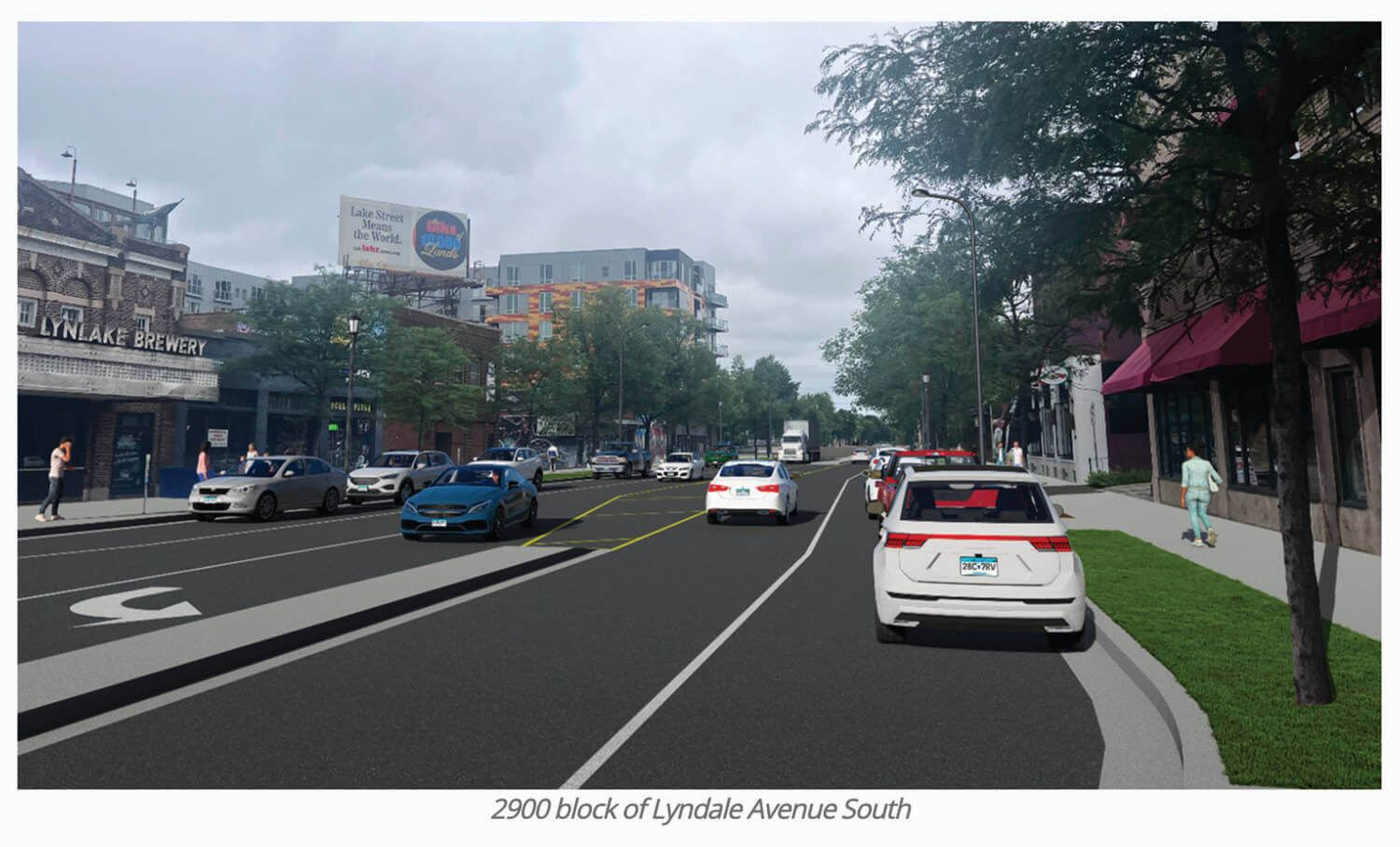
Watching the plans for the reconfiguration of Lyndale Avenue is like watching a slow-moving ping-pong game, with the ball bouncing between small business owners on one side and bus and bike lane advocates on the other. Only with higher stakes.
Business owners and their supporters say that the removal of parking places in favor of bus and bike lanes, and adding concrete center medians to prevent turns, will drive customers away and point to the reconfiguration of Hennepin Avenue as Exhibit A.
The bus and bike lane advocates say we must move away from our reliance on cars if we’re to have a chance of surviving as a planet, and that roads need to be made safer for those who walk and bike, and more convenient for those who ride the bus. And they say that businesses will be fine with a slower paced traffic flow that favors strolling and pedaling over driving and parking.
Lyndale Avenue is a county road, but the planning process has been a joint effort with the City of Minneapolis, and the City Council has final say on the plan.
After a lengthy community-input process to review various options — parking bays, bikeways, a dedicated bus lane, more crosswalks — and hearing passionate arguments from all sides, planners released a compromise plan last fall. Some parking would be retained, there would be no northbound dedicated bus lane and bikers and pedestrians would share a wider, winding pathway.
“The bike path will require the removal of 52 mature trees. People getting out of their cars will step into an active bike lane — one that encourages speed rather than slows it.”
The business owners and supporters thought this was a workable solution. The bus and bike lane advocates thought differently.
Among other things, the bike and transit proponents favored a dedicated bus lane over parking, arguing that this is a once-in-a-lifetime chance to make our roads more car free and more transit friendly. They cited safety concerns of putting bikes and pedestrians on the same path, noting that e-bikes and scooters move at higher speeds as well as the high potential for mashups. Their pushback was well organized and effective.
So effective that in March, the county released another plan reflecting their concerns. It puts back the designated bus lane, removes center turn lanes and retains lengthy concrete medians. Instead of a shared pathway, there will be a sidewalk and a separate, straighter bike path.
The business owners and their supporters returned the volley. The bike path will require the removal of 52 mature trees. People getting out of cars will step into an active bike lane — one that encourages speed rather than slows it.
The bus lane will not only take away much-needed parking, it will cause congestion. There is no place for plowed snow to go in the winter. It compromises the ability of emergency vehicles to move through narrowed traffic lanes.
Business owners suggest county and city planners hit pause and take an in-depth look at the effect a similar plan is having on Hennepin Avenue businesses and nearby residents before committing to any new plan on Lyndale.
What’s Next?
Due to the lengthy give-and-take, the deadline for finalizing the plan has already been extended.
A final plan will be submitted to the City Council in late spring.
The council will vote it up or down, and the mayor will have the option of a veto.
For now, construction is slated to start in 2028 and to take three years to complete.
The current plan can be viewed at beheardhennepin.org/lyndale-avenue.
Comments can be directed to the mayor at Jacob.Frey@minneapolismn.gov, to the City Council at councilcomment@minneapolismn.gov, or to individual council members.
Susan Lenfestey writes for the Hill & Lake Press. She lives in Lowry Hill.