
Unsheltered homelessness and substance use disorder have sharply increased in Uptown since the fall of 2025. The easy narratives of addiction and mental illness explain some of what people see on the street but not all of who is there. The Hill & Lake Press spent time at Hennepin and Lake looking for the fuller picture.
Local Experts
When I first tried to interview people experiencing unsheltered homelessness in Uptown, I got many rejections.
On a personal level, I struggled to believe anyone really wanted to talk to me, and my questions seemed to come out awkwardly — I was grappling with a sensitive topic, aware that to them I might look like some random “reporter” asking intimate questions. They wouldn’t have been wrong.
For more context, I spoke with two neighborhood professionals who work in the field.
Dr. Angie Erdrich
Angie Erdrich, a Kenwood resident, is a pediatrician in Phillips who regularly interacts with family members of people experiencing unsheltered homelessness and addiction.
“I hope it is uncontroversial to say that nobody wants their child or relative to live outdoors and have an unaddressed addiction or human trafficking problem,” Erdrich said. “We don’t even know the degree to which people living outdoors are trafficked for their bodies or their services as a means of survival. Some of the people on the street are quite young and desperately suffering from addiction.”
“I have known many moms who lost custody of their children but eventually grounded themselves and, with support, turned their lives around and truly became leaders,” she added. “As a society we are losing this human potential. I believe we can find a better balance of intervention to help people reclaim their lives.”
“I have known many moms who lost custody of their children but eventually grounded themselves and, with support, turned their lives around and truly became leaders.”
— Dr. Angie Erdrich
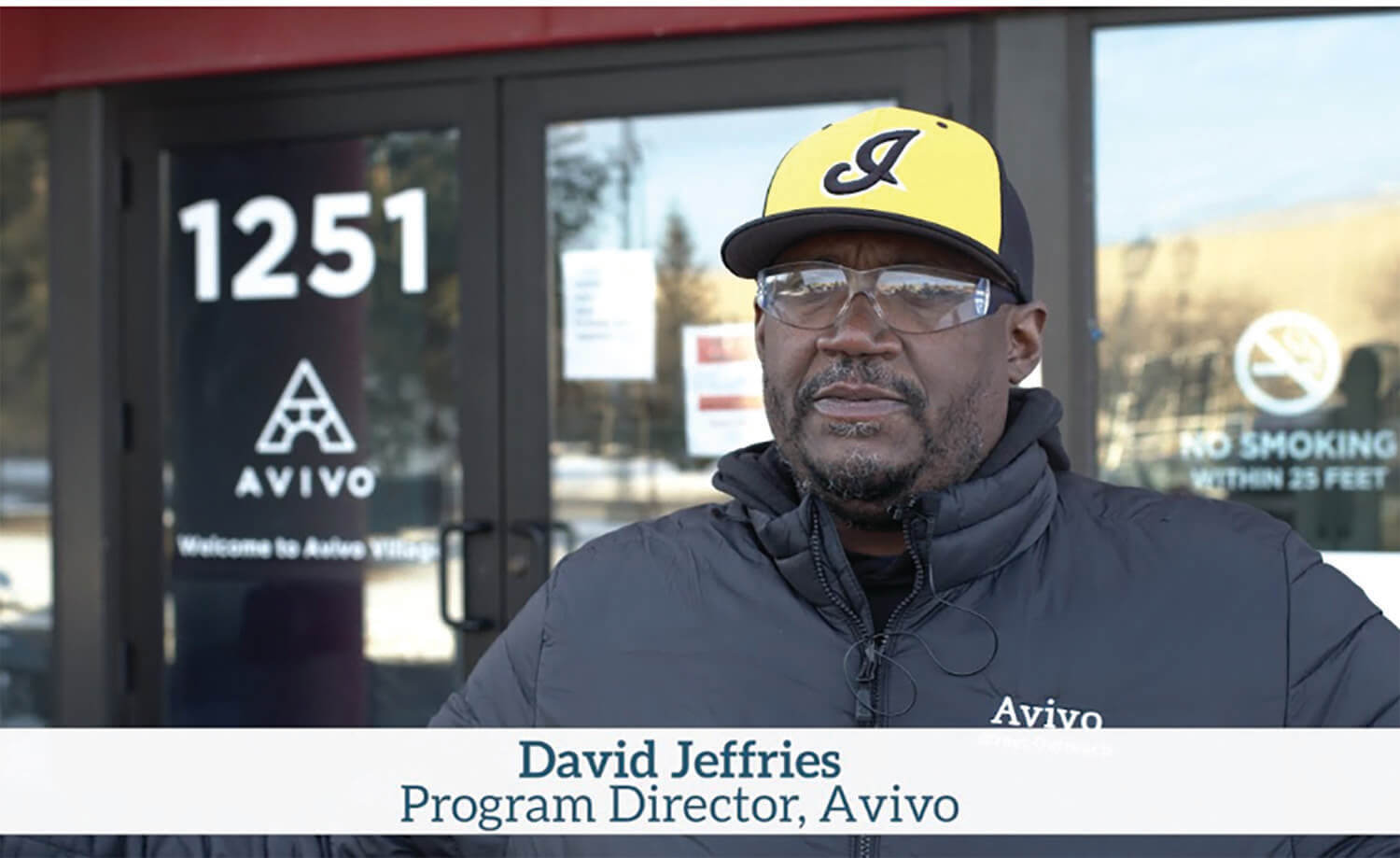
David Jeffries, Avivo Village
David Jeffries, an East Isles resident, is the program director of emergency services at Avivo Village in the North Loop.
“Most people on the streets have a dual diagnosis of substance use disorder and mental illness,” Jeffries said. Still, he encouraged the Hill & Lake Press to pursue further interviews, which we did: “People want to tell their stories. You just need to find the right people.”
“It’s better to give them a resource than to give them money. I know people want to help, but giving someone money can keep people stuck. Instead, you can tell people where to eat, where to sleep and where to get support.”
— David Jeffries, Avivo Village
Asked some big-picture questions about unsheltered homelessness, Jeffries was direct.
“People think it’s such a difficult problem, but it’s not,” he said. “We need to create a system where it’s as easy to get out of experiencing hardship as it is to get into it. That’s it.”
“It is the public’s will that we still have unsheltered and unhoused people,” he continued. “We make choices as a society about allocating our resources — if we had more desire to fix this, we would prioritize getting people off the streets. Right now, our federal government is choosing to prioritize war. With the money spent on that, they could have given every homeless person a home.”
Asked what advice he would offer to people encountering folks living unsheltered or struggling with addiction, Jeffries replied, “It’s better to give them a resource than to give them money. I know people want to help, but giving someone money can keep people stuck. Instead, you can tell people where to eat, where to sleep and where to get support.”
Listening to the Unhoused
At Hennepin and Lake, three people agreed to share their stories. Their names have been changed to respect privacy.
“Michael”
Michael has friends and family he can stay with but sometimes sleeps outside in case of emergency, such as missing the last bus home.
Asked how he came to be homeless, Michael said he was running his own company, but a few of the people he tried to give a job to ended up stealing from him. “Then,” he continued, “I ended up getting a gambling addiction that caused me to put my company’s assets at risk.”
Michael maintains a “side hustle.” The weather can impact how much money he makes in a day and whether his customers are outside. He was not asked for details.
Michael said one challenge of being on the street is that some people, “before they let you get clean and successful, they will try to keep you down in a situation where you’re not progressing past them, you know? Like a crab in a bucket. So, you might have to let go of some of the people around you.”
In a perfect world, Michael said, he and his girlfriend would both be employed, have a place of their own, working toward licenses and getting a vehicle. Michael would like to be self-employed.
“Rebecca”
When Rebecca asked for money, I offered to buy her food instead. We went into a restaurant and were looking at the menu when the server turned to Rebecca: “I’m sorry, you can’t be in here.” He added: “She messed up our bathroom pretty bad, and we had to call the cops. I’m not judging, we just can’t have her in here.”
Rebecca vociferously disagreed with the server’s story. “I didn’t do it!” she said.
After some back-and-forth, Rebecca agreed to wait outside while I ordered and brought food out. The server apologized again.
After the food arrived, Rebecca began to talk. She said she lived in a group home in the northern suburbs but hadn’t been back in a while because they don’t pick her up. Asked how she gets back, she replied: “I don’t.” She seemed to have accepted this.
Asked where she slept: “Here, in the building,” she said.
Rebecca has “so-called friends.” Asked whom she could lean on for support, she replied: “Me.”
Asked if there was anyone else, she said: “No.”
She mentioned that her back hurt and that she was in a lot of pain. Asked whether she felt she could get the care she needs, she said: “No. Where would I go? There’s nowhere to go.” When HCMC was suggested, she said she would never go back because they had taken money from her. Rebecca then excused herself because she had to talk to someone about getting money.
“We’re not animals. We’re human too.”
— Joe
Rebecca said if she ever “got on [her] feet,” she would like to help women, pregnant women in particular. She would like to have a business.
“Joe”
Joe lives with his sister now, but was previously homeless, which, he specified, was a choice. After being in prison for a long time, he wanted to be outdoors. “I was never homeless, I always had a place to go and rest my head,” he said. Like Michael’s, Joe’s situation underscores the gray nature of homelessness that came up again and again.
Asked if there was something he’d like to share with readers, he said: “We’re not animals. We’re human too.” Asked if he felt people treated or judged him as an animal, he replied: “Yes. They think we all do drugs on the streets, but that’s not true. Get to know a person before you judge.”
Joe said he was mostly out to provide support for Rebecca, who had encouraged the interview.
“I want to see her get off the streets,” he said. “She’s a great person, but she’s been out here a long time.”
Joe is working with his parole officer on getting his birth certificate and an ID so he can get a job. He has previously worked in plumbing.
Paula Chesley writes for the Hill & Lake Press. She lives in East Isles.