

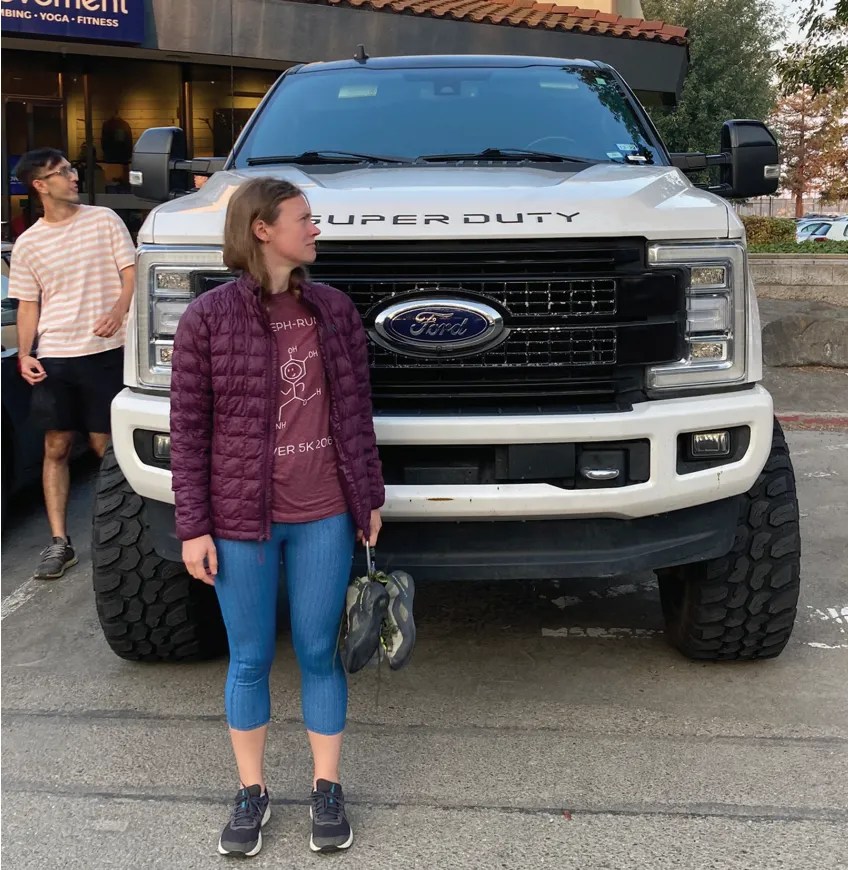
I am a 5’4” tall woman, and this truck’s hood is at my head height. It physically cannot fit into any of the spaces of the lot. However, it is de - signed, marketed and sold as a consumer car.
Why have trucks continued to grow?
One reason is a 2012 standard by the Environmental Protection Agency and national Department of Transportation increasing fuel efficiency standards. When they did so, they increased standards only for cars and light trucks.
Automakers had an easy loophole: just make the wheelbase bigger, and the increased fuel standards no longer applied. Of course, trucks got larger. It even affected everyday cars — SUVs as a category are built on a truck base, and SUVs like the Subaru Outback are not subject to these fuel economy standards.
We’ve gotten ourselves into an arms race.
In a roadway with trucks this size, you want a car that won’t get smushed in every collision. How do we get out of this mess? One way is by refocusing on the roadway as a whole, and not just the safety of people in cars.
When a car gets its safety rating through crash testing by the National Highway Transportation Safety Administration (NHTSA), there is no standard for testing injuries outside the vehicle. Actually, there’s also no requirement that the “female” dummies are anatomically proportioned. At least NHTSA may add testing around pedestrian safety soon.
Larger vehicles are at least partly responsible for the rise in pedestrian road deaths across the U.S. Physics tells us that kinetic energy is proportional to mass, so a heavier vehicle stores more energy for your body to absorb when it hits you.
Kinetic energy is also proportional to speed squared, which is why the “20 is plenty” campaign exists. Taller trucks are also more deadly because the energy hits your torso instead of just your legs.
To undo this trend, we must understand its roots, question our individual decisions and take a society-centric view when designing our roadways. It will take all of us, working together, to drive road deaths to zero.