
For 22 years I’ve lived in an apartment in East Isles just off The Mall, the parkway that connects Hennepin Avenue to the lagoon between Bde Maka Ska and Lake of the Isles.
The Mall is slated to be redeveloped as part of a plan by the Metropolitan Council to replace aging sewer pipes and structures near Lake of the Isles. The Metropolitan Council has already completed work along Humboldt Avenue north of The Mall as part of this project.
The remaining sewer upgrades along The Mall, between Humboldt Avenue and Bde Maka Ska Parkway, will be implemented in coordination with planned improvements for the park, as approved in the Southwest Service Area Master Plan on Nov. 4, 2020, by the Minneapolis Park and Recreation Board.
Two public open houses were held on Nov. 8 and 14 at the Whittier and Painter Park recreation centers to receive public comment on updated concept plans developed by design consultants and the MPRB.
According to the park board’s website, the public comment period has passed, but there will be a project update to inform the public of the MPRB’s intentions, date TBD.
Three main goals
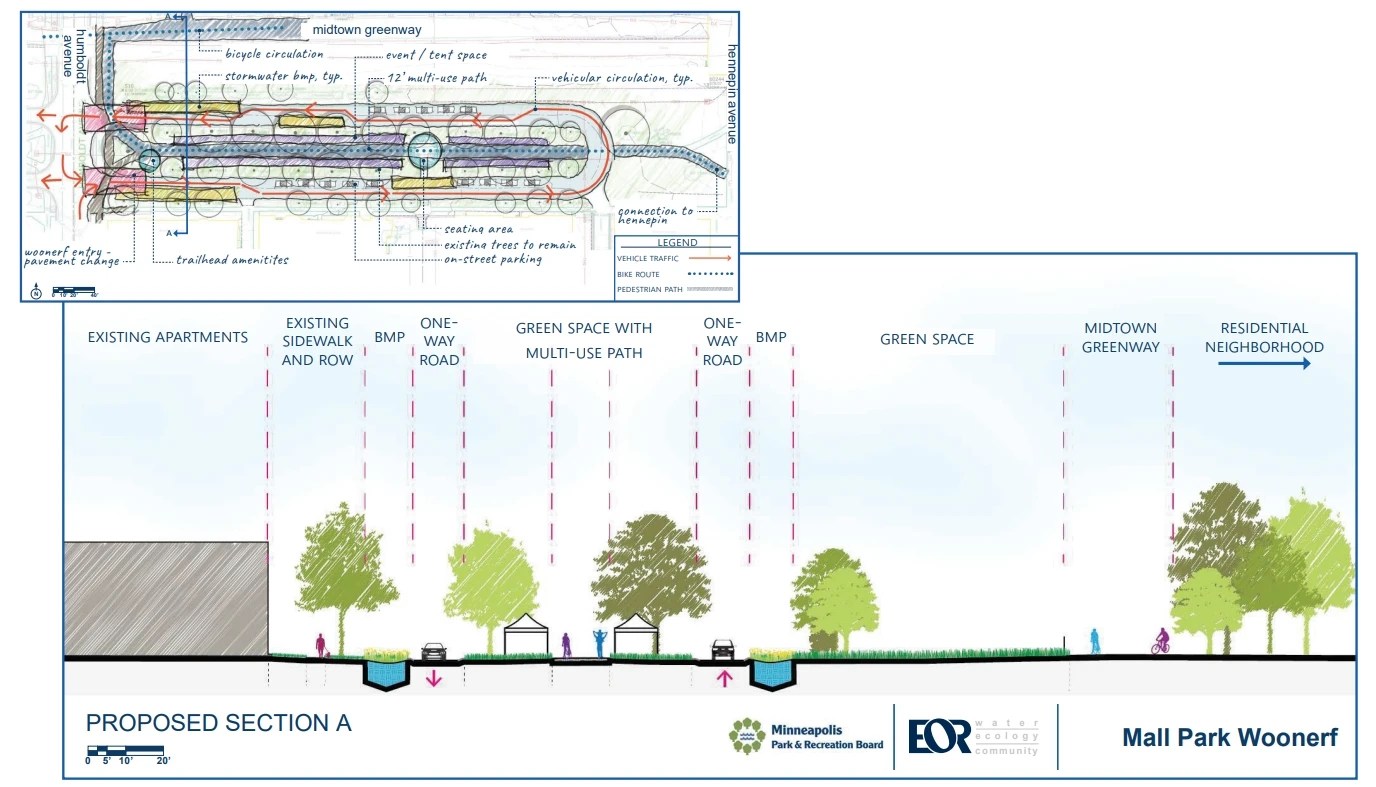
The park board aims to construct a “woonerf” on The Mall, a Dutch term for a shared-living street, between Humboldt Avenue and Hennepin Avenue. The MPRB defines woonerfs as creating common space shared by walkers, bikers and low-speed motor vehicles and using traffic-calming techniques to slow vehicle traffic while still accommodating parking.
A second goal is to create an improved, multi-use trail connect ing Hennepin Avenue and the Midtown Greenway, which travels parallel just north of The Mall.
The third objective is to remove two westbound blocks of roadway, including parking places on the north side of The Mall between Irving Avenue and Bde Maka Ska Parkway, and replacing them with recreational green space. The eastbound roadway will not be removed so that alley access is maintained.
The hope is to create a more continuous, uninterrupted green space between The Mall and the lagoon at its west end.
Motivation for the Proposed Changes
The Southwest Service Area Master Plan, which includes The Mall, is the result of nearly two years of planning and design by MPRB staff, the community, and hired technical consultants.
According to the park board, “over 170 community engagement events were held and several different stages of input garnered thousands of individual comments on park plans, guiding principles, and the planning process itself.”
Katie Jones, a pedestrian and bicycle advocate who served on the Southwest Service Area Master Planning Community Advisory Committee as a representative of Stevens Community, Whittier and the Wedge neighborhoods, said that it was an enlightening process to learn about the history, mission and policies of the park board.
Katie writes, “When we got to The Mall, I questioned how the layout and function of this parkland is serving the park board’s natural resource stewardship and recreation mission. How are people, plants and wildlife being supported? How are health, well-being, community and the environment being promoted? Following those, the natural next question became: should this parkland be used as vehicle park ing, or would the mission be better served by adding green space? Through many discussions, it became clear to many committee members that providing more green space would support wildlife, enhance air quality and storm water management and provide greater recreation opportunities and experiences in nature in line with the park board’s mission.”
The Removal of Parking
The most contested issue is that parking would be largely eliminated — parking that is seen as critical to many residents and businesses in a high-density neighborhood with buildings that often lack offstreet parking for residents, including me.
The park board suggested that parking is not typically allowed on parkways. While this is mostly true citywide, The Mall is certainly an exception to that rule, with parking having been allowed there for over a century.
According to Hennepin County archives, a 1953 aerial photo clearly shows cars parked there.
The Mall Apartments, built in 1915, has 18 units and at best 25% of tenants do not have cars. Most of the three-story apartments between Hennepin, the Parkway, The Mall and lagoon were built before WWII. With the exception of two buildings on Knox, 19 of these buildings do not have underground parking.
Today it is difficult to find a parking place on The Mall due to demand. This is exacerbated by entertainment venues like the Uptown Theater, which has a capacity of 1,600 people. The Uptown commercial district will eventually recover and thrive once again, increasing demand for parking.
I also think the MPRB is being a bit misleading by not being clear as to how many parking spaces would be eliminated. The removal of 25 spaces west of Irving Avenue is noted, but the loss of parking east of Humboldt is not. There are currently 34 parking spaces on that block. Option A would reduce it to 14, and Option B to 10. That’s close to 50 spots removed in total.
I'd like to think I'm not pro-car, and I bike when I can, but the reality is my job requires me to have a vehicle. Of course, if self-driving shared cars happen in the near future, then maybe the whole parking argument is moot. But the reality is that we are still an auto-centric city, IN TRANSITION. The big question is how long will the transition take to happen? Thriving commercial districts still need parking!
My Take
The Mall is a beautiful space. The historic design was meant to provide a leisurely walk from the Walker Library to the lagoon, sandwiched between the industrial railroad corridor to the north and busy lagoon and Lake Street to the south. It’s an excellent example of a classic allée design, with a gently meandering walk flanked by maple trees. Some trees have been replaced, and pollinator gardens have been added, and it’s home to bees, butterflies, rabbits, squirrels and many birds including a resident peregrine falcon that keep the smaller critters in check. Nature will balance itself out if only we will let it.
I’m hoping that the park board doesn’t remove any trees and maintains the historic character of The Mall. It really should be a designated Historic District someday. Once this project is completed, it will be a great place for a future Winter Market, the Farmers Market and the Uptown Art Fair.
Overall I support many of the changes proposed by the park board because they will improve water quality, habitat and wellbeing.