
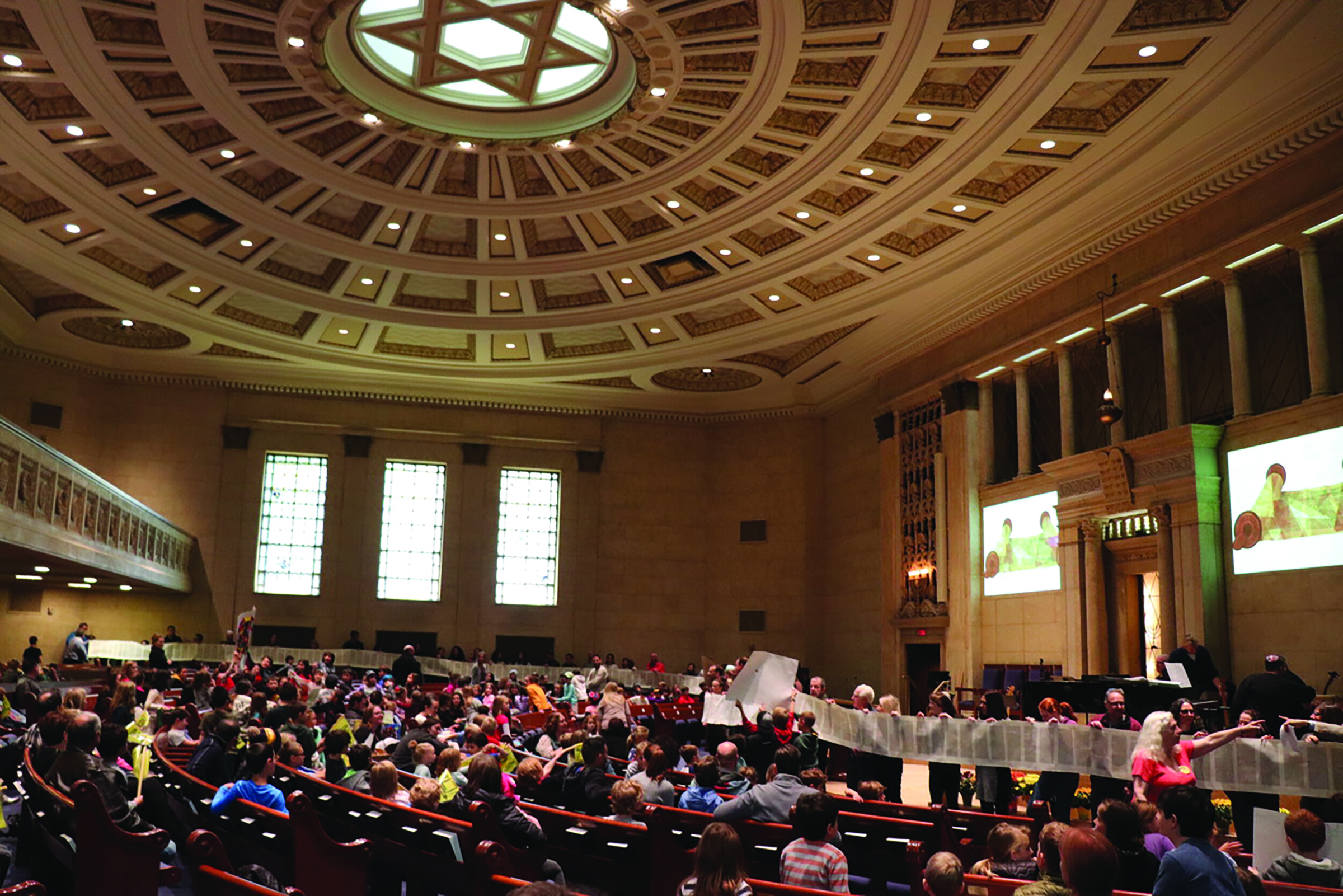
How does an almost 100-year-old synagogue embrace sustainability in the 21st century?
For Temple Israel, one of the largest Jewish Reform synagogues in the country and located just a few blocks east of Lake of the Isles, sustainability is rooted in the value of Tikkun Olam — the Jewish tradition of repairing and improving the world.
For the past two decades, I've been deeply involved in Temple Israel's sustainability efforts. In 2004, we established the Ner Tamid Task Force for Sustainability and installed a small array of solar panels on the synagogue's roof. These panels provide more than enough electricity to power Ner Tamid, the Everlasting Light above the Bimah (altar), symbolically making it a truly holy light.
In recent years, Temple Israel has set ambitious sustainability goals, including working towards net-zero carbon emissions and net-zero waste by 2030 and LEED certifying its building on Fremont Avenue South. On April 12, we celebrated a significant milestone: achieving LEED Gold Certification.
What makes this achievement unique?
Temple Israel is not only one of the oldest synagogues to achieve LEED certification but also the first and only synagogue to attain it as an existing building. Most LEED-certified projects are newly constructed buildings; only a small fraction, about 8%, are certified as existing buildings. Since most buildings are existing, that’s where there’s opportunity for meaningful improvement.
LEED, which stands for Leadership in Energy and Environmental Design, is a holistic, point-based green building rating system developed by the U.S. Green Building Council (USGBC) in the 1990s to address the enormous impact buildings have on our health and environment.
To attain LEED certification, a project must comply with all seven prerequisites and earn at least 40 points in energy, water, landscaping, materials, waste, indoor air quality and transportation. Earning 50+ points achieves Silver, 60+ is Gold, and 80+ points gets you to the highest level of Platinum certification. Temple earned 67 points, achieving LEED Gold status.
Of course, this journey wasn't without its challenges.
Like many nonprofits, we faced constraints of time and budgets. But we found that our community was there for us. Xcel Energy and the City of Minneapolis offered financial rebates for conserving energy. The USGBC admitted us into their Legacy Program, which provides nonprofits with pro bono engineering time and volunteer hours to help manage the project.
COVID-19 presented challenges as well. We started the process in 2019, and LEED requires at least a year of occupancy data (e.g., monthly energy usage, water usage and waste reports). In March 2020, the building emptied out, and an unoccupied building can’t be LEED certified. While that delayed the process, it provided an opportunity to implement additional energy conservation measures identified in a previous recommissioning study, ultimately improving our energy efficiency and increasing our score.
The benefits of our sustainability efforts are manifold.
From promoting healthier indoor air quality to realizing long-term cost savings (the LEED project paid for itself in less than two years), sustainability touches every aspect of our community's well-being. Moreover, it aligns with our values of environmental stewardship and social responsibility.
Through our ongoing commitment to sustainability, Temple Israel hopes to educate and inspire. For example, rather than thinking of buildings as burning fossil fuels, creating dirty stormwater runoff that pollutes our lakes and rivers, generating trash and using chemicals, what if we can change the paradigm and ask: How can our homes, offices, schools, and places of worship be of service to our community?
I know a couple in Roseville who built a house that returns more electricity to the grid than it uses. Their rain gardens absorb the whole neighborhood’s stormwater runoff. By reimagining our buildings as assets to future generations, we can make a meaningful difference in the world.
For Rabbi Marcia A. Zimmerman, Temple Israel’s senior rabbi, this is another example of the congregation’s long-standing commitment to interpreting an ancient tradition in a way that has present-day impacts. “Judaism teaches us that God created human beings to be mindful stewards of our planet, not careless consumers. Working to achieve LEED Gold Certification was truly holy work and our highest expression of Jewish values,” said Zimmerman, underscoring the spiritual significance of sustainability endeavors.
As a lifelong member of Temple Israel, I take great pride in its leadership in environmental stewardship, working towards a more sustainable future. Cheers to Temple Israel for literally LEEDing the way!