
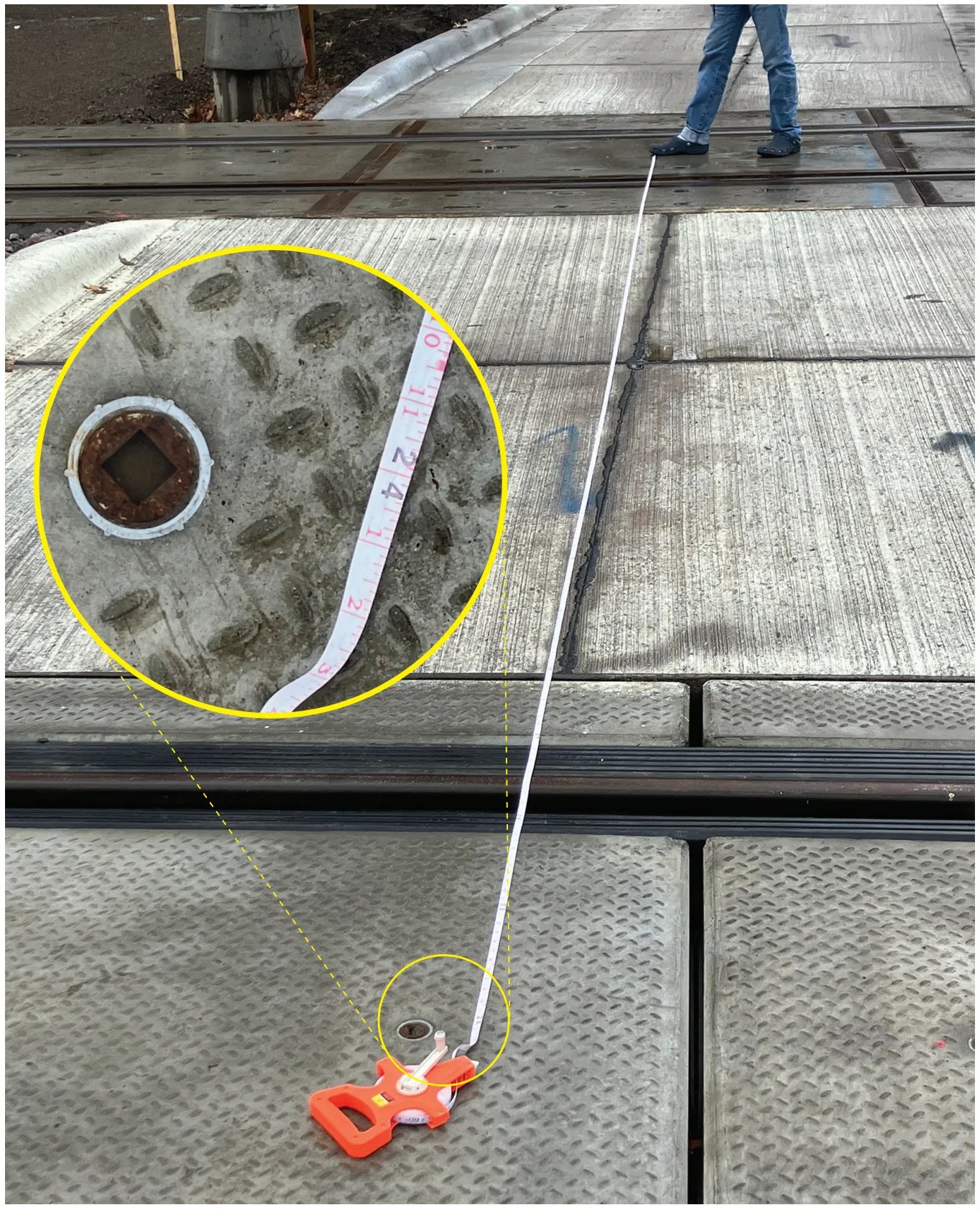
Last month, the Hill & Lake Press interviewed Dr. Marion Collins, whose concern for safety and precision led her to check the distance between the freight and light rail tracks at 21st Street.
She found that the centerline-to-centerline distance was 12 inches less than the industry standard minimum of 25 feet.
The Met Council followed up and found a discrepancy of seven inches.
Without acknowledging fault or expressing regret, the Met Council announced that the tracks will be moved.
For the neighborhood, that means the end of May and early June will see "significant construction noise" and vibrations from the work to remove tracks currently embedded in concrete.
Placing the new tracks will involve more traffic from greenhouse gas-emitting cement trucks, dump trucks and other rail maintenance vehicles and activities.
Scheduled for Sunday, June 2, from 9:00 a.m. to 8:00 p.m., the road to East Cedar Beach (Hidden Beach) will be closed to car traffic (assuming weather permits).
Pedestrians and bicyclists will still be able to cross, and people who live on the small stretch of Upton Avenue across from the park will be able to drive in and out with help from a flagger.
Some people wonder if seven inches (or 12?) matters in the bigger picture of freight rail safety.
But apparently, the Met Council feels the effort and expense is worth it and will "ensure there is at least 25 feet between the centerline of the freight tracks and the centerline of the LRT tracks," according to Kaydee Kirk, community outreach coordinator.
Considering all the safety and livability concerns of this nearly $3 billion project, let's hope Dr. Collins won't put her measuring equipment away just yet.