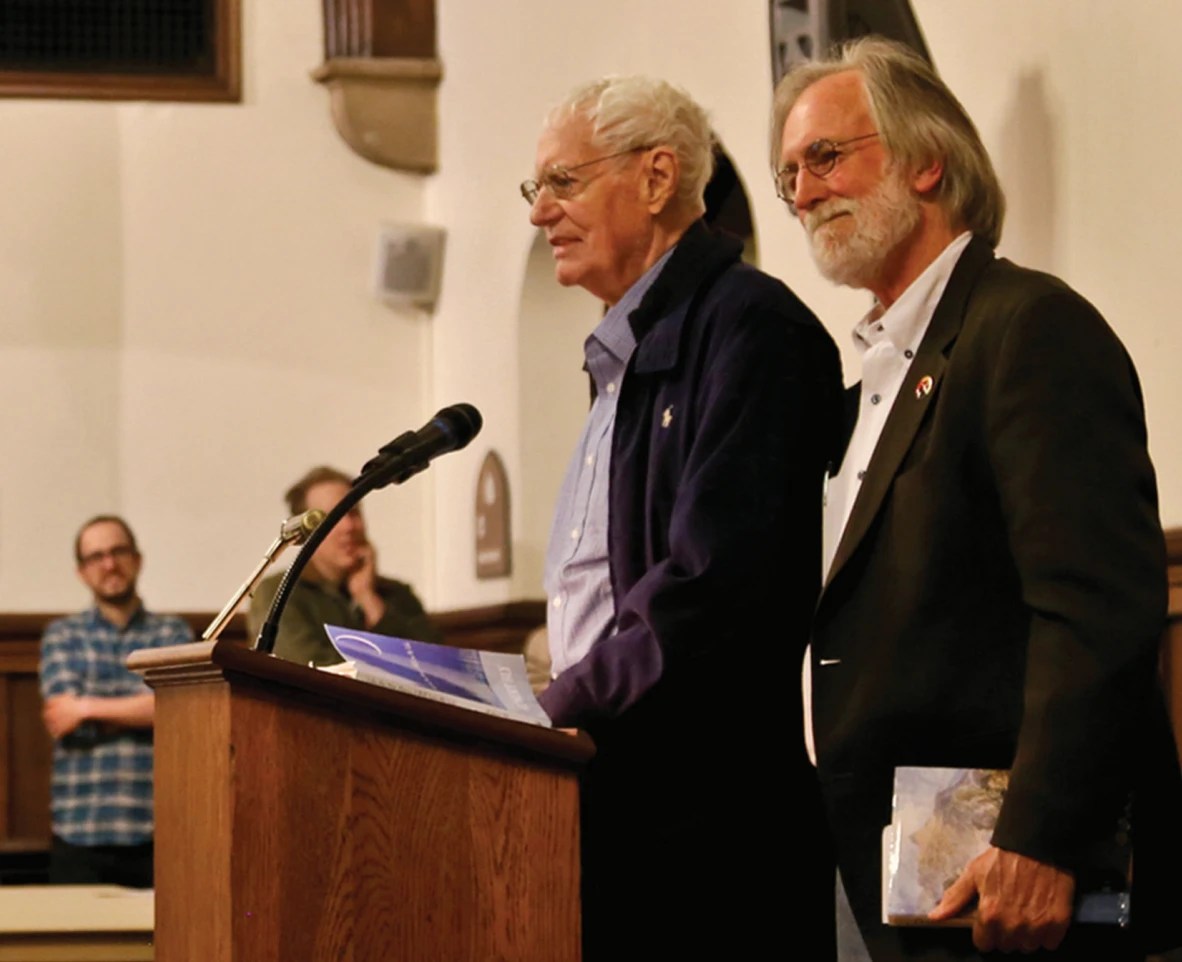
More than three decades ago, Robert and Ruth Bly moved into a house across the street from my family on the 1800 block of Girard Avenue South. Who could believe it? His international fame as poet, activist and author of the iconic “Iron John” then riding a year atop of the New York Times bestseller list, had been established from a farmhouse on the westernmost prairies of Minnesota. So, when he turned up in the neighborhood, I was flabbergasted. In fiction such a coincidence would be ludicrous, in life it happens. But what are the odds?
I had been inspired by Bly’s poems and activism against the Vietnam war since the mid 1960s. When in graduate school in 1967 at the University of Wisconsin at Madison the professor urged students to bring in works of a contemporary poet we loved. I rocketed off to the rare book vault in the University library (literally a vault) to read all the issues of Bly’s fabled, deeply influential little magazine The Fifties and The Sixties. His poems held the familiar fragrance of midwestern corn stubble at a time when one could only imagine poets writing in Paris, New York, or San Francisco. Yet here was an authoritative poetic voice and vision rooted in the familiar Midwest, using our landscape to open ears, hearts, minds, and consciousness to the grand waves of global poetry, the subtleties of language and psychology, and inspired social and political activism.
So, when Robert and wife Ruth turned up across Girard Avenue, moving into the original farmhouse from which Lowry Hill was platted, I could not believe my luck. And luck it was. In the decades that followed, I was able to repay some of his gifts by hosting events for his poetry publications at Literary Witnesses at Plymouth Congregational Church, including his last public reading on April 13, 2015, accompanied by 24 poet friends, and helped the University of Minnesota acquire his extensive, invaluable archive.
At home on Girard, the Blys attended my wife’s annual Winter Solstice gatherings, Robert reciting Yeats and Hafez and his own poems by heart around the backyard fire. In warmer seasons he’d walk to Sebastián Joe’s, share a lunch at Namaste, and visit our porch for a gin and tonic with my wife Susan after his workday ended in his backyard studio crafting memorable poems, anthologies, trenchant cultural critiques, and translations of twenty-two poets from ten different languages.
Robert Bly passed away at home on November 21, 2021, with Ruth and members of his family by his side. On Saturday, October 22, 2022, after a quiet family interment ceremony in Lakewood Cemetery, Ruth Bly hosted a celebration of Robert’s life and work at Plymouth Congregational Church, followed by lunch and performances at International Market Square by Bly family and friends from around the world. Jane Lewisohn attended from London, an expert on Persian culture whose deceased husband Leonard worked with Robert for a decade translating thirty “untranslatable” poems of Iran’s greatest poet Hafez.
Mark Rylance, the greatest male actor of our era, also attended from London. He deeply admires Robert’s work with ancient stories and men’s consciousness and poetry learned during Bly’s London teaching sessions, and from Robert’s essential poetry anthology, The Rag and Bone Shop of the Heart. Coleman Barks from Athens, Georgia told of Robert’s gift to him of Rumi translations, and their trip together to Iran to visit Hafez’ tomb. Miguel Rivera from Los Angeles called us to attend to the ancestors, Zachary Cohen from the St. Paul Chamber Orchestra gifted us Bach on the double bass, poets read Bly poems, the family told stories, while a hundred others laughed and wept with gratitude.
I recited Robert’s poem with the memorable title, “Gratitude to Old Teachers,” expressing the gratitude all of us felt for Robert Bly’s remarkable influence as teacher and neighbor in this world and the worlds to come.