
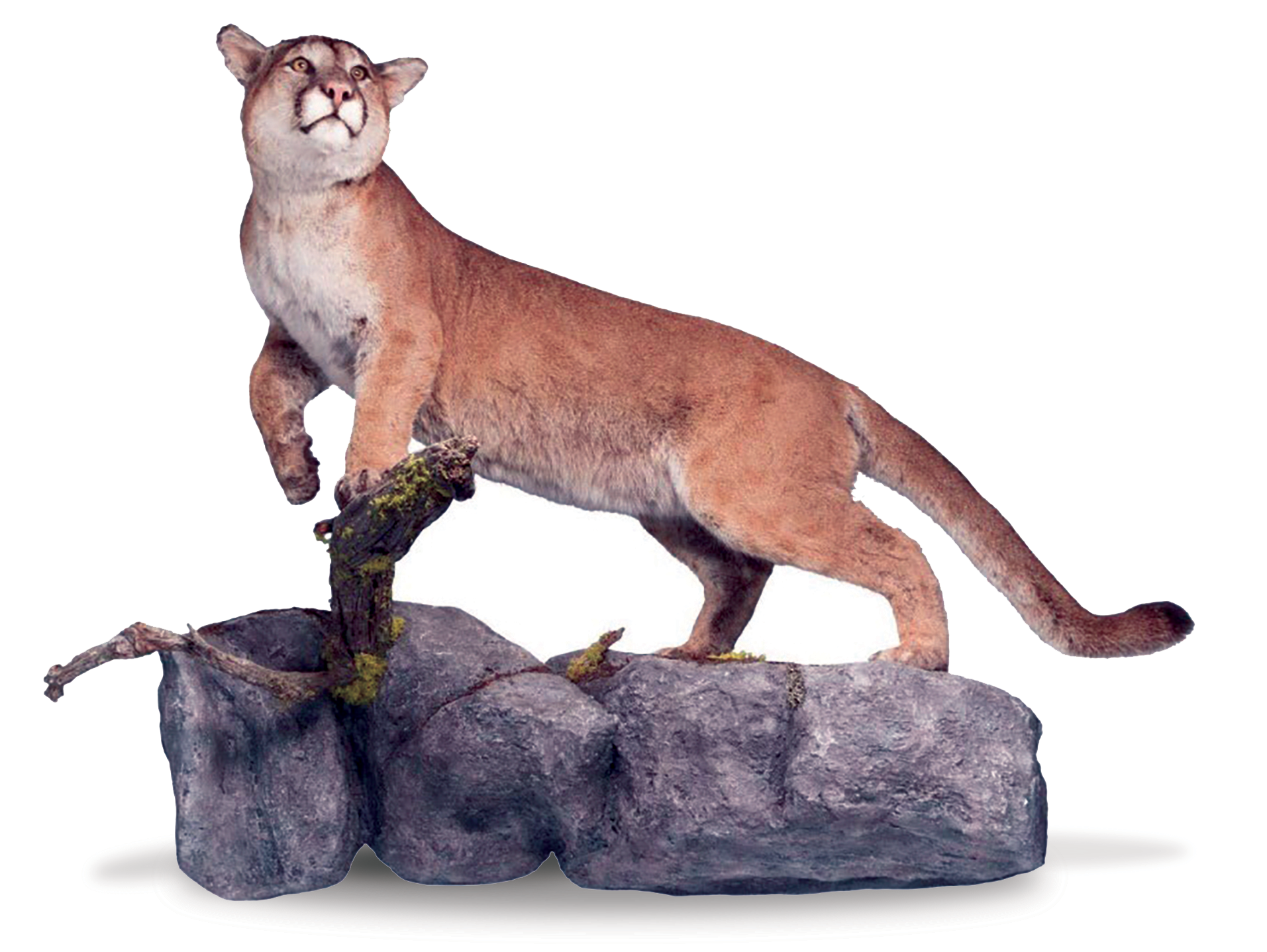
As previewed in January’s edition of the Hill & Lake Press, the Lowry Hill cougar is continuing its unlikely journey from the grasslands of Nebraska to Lowry Hill to becoming an educational exhibit for the Minneapolis Park and Recreation Board. Work to prepare the specimen is well underway, and organizers hope it will make its debut at the Kenwood Community Center this coming spring.
The basics of the cougar’s story are likely still fresh in readers’ minds. On December 4, 2023, surveillance video from the Lowry Hill neighborhood captured the astonishing sight of a full-grown cougar walking across a nearby driveway in the dark of night. Neighbors found tracks in the snow, and the animal was sighted the following day near Kenwood Park. Officials speculated that it may have been using the trail system near Cedar Lake as well.
Sadly, the cougar was killed just two days later, in the early morning hours of December 6, when it was struck by a Hummer on I-394 as it attempted to cross the freeway near the border with Theodore Wirth Park. Department of Natural Resources officials who examined the remains determined it was a two-year-old male, tagged as a kitten in the Oglala National Grasslands in northwest Nebraska, who apparently made the 650-mile journey to Lowry Hill in an effort to establish his own territory and/or find a mate.
The cougar’s story might have ended there, in a brief burst of media fame, but for the efforts of intrepid neighborhood volunteer Cam Winton, a Lowry Hill resident. Shortly after news of the cougar’s death broke, Winton thought of having the animal’s remains mounted as an exhibit that could be used for educational purposes, so its short-lived journey might have a larger purpose.
Turning that vision into reality required close cooperation among different units of government and the community. Winton found an immediate ally in the Park Board, where Superintendent Al Bangoura, Assistant Superintendent Michael Schroeder, and local Park Board Commissioner Elizabeth Shaffer each enthusiastically supported the project. Winton and other local volunteers raised over 40% of the nearly $12,000 needed to preserve and mount the specimen, and the Park Board made up the difference. The DNR, which had legal custody of the remains, agreed to transfer custody to the Park Board after determining the plan was viable.
Finding a taxidermist to capably preserve and mount the animal was a separate task. The group ultimately landed on Meadow Kauffeld, a Grand Rapids-based taxidermist who, in her day job, teaches as a wildlife biologist at Minnesota North College – Itasca. An obvious outdoors polymath, Kauffeld has significant education and experience in ecology, hunting, guiding and dog training in addition to taxidermy. Kauffeld learned the basics of taxidermy from her father, a passionate hunter who first started mounting animals to pay his way through technical school in the Netherlands, his country of birth. Kauffeld took up the craft herself in college, checking out a book on the subject and first trying her hand at birds. Kauffeld has now been mounting birds for over 20 years and started working with mammals around four years ago.
Not surprisingly, this is Kauffeld’s first mountain lion, and it comes with challenges both technical and artistic. On the technical side, there is the condition of the remains. Getting hit by a Hummer at highway speed does real damage. Along with crushing the skull, the hide suffered significant “road rash,” particularly on the shoulders and hips. Attempting to simply cover up the damage would not only look artificial but would also obscure an important part of the animal’s story and impair its educational value — roadway accidents are a significant cause of early cougar mortality.
On the presentation front, Kauffeld hopes to create a stand and mount the animal in a way that acknowledges its birth in Nebraska, its journey to Minnesota and its end on the freeway, all of which should be helpful in teaching young people about these animals’ remarkable lives and the risks they face in the modern world.
To date, Kauffeld has skinned the animal, salted the hide (which acts as a preservative), had the hide tanned by an established firm in Idaho, and is presently working to stretch the hide over an existing mount that she will custom-size and articulate into an appropriate pose. Once mounted, the specimen will be placed under glass on a wheeled case to better facilitate its movement throughout the Twin Cities. When it’s not on tour at other locations, the cougar will find its permanent home at the Carl W. Kroening Nature Center museum, located along the Mississippi River in North Minneapolis.