
Our goal is to offer readers diverse perspectives on newsworthy events or issues of broad public concern to the Hill & Lake community. Our copy limit is 300 words (750 words for a commentary or as space permits), and we reserve the right to edit for clarity and length. We do not publish submissions from anonymous sources; all contributor identities must be verified.
Excited About New Bike Lanes on Hennepin
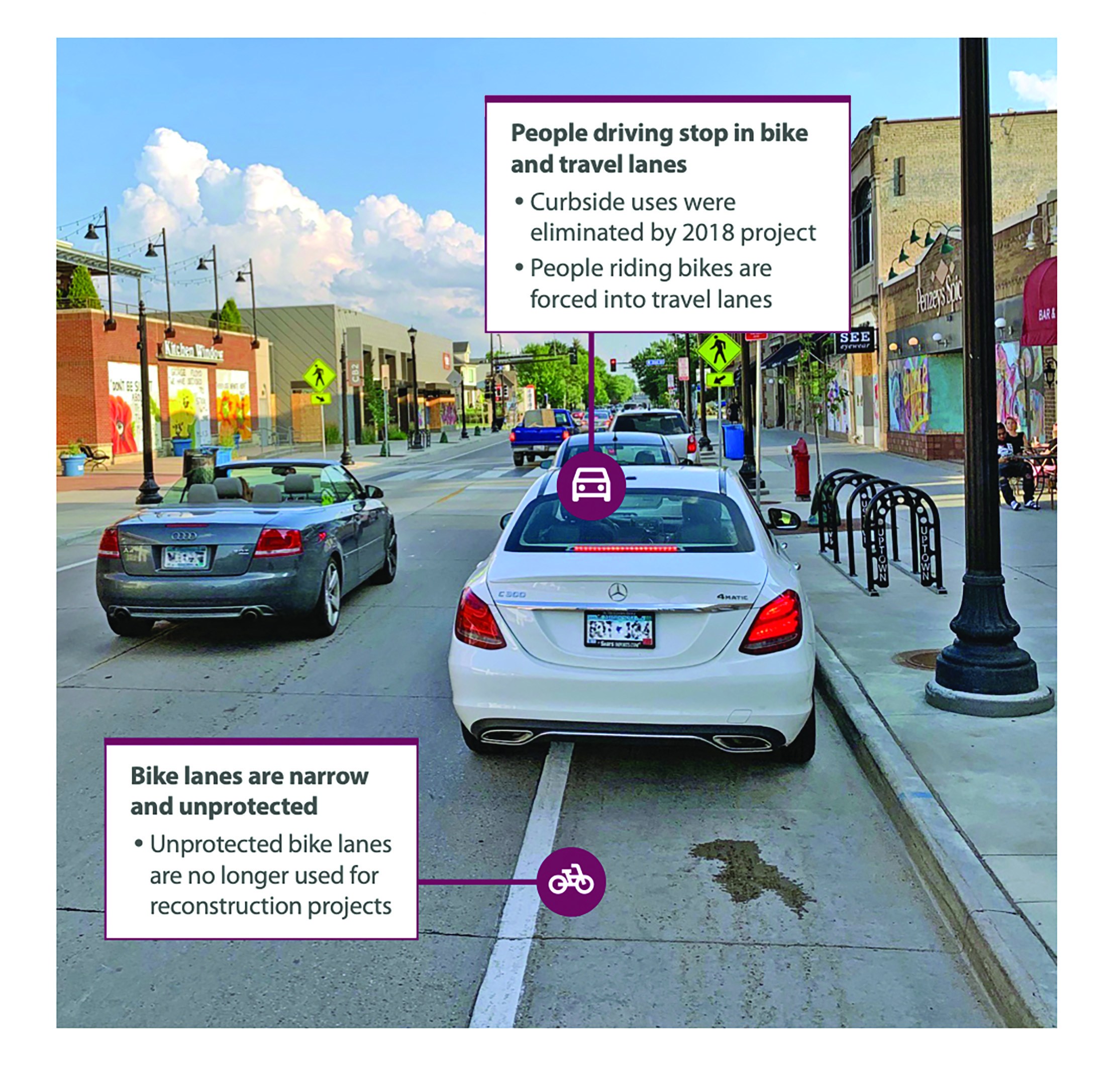
As an avid cyclist, I want to applaud the long-awaited improvements to the Hennepin Avenue bike lanes. Riding a bike in a city can be a dangerous pursuit. Cars do not always see you. Trucks, construction vans and landscaping features make it difficult for cyclists to see traffic at four-way intersections. When you factor in rush-hour congestion, speeding cars and distracted drivers, it is a wonder we cyclists try at all.
In my 50 years of cycling, I have been door-swiped, sent to the emergency room and have had numerous falls because of road conditions and my own blunders. Riding the backstreets through Uptown during the construction phase, I was nearly clipped by UPS trucks and had to ride up onto sidewalks to avoid errant cars. I even hopped a few curbs for my own safety.
Now that the Hennepin Avenue project is complete, I can breathe a sigh of relief. That is not to say the bike lanes are completely safe. I still pay attention on Hennepin Avenue. I still obey traffic laws. But for the most part, it is a far safer route when I am exiting the Greenway or running an errand to Kowalski’s.
I sometimes think Minnesotans forget how lucky we are to live in a state with strong local guidelines that protect pedestrians and cyclists from motorized vehicles. Not every state abides by the same standards. We are a better community for it. I sure am grateful. See your local bike store and wheel up.
Tom Trondson
Lowry Hill
Have You Seen Jeff?
Jeff is a homeless man who wanders around Cedar-Isles-Dean pushing worldly goods in a shopping cart. I have talked with him many times. He says he is “in transition,” no doubt, and he knows baseball statistics galore. He often hangs out at Rustica and Punch Pizza, where he writes in a notebook with a pen. I once saw him sleeping in the periodical section of Barnes & Noble.
I assume he stays in a shelter at night and is turned out in the morning. A few months ago, I bought him a coffee and a slice of banana bread at Rustica, for which he was grateful. Where is he now that the cold weather has arrived is anybody's guess.
If you see him, buy him a coffee and a slice of banana bread and be grateful for what you have.
Michael Rothman
Cedar-Isles-Dean
A Response to Susan Lenfestey’s Article, “We Can Do Better, Minneapolis. Here’s How.”
Bravo to Ms. Lenfestey for her proposal to eliminate caucuses. On the other hand, she writes, “Combined with caucuses, ranked choice voting’s promise of a more democratic process falls flat when participation requires time, childcare and a how-to manual just to cast a knowledgeable vote.” This is a very old manipulative propaganda device, somewhat akin to a doctor saying, “Combined with cancer, that hangnail spells big trouble ahead.”
As for manuals, most people have only the dimmest grasp of Robert’s Rules of Order. If caucuses were to continue, perhaps a routine regimen of pre-caucus practice should be placed on autopilot. However, nearly no one requires anything resembling a manual to meet the RCV “challenge” of counting from one to three or just one, if the voter so chooses.
Which brings us to the claim that “one in five voters did not rank candidates at all.” The selected only Jacob Frey; a smaller portion did the same for Omar Fateh? So, four out of five voters did rank. And the point is?
Ms. Lenfestey is absolutely right that voters were inundated with campaign mailers. But she suggests holding party primaries in April. That would mean seven months of party-based general election inundation, plus the pre-April mail that would inevitably arrive. All of this for nonpartisan offices.
One reason for ranked choice voting’s creation was the notorious low turnout for primaries, whether partisan or nonpartisan. If caucuses are eliminated, why do we compromise with a tweak along the lines of the Alaska Two-Step, widely regarded as the current gold standard of electoral reform?
My suggestion is a “vote for one only” primary held the day after Labor Day, with the top five candidates, regardless of party, advancing to the general election, where ranked choice voting would be used.
Darryl G. Carter
Bryn Mawr