
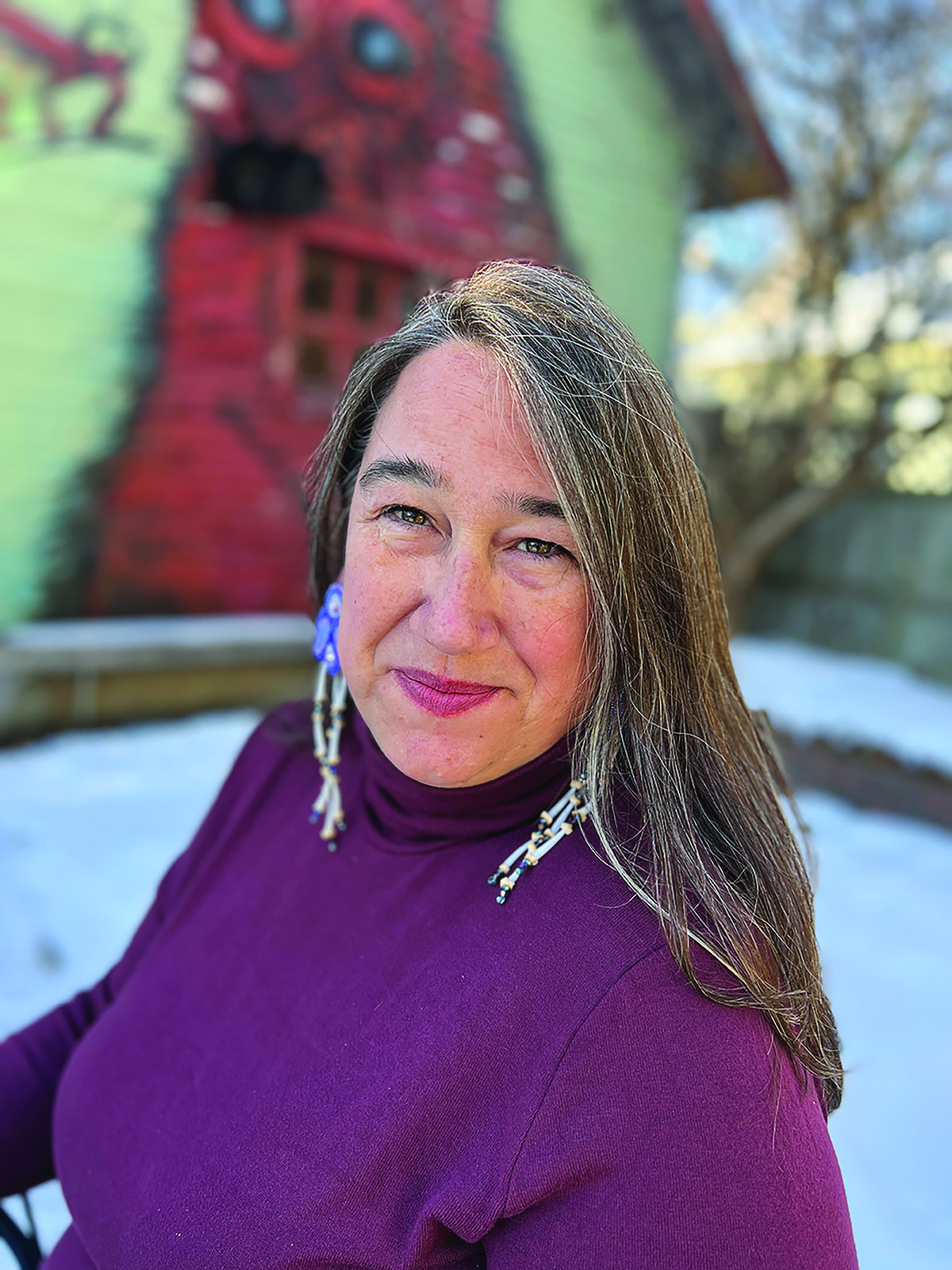
David Piper is a retired judge and regular contributor. He lives in Kenwood.
Heid Erdrich was born in Breckenridge, Minnesota, and raised in Wahpeton, North Dakota, to an Ojibwe mother and a German American father. She is Ojibwe and enrolled with the Turtle Mountain Band of Chippewa.
Both of her parents taught at a Native boarding school run by the Bureau of Indian Affairs. One of her seven siblings is Pulitzer Prize–winning author Louise Erdrich, owner of the independent bookstore Birchbark Books in Kenwood. Her sisters Lise and Angela are also authors, and Angela, who lives nearby, is a pediatrician.
Erdrich graduated from Dartmouth College and holds two master’s degrees from Johns Hopkins University and a doctorate from Union Institute. She and her husband live in Kenwood.
In addition to writing nine books of poetry and prose, Erdrich has received numerous accolades, most recently the 2025 Camille Gage Fellowship Award, which honors Minnesota artists who have demonstrated a legacy of service through their art and activism.
She said she is especially proud of this award because Camille Gage was a musician and Writer and what Erdrich called an “extraordinary force” for the environment, women’s reproductive rights, and people experiencing homelessness.
This interview has been edited for length and clarity.
What piqued your interest in poetry and activism?
That’s so interesting. At first, poetry was not something I thought of as political—just as a young person, a teenager. Then I began to read poets like Tom McGrath, who I didn’t understand at the time, but I understood there was something political about it.
I read women poets like Plath and Sexton, as many people did, and thought they were powerfully speaking to being a woman in a way I’d never heard.
By the time I was in college, I was more interested in poetry as a political response and as a way of thinking about the world and reaching others through poetry.”
How did you end up in Minneapolis?
In 1990 my husband and I were driving to get married in North Dakota. We stopped to visit a friend in St. Paul and went to get coffee at the original Dunn Bros., and it was the best coffee we’d ever had.
I looked around and every kind of person was in there—every race, every walk of life. There were Native people there, which we didn’t see in Baltimore where we met.
I said, ‘Can we move to St. Paul?’ My husband said sure. I said, ‘Let’s do it.’”
What do you do for fun in Minneapolis, and what interests you about your neighbors?
I’m somebody who walks in our parks. That’s the great joy—to see the same animals and trees and lakes. That’s important to me.
I’m always curious about the creatures or trees that are my neighbors’ favorites. I wonder if there’s some place they like to go.
I really love the crows in the neighborhood. I kind of know some of them by sight and sound. I also really enjoy the muskrats. I always wonder who else has a relationship with these living beings that share our space.
that share our space.
Do you write poetry when you’re inspired on the spot, or do you have a set time when you write?
I’m super undisciplined. I often get ideas for poetry when I’m out for a walk, traveling or looking out a car or plane window. I tuck those away mentally and occasionally on paper. Sometimes I’ll email myself something.
If something keeps coming back to me, I’ll catch and keep the voice and shape of it. I’ll have a kind of synesthesia where I see a physical shape, such as a creek under a bridge, a spiral or a pocket, and then I let the image hold the poem. When I go back to think of that shape, the poem comes back.
That’s my strange way of doing it, meandering to find something. I do have studio time, but not every day.
I’ll go through a productive period and then take a break. I also do a lot of other work to support myself, and that can be distracting. I care about my community. We’re in a crisis right now, and supporting other artists and individuals is a huge part of my daily life.
Do you write alone, with friends or through crowdsourcing?
I usually write my own work alone. However, for the poet laureate project and for this iteration of Poetry Service Announcement, promoting poetry as public art, I am writing crowdsourced poems.
I communicate with people and we make a little poem together. Then I incorporate it into a larger poem using sometimes hundreds of people’s words. I ask questions, they answer, and whatever they say most often gets into the poem.
Are you optimistic or pessimistic about the future of society, including Native American society?
I think we’re at a real turning point for our governance and how free we will be in the future. I’m not tremendously optimistic, but maybe I’m more of a realist than a pessimist. I know there’s going to be struggle, and I know I’m going to see people harmed. I want to do what I can to protect the people I love and the larger community.
I have a lot of faith in the way Minneapolis helps one another, and we’re seeing that now. It’s extraordinary. We have tenacity and the will to hold on to the city we love. I see neighbors responding to neighbors, which is the most beautiful thing.
Native nations are being tested now too. I’m paying attention to the ways Native nations are being asked to understand our legal position and respond to national forces. The proving ground is here because there are so many Native people in Minneapolis. I’ve never seen people respond with more creativity. We know how to do mutual aid, and we will continue doing it.
After this interview, you worked with a team of artists and neighbors who created a snow sculpture near Lake of the Isles. Tell us about that.
I had been planning to create some kind of poetry-infused memorial to Renee Good and was in conversation with Heather Friedli, a current artist in the parks. Heather’s work is extraordinary. I hoped we could have something ready so people would see it in our neighborhood for the Loppet, but we were just in the planning stages.
Then Alex Pretti was killed.
Not long after these terrible losses, two snow-sculpting teams had their work destroyed because of anti-ICE messages. Their work was defaced and disqualified by organizers of two different competitions. I contacted Heather to see if she could create a response in our neighborhood.
My yard is too small and not very visible, so I spent a morning asking around. Because our neighbors are amazing, by afternoon Heather and I were in the yard of generous hosts. She and her team, along with snow sculptor Dusty Thune and his team, went to work.
“ICE Out 4 Good” was ready in a week.
We organized a vigil with poetry and song, and 200 neighbors appeared carrying luminaria that were later placed to spell “ICE Out!” It was solace and magic in our coldest days.