
In 2011, after several years of contentious negotiation, the City of Minneapolis closed the award-winning Neighborhood Revitalization Program, known as NRP, and took control of its assets, as well as responsibility for management and oversight.
NRP was created in the early 1990s as an innovative approach to save the city from persistent urban decline; over four decades the population had fallen by more than 150,000, and the city was filled with thousands of boarded and vacant buildings.
During its existence, NRP allocated more than $236 million dollars to fund neighborhood action plans developed by neighborhood organizations across the city. Much was dedicated towards addressing the housing crisis, but neighborhood action plans also funded school, park and library projects, commercial corridor and economic development initiatives, addressed community safety concerns, and more.
Despite its popularity and success, the city gaslit the NRP program.
NRP was recognized by the United Nations and the federal Urban and Housing Development agency for its innovative, bottom-up planning process. Several respected studies also noted the NRP’s allocations were heavily weighted to more diverse and low-income neighborhoods.
Despite these prior studies, city leaders continue to claim that the NRP was an example of “structural racism” that primarily benefited white affluent homeowners.
However, an analysis of the city’s own management of these neighborhood programs suggests that city management — not NRP — was the real culprit.
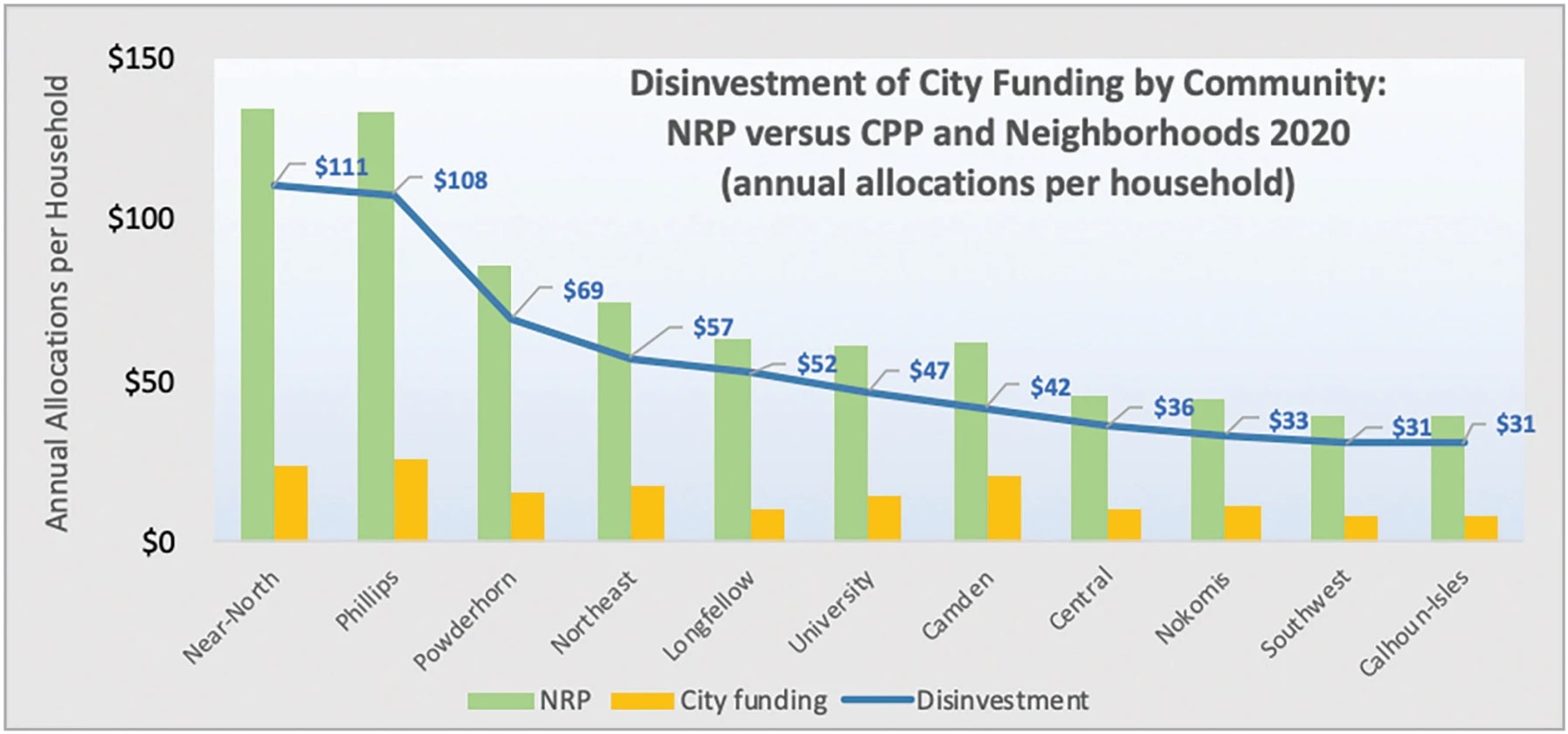
Both NRP and the city’s current neighborhood funding programs used a formula to determine annual allocations to neighborhoods. The NRP formula generously allocated funding to the least affluent and most diverse neighborhoods of the city. After the city takeover of the NRP program in 2011, annual neighborhood allocations fell dramatically across the board.
Racially diverse and less affluent neighborhoods suffered the most.
While this decline has now impacted all neighborhoods, the least affluent and most diverse were affected far more heavily than those in the more affluent parts of the city. For example, on a per household basis, neighborhoods in Near North and Phillips experienced nearly four times the level of disinvestment compared to neighborhoods in Cedar-Isles-Dean or Southwest.
Actual expenditures of NRP funds have also fallen significantly since the city took over the program, and this fall has not hit neighborhoods equally. Between 2015 and 2021, average annual expenditures for the 20 least affluent neighborhoods fell by 61%. During that same period, average annual expenditures for the 20 most affluent neighborhoods increased by 46%.
The most diverse neighborhoods also have fared poorly under the city’s oversight of neighborhood programs. From 2015 through 2021, average annual NRP expenditures for the 20 most diverse neighborhoods fell by almost 30%, while annual NRP expenditures for the 20 least diverse neighborhoods increased by 37%.
This is not due to lack of NRP funds, with approximately $26 million remaining as of August 2022.
These disparities and lack of support has led to a growing sense of frustration and distrust among many city residents, who feel that their voices are not being heard and that the city is not doing enough to address their needs and concerns.
In 2019, neighborhood leaders from North Minneapolis wrote a letter to city leadership demanding the city dismantle Neighborhood and Community Relations, the department responsible for managing neighborhood programs. There was no response. Shortly after, the city’s Neighborhood and Community Engagement Commission echoed the neighborhoods' call to reform or close the department. Instead, the city disbanded the commission.
What does the future hold? That’s up to the City Council, but the current program is exacerbating the very problems it was meant to solve, while undercutting neighborhood support across the board.