
The most recent version of the Cedar-Isles Master Plan, the so called “preferred park concept,” is a vast improvement over the prior iterations and deserves our overall support.
In my previous articles for Hill & Lake Press, I argued that the first versions were replete with solutions in search of problems, that less was more when it came to preserving the parks’ character and usage, and that a more restrained plan would be an important first step in rebuilding civic trust, which has been badly damaged after a decade or so of serious missteps.
In broad outline, this is that plan. While many of us may advocate for some tweaks here and there (and I will do so below), the overall plan is a substantial, meaningful improvement over the prior versions.
Gone are the permanent structures on park land. Gone are the parkway closures. Gone are the boardwalks. Gone are the floating bogs and parkland plantings that would have gobbled up valuable open lawn space.
What we have instead is a plan that focuses on water quality and ecology—a clear community consensus item—that is still respectful of both parks’ historic characters.
The structures that remain are structures we actually want: more and better portable restrooms that are usable year round (unlike permanent ones), stable and less intrusive water access points, and—quite happily—an improved temporary warming house for the ice skating rink. These are all items that will improve the parks’ accessibility and functionality without impinging on their overall natural setting.
For me, the inescapable conclusion is that we have been listened to. For reasons not worth re-hashing, the prior versions of the plan did not at all reflect our community needs and preferences. As a community, we spoke up in great numbers in what I believe was a civil and thoughtful way, and a broad consensus emerged.
This new plan fully embraces that consensus and I, for one, am grateful to this new Park Board and its staff for its willingness to engage with us and change course to such a significant extent. That’s not always an easy thing to do, and I respect them for doing it.
I also believe particular credit is due to Elizabeth Shaffer and Cathy Abene, two of our new Park Board Commissioners, and Emma Pachuta, the project manager, for their consistent openness to community feedback and for effectively using the tools they have to help chart a new direction.
It’s important to emphasize this isn’t the final plan. A new public comment period has already started and given the significant course correction we have just seen, I’m inclined to take at face value the Park Board staff’s assurance that the new “preferred park concept” is not set in stone. If new points of community consensus or creative solutions emerge, there is room to include them.
Regardless, I hope that the great many residents and readers who took time to write the Park Board with comments will now do so again in overall support of the new plan and its focus on water quality and ecology.
Yes, writing emails and letters is not fun and is generally a pain, but in my view, we’ve just seen proof positive that community feedback matters, and if we like the new plan in its broad outline (which I hope we do), it’s now incumbent on us to defend it until it’s finalized.
As for the tweaks, I’m confident we can and will feel free to express our own individual views, but here are some that resonate with me and/or have generated traffic in my in-box:
Two-way bike trails on Isles
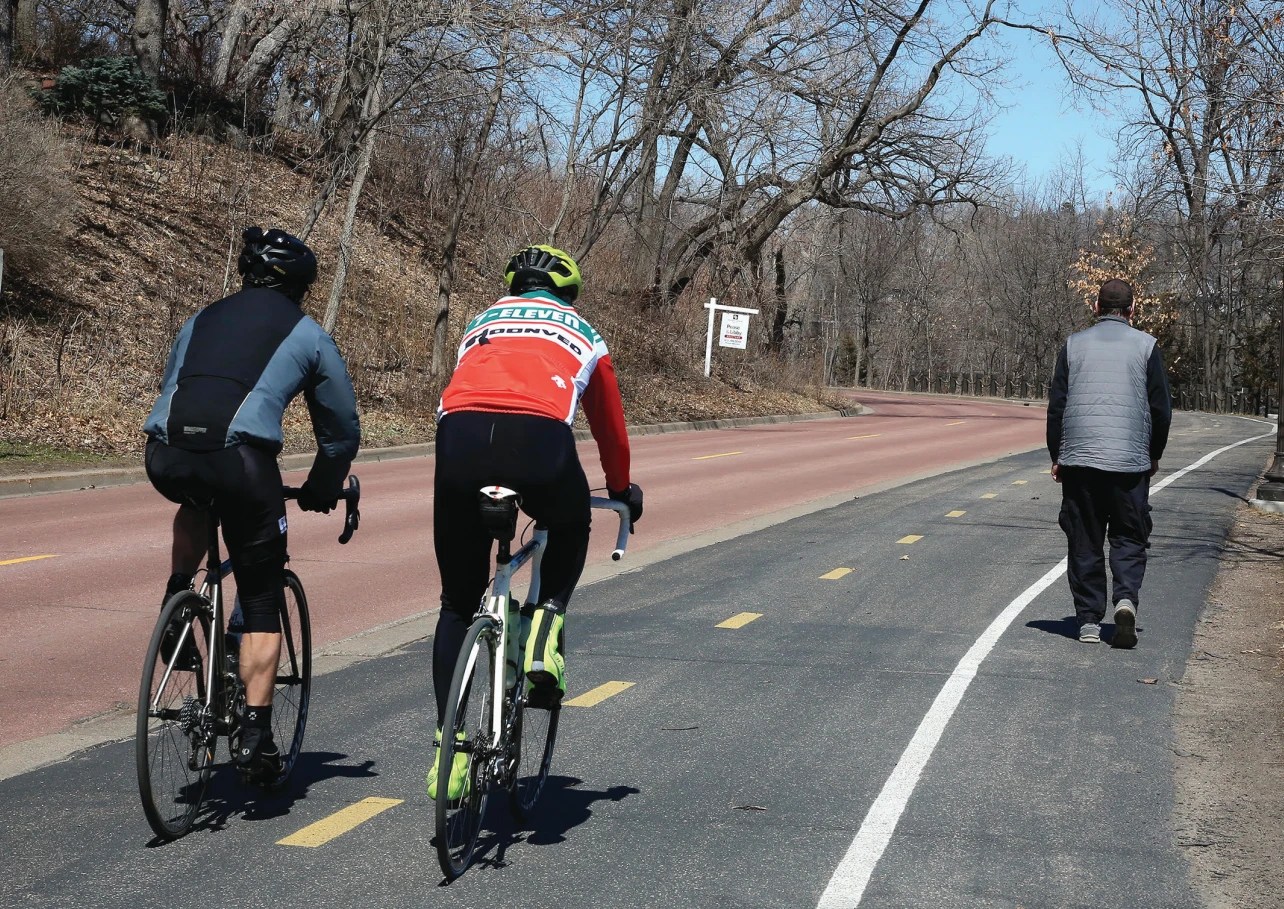
This is the number-one issue I’ve been hearing about from neighbors, and their concern is safety. While two-way bike trails have worked reasonably well on Cedar for years, the bike traffic levels on Isles are much higher, which means so is the potential for collisions.
This concern is amplified by the likelihood that inattentive or discourteous riders will simply disregard the official endpoints for the two-way sections and ride against traffic for the entirety of the lake.
Further, while the rationale for a two-way stretch on the south side is articulable— allowing an off-roadway counter-clockwise connection between Kenilworth and the Greenway – the rationale for a similar section on the east side of the north arm seems fuzzy at best.
Although not perfect, I think the better solution would be to stripe a counter-clockwise bikeway along the existing parkway, which already allows for counter-clockwise traffic around the lake. A striped lane would reinforce to drivers that the parkway is a shared resource and that they need to be watchful for bicycles and yield when necessary.
I also don’t think the volume of bike traffic would be much higher than it is now, since most bicycle through-commuters are likely to remain on the Midtown Greenway or the Kenilworth Trail (whenever LRT is actually finished) without diverting to the channel or the lake.
Cedar Lake Management Plan
Cedar Lake is more ecologically complex and in need of help than Lake of the Isles, and there needs to be a comprehensive management plan. While some detailed plans already exist to help guide decision-making (such as the Natural Areas Plan and Ecological Systems Plan), there is no management plan for the Cedar Lake area as a whole.
One thoughtful suggestion from a committed volunteer is to break the area into discrete, sensible management units, then plan and prioritize those units based on need, ecological importance, and achievability of the goals. This would probably catch issues like a “Mesic Oak Forest Restoration” where there never was a mesic oak forest (and where a forest of large cottonwoods exists today).
The Cedar Lake Park Working Group formed by community members is working directly with the Park Board. The goals and recommendations of the Working Group will be presented to the public at the next meeting of the Community Advisory Committee at Lake of the Isles Lutheran Church on July 28.
Whatever happens, Cedar needs comprehensive and focused attention due to its deteriorating water quality, out-of-control invasives, and conflicting uses.
A detailed plan will better position the Park Board and volunteers to credibly apply for much-needed grant funding in the future, and would give the Board the flexibility to accept bona fide assistance from third parties, such as help with prairie maintenance and stabilizing fishing access points.
Finally, while the new park concept appropriately recognizes the importance of neighborhood volunteers, it needs to make clear that responsibility for maintaining this complex area ultimately rests with the Park Board alone.
There’s time to do this.
At present the “preferred park concept” is mostly a collection of maps; in the coming months it will become an actual written document, and these issues need to be comprehensively and realistically addressed.
Northeast Cedar Shoreline Trail
This is one that’s particularly dear to me. It’s the stretch of shoreline trail that begins at the eastern edge of the reed bed on the north side of Cedar and runs to the “mound” at the very northern edge of the lake (which I understand is actually a 19th century industrial slag heap).
The new plan proposes to close it. To my mind, this is one of the most scenic stretches of trail in the Chain of Lakes; it’s quiet, showcases the lake, and offers great wildlife viewing (birds and turtles in particular). For years, I’ve made a point of taking our out-of-town visitors there, and they are consistently amazed we have such a calm woodland oasis in the middle of our busy city.
The proposed reroute would eliminate the lake and wildlife viewing entirely and direct traffic through a depressing thicket of buckthorn instead. Apart from the “mound,” which is deteriorating rapidly, the existing trail is stable and narrow, so it’s not contributing runoff or erosion in a material way, nor does it appear to be disturbing the wildlife.
Please, please, let’s keep what we have here.
Prairie/pollinator plantings on Isles
It’s not the plan, it’s the execution.
While I’m generally opposed to giving up open lawn space on Isles, the relatively modest plantings proposed in the new plan (mostly in the existing and little-used depressions) seem reasonably calculated to help with water capture and filtration, which ties into the overall goal of improving water quality.
The problem is maintenance, which to put it mildly has not been a “center of excellence” for the Park Board. If thoughtfully planted and maintained, these could be a reasonable addition to the park, but history suggests they would most likely turn into unsightly, unusable, invasive-choked weed-beds.
For a nearby example, look no further than the North Cedar Lake Prairie. I love this area, and the prairie conversion was a transformative use of the old railyard.
Unfortunately, it hasn’t been effectively burned in years and has become loaded with hard-to-eradicate weeds and other invasives, and there doesn’t appear to be any serious momentum to deal with it. We shouldn’t be adding such labor-intensive features to Isles until there’s a rock-solid means to maintain them. I don’t think we’re there yet.
Traffic on the west side of Cedar
Overall, I think the Park Board did an excellent job of balancing competing interests in this portion of the plan. The new plan (importantly) preserves two-way vehicle traffic on the parkway, but modestly constricts it to allow needed additional space for pedestrian and bicycle traffic.
My only gripe relates to the proposed comingling of bicycle and pedestrian traffic on the short trail that connects the parkway with the north Cedar Lake trail. Using pedestrians as a traffic calming measure seems fraught with peril, and the existing connector trail has already been informally widened by several feet.
If it is formally widened to reflect this existing reality, there will be more than enough room for bikes and walkers with separate striping.
Kenilworth bike connector trail
The issue here is need. The new plan proposes to add a connector trail along the north side of the channel from the currently obliterated Kenilworth Trail (thanks, LRT…) to Lake of the Isles. The new plan thoughtfully envisions diverting bicycle and pedestrian traffic to a striped section of Kenilworth Place, which would preserve green space for much of the route, but still would require clearing and paving a decent portion of undeveloped land to make the actual connection to the Kenilworth Trail.
There is an already-existing connector trail that runs along Dean Parkway to the same point at Lake of the Isles, and it’s only about 500 feet longer than the proposed new connection. Do we really need two in such close proximity? Something to think about.
Those are the main issues I’ve heard about directly. Two others recently made it to me indirectly through the grapevine: (1) permanent restrooms on Isles, and (2) mountain biking at Cedar. I hope both issues go the way of the dodo.
As to permanent restrooms, I’d be more open to them if anyone could persuasively explain how permanent restrooms that are closed half the year would be more useful and accessible than year-round temporary facilities. Temporary restrooms can also be swapped out with greater ease if and when vandalism gets particularly bad. And they are far less costly to build, staff and maintain.
As to mountain biking, I confess to being biased. I hate mountain bikes with a passion, mostly for the destruction they cause to trails and green space, not to mention how snippy many of the riders get when pedestrians don’t jump out of their way quickly enough.
In particular, the trail conditions at Burnham Woods, on the east side of Cedar Lake, have deteriorated noticeably in the 20- plus years I’ve lived here due to mountain bike traffic. Although vocal, mountain bikers comprise a small subset of all park users, and their use takes up inordinate space and conflicts with pretty much everything else.
Mountain bikers have already been allowed to monopolize and destroy large sections of Wirth Park. Let’s keep them confined there.
That’s what I’ve got, and it’s possibly more than enough. As readers, regardless of your feelings on these individual issues, I hope you will take time in the next week or two to write in overall support of the new plan and to thank the Board for its responsiveness to our community needs and preferences; it deserves some credit here.