
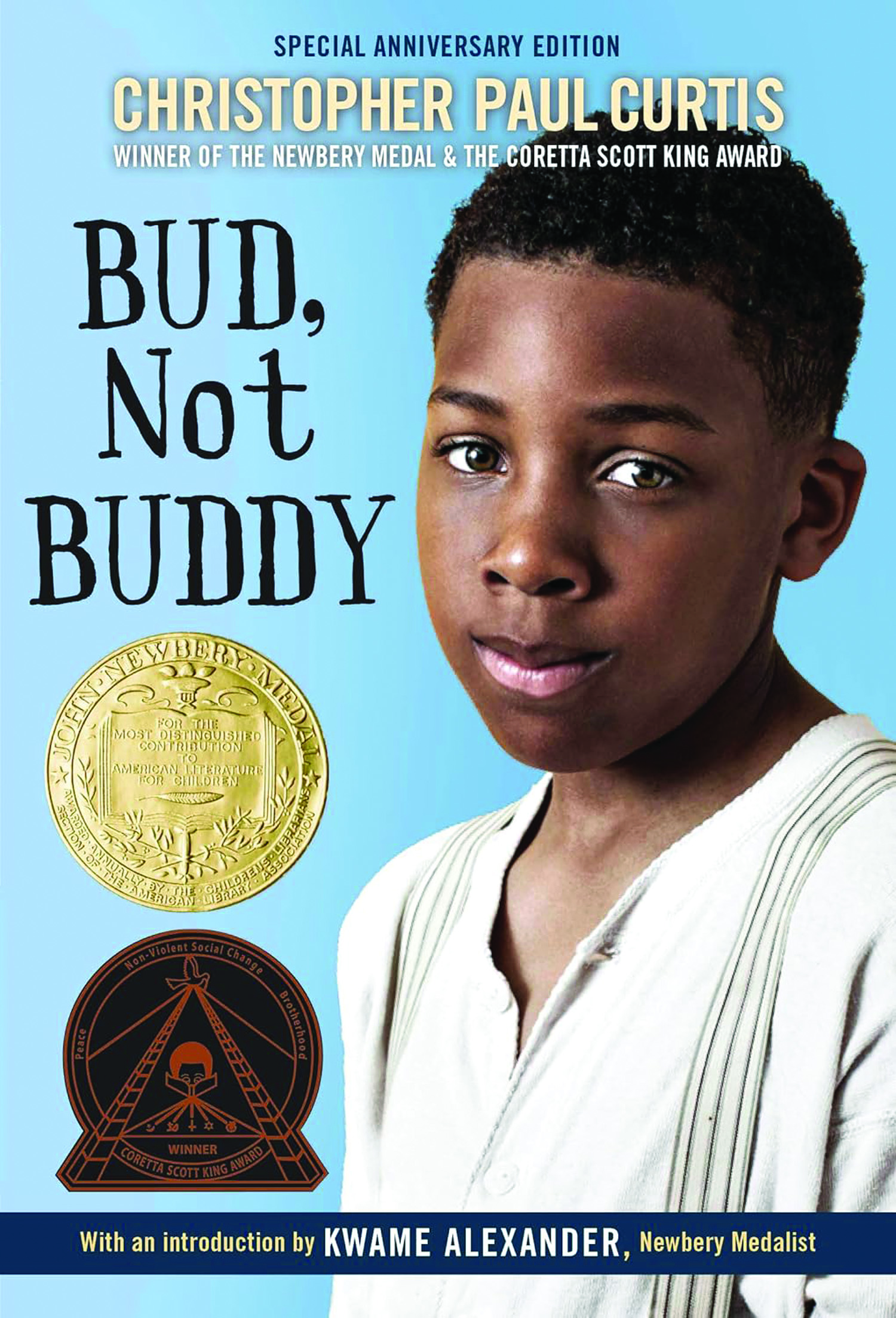
Bud, Not Buddy a novel by Christopher Paul Curtis
By Aristotle Baylor, age 10, Blake School, Lowry Hill
For ages 10-11
If you cannot travel this summer -books can be a great way to travel in your imagination- Even time travel! I recommend reading the book Bud Not Buddy by author Christopher Paul Curtis.
Bud Not Buddy takes place in the 1930s during the great depression in Michigan. Bud, not to be called Buddy, sets out to find his father. Bud begins his journey in Flint and continues to Owosso, St. Johns, Ovid, Lowell, Ionia and Grand Rapids. This journey is important to Bud because he wanted to be reunited with the only family member who he thinks could be alive and not suffer every day just to survive. His journey is possible because he is a hardworking soul, and he gets help from a stranger named Lefty Lewis, whom he thinks is a vampire. Lefty Lewis drives him to help locate his dad.
This story taught me that there wasn’t a lot of food or jobs in the 1930s because in the 1920s people called it the good years. In the 1920s people spent all their money to celebrate the end of World War I and almost no one was poor because people didn’t have a care in the world, and they gave away lots of money. The rich people spent their money on wine and cars. The lightbulb was modified to be functioning in a home during that time. In the 1930s many people did not have jobs, so nobody deposited money in banks which led to the banks closing. This historical time was called the great depression.
I learned from the story that the great depression also had things called food lines. Food lines were opened in Flint, Michigan and many other places. These places gave people free food they needed to survive. A hungry Bud visits the food line and is helped by a family and given brown sugar. Shanty towns were also a part of the great depression. In this story the shanty towns attracted a lot of police who clear out the shanty towns of the homeless people who were trying to board the trains for a better life.
There is a mystery ending to this story which I won’t reveal because you should read this great award-winning book to find out.