
American artist Keith Haring was an Artist in Residence at the Walker Art Center 40 years ago for its 1984 ArtFest, which is celebrated in its exhibit Art Is For Everybody. It runs from Apr. 27 through Sept. 8.
A key component of his residency was youth arts education. Arts education played a key role in Haring’s own development as an artist.
His distinctive style emerged at Haring’s young age. When other children were painting refrigerator art, he was already developing his colorful characters.
Growing up in Kutztown, Pennsylvania, he had supportive adults around him. His father recognized his son’s unusual drawing talent and encouraged him not to copy but instead to create his own characters. His mother enrolled him in kindergarten at the Lab School, still known today for its arts-centered education, because “he was drawing all the time.”
In the local public schools, his art teachers taught him not to be ordinary and allowed him the freedom to develop his unique style. His high school art teacher said, "He had such imagination. I felt that anyone who liked to explore line the way he did shouldn't be pushed into areas he didn't care for. So, I just left him alone."
Even art school couldn’t contain his explosive need to express himself. He left the School of Visual Arts in New York City, and his canvas became the subway and walls of the city. There he could share art, even temporarily, with the public. In 1982, Haring had his first solo show at New York’s Tony Shafrazi Gallery, confirming his talent and validating the graffiti art genre.
Meanwhile, the Walker Art Center embraced exposing children to the arts. Adam Weinberg, Director of Education, believed that it was valuable to have artists and kids connect. He enlisted Susan Rotilie to develop curriculum and work with schools to create programs for children to work with artists.
A merging of performing and visual arts was conceived for ArtFest, a weekend celebration in May 1984. Jacques D’Amboise of the New York City Ballet would choreograph a dance with grade school students, but they needed an artist to create the scenery. A Walker intern from New York suggested Keith Haring, not widely known at the time, for this art
residency.
Haring was familiar with Minneapolis and the Walker from a 1977 road trip. He brought his philosophy that art is not for the elite and should be shared with all to the residency. Rotilie reached out to Carol Sirrine, Fine Art Coordinator for the Hopkins Public Schools. “I didn’t understand graffiti. I just knew if Susan recommended it that it would be wonderful. Susan and Adam were an amazing team. They were so much ahead of their time.”
For a week, students from Alice Smith Elementary worked with Haring. Craig Anderson, now the Director of Curriculum for the Saint Paul Public Schools, was one of those students. “I was a rule follower, so I was conflicted because I was meeting a law breaker,” he remembers as his initial reaction to Haring.
He quickly got over his hesitation because Haring was “cool and amazingly talented.” Sirrine remembers that Haring seemed shy and didn’t talk a lot. “Yet he got so much out of the kids, and they adored him.” Rotilie said he seemed like the nerdy but very cool kid. “He was quiet, generous, and had super energy. He never seemed to get tired.”
The new education center at the Walker was underground, which complemented Haring’s work in the subways. The performance would be titled Rompin’ and Stompin’ in the Underground.
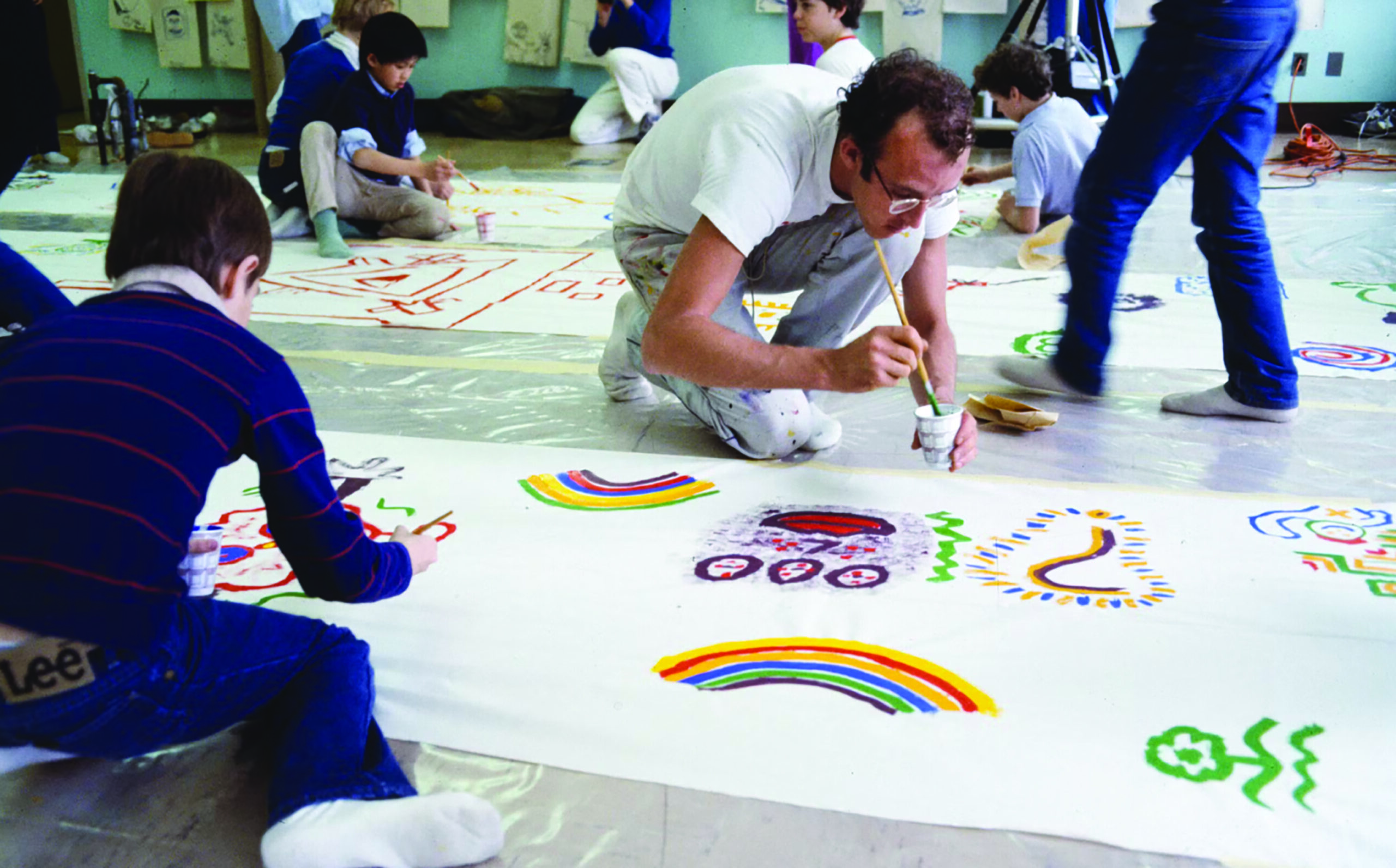
Haring was a natural teacher and employed a process of creative risk-taking. “He encouraged them to go into their imagination and create animals from the underground.” He wanted the children to collaborate on their creatures, so he employed Stop!, a game taught to him by his father.
Haring and his father would draw side by side until one yelled stop. Then they would switch drawings and add on to the other’s until one called stop again. Rotilie recalls that he played hip-hop music on his boom box and would stop the music to indicate it was time to switch to someone else's drawing. After the initial activity, they moved to the large muslin banners on the floor. He stressed that they should magnify their current drawings.
Each child had a pot of paint and would move around and add on to others' artwork. Haring was also down on the floor working with them and showing them how to accentuate with black outlines. Rotilie recalled that he was so respectful of the young artists. “At the end of the school day, after the children left, he added his energy lines around their characters but didn’t paint his own character.”
When the project was completed, Haring spent the extra time drawing for the students and demonstrating his art method. Anderson said that Haring “drew them in front of us in 15 seconds.” He still has his Haring drawing framed in his office, reminding him of this special time he worked with a famous artist.
Even when Haring designed the poster for ArtFest, he thought of it as collaborative. It was only black and white so that people could color it in and create art.
As part of the Keith Haring exhibition, the Walker is revisiting the original ArtFest with a special three-day festival from May 30 to June 1. There are art opportunities for teens on Friday nights and for families on Saturdays. Haring would undoubtedly be thrilled that so many people are coming to explore and create art. After all, art is for everyone.