
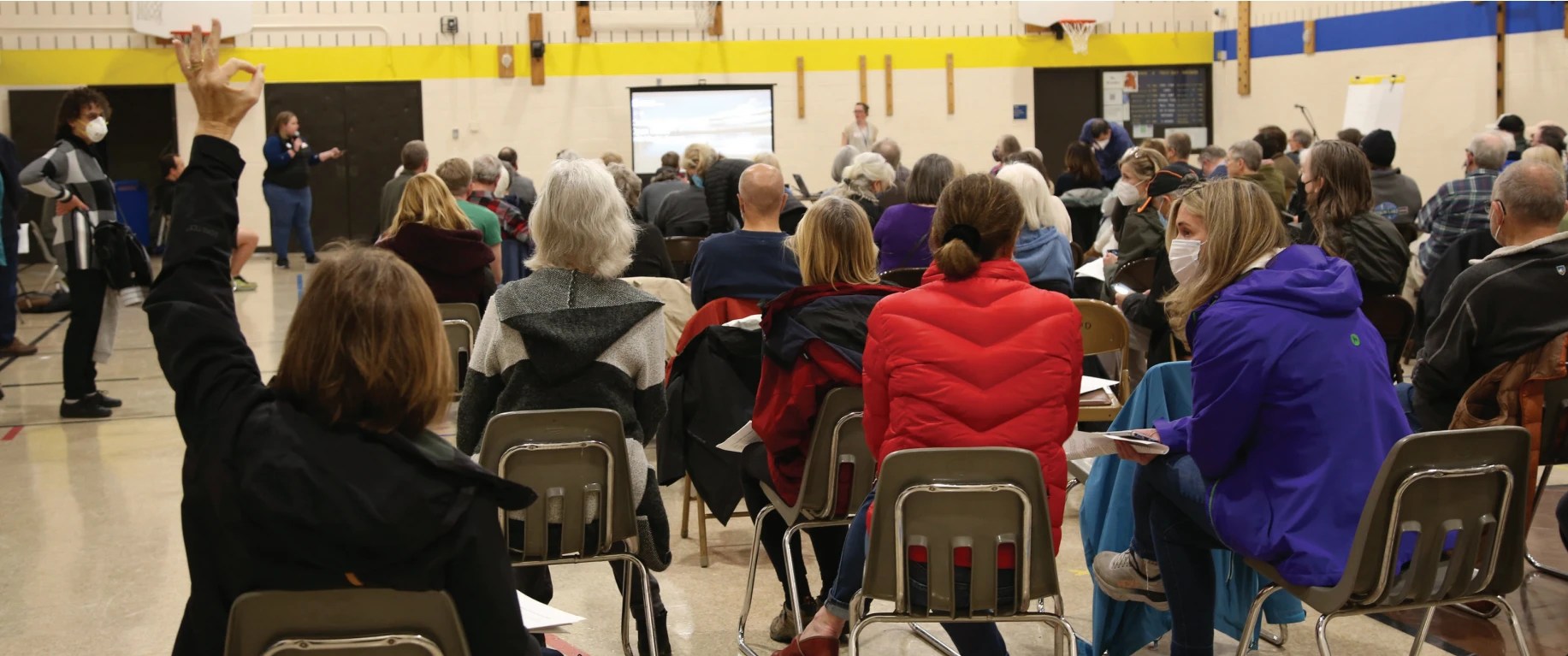
More than 120 residents from Cedar-Isles-Dean, Kenwood, Lowry Hill, and East Isles packed Kenwood Community Center’s gymnasium April 30 for a public meeting hosted by the Minneapolis Parks & Recreation Board (Park Board) and Cedar-Isles-Dean Neighborhood Association (CIDNA) regarding the Cedar-Isles Master Plan. CIDNA asked the Park Board to hold the meeting in the final days of public comment on the plan, given the limited and poorly timed opportunities the public had to engage with the process. Craig Wilson, a member of the project’s Citizens Advisory Committee (CAC), presented goals drafted by a CAC water quality subcommittee aimed at managing Lake of the Isles as an ecologically healthy, shallow lake and Cedar Lake as an ecologically healthy, deep lake. They include:
- Maximizing and restoring habitat (terrestrial and aquatic) to improve health of the lake and have spaces for wildlife,
- Meeting state swimming standards at Cedar Lake,
- Meeting state boating standard for Lake of the Isles,
- Returning to 1990s water quality standards,
- Addressing run-off from all hard surfaces on parkland, and
- Reducing chloride (salt), trash, pollutants (phosphorus and nitrogen from lawn care) and erosion from entering the lake.
Many residents called on the Park Board to remove a proposed boardwalk and walking path along the southeastern side of Cedar Lake’s Park Lane shorefront—citing safety, habitat concerns and the eventual return of the Kenilworth trail for bike and pedestrian traffic. Emma Pachuta, a senior planner with the Park Board said opposition to a boardwalk on the southwest shore of Cedar Lake had been heard and was “likely off the table.” Pachuta said plans to post a warming house on the western side of Lake of the Isles had also been taken off the table and the warming house will stay on the eastern side of the lake in its present location.
Residents raised issue with the process, timing, and lack of transparency in the development of the master plan, as well as a lack of coordination between the Park Board and additional development projects in the area, including light rail. One complaint has been too much emphasis on light rail; the Park Board’s mission to preserve and protect natural resources should take precedence over accommodating transit. Residents voiced opposition to the proposed closure of the north end of Lake of the Isles Parkway which would dramatically impact routes to Kenwood School, churches, and small businesses. Several people questioned how the Park Board could maintain proposed new infrastructure, given that maintenance of much of existing infrastructure has been “deferred” (neglected). When pressed to explain for how the expanded facilities would be maintained and staffed by Adam Arvidson, Park Board Director of Strategic Planning, said it was too premature to assess.
Several people faulted the Park Board for not including cost or budget information in the plan. Arvidson defended the strategy, saying it allowed planners to propose bold new infrastructure projects as a carrot for seeking capital funding from the legislature and other governmental and philanthropic sources. By contrast, he said, requests for funds to maintain existing infrastructure is often unappealing.
As an example, he cited the proposed North Commons project in North Minneapolis. He said its budget increased from several million dollars to over $22 million due to infrastructure proposals. They included a new recreation center, upgraded gym, running track, art rooms, expanded outdoor waterpark, synthetic turf soccer and football field, synthetic walking track and inflatable dome for winter use.
CAC Chair Win Rockwell responded by saying that the Park Board staff has declined to provide cost information about the Master Plan proposals being presented to the CAC and the public by Park Board staff and consultants. Rockwell said that didn’t make sense. “While it is understandable that exact costs cannot be provided,” he said, “reasonable estimates of the level of cost—such as high, medium, low, or the like—of the improvements being proposed by staff and consultants should be provided to the CAC and the public from the beginning of the process.”
“To withhold cost estimates of the staff and consultants’ master plan proposals until almost all of the working time of the CAC and the public has been exhausted deliberately deprives the CAC and the public of critical information that is relevant to making meaningful decisions”, said Rockwell. “We don’t operate that way in managing our personal lives and the Park Board shouldn’t operate that way in the master plan process,” he said. “When the Park Board is today clearly struggling to maintain the infrastructure it already has, withholding the cost of adding yet more capital infrastructure makes no sense,” he concluded.
Becka Thompson, the Park Board Commission for District 2 who represents North Commons Park in North Minneapolis, was not present at the meeting but later remarked that she is skeptical of the plans for North Commons Park and says there is little local support for the additional infrastructure by area residents. She is trying to amplify Northside voices calling for more green space and preserving existing trees that will be destroyed should plans move forward, something that resonates with most in attendance of the April 30 meeting. Elizabeth Shaffer, the Park Board commissioner for District 4, our part of the city, attended the meeting. She stated her strong support for the community and said her votes would reflect its wishes. Commissioner at-large Meg Forney was also in attendance but did not comment. One attendee noted that if the “guiding principle is to protect parkland and water bodies, why does all the new and proposed construction create concrete and traffic? Wouldn’t trees be better than pavilions and permanent structures?”
The Park Board is expected to release the final plan for a final public comment period sometime this summer.